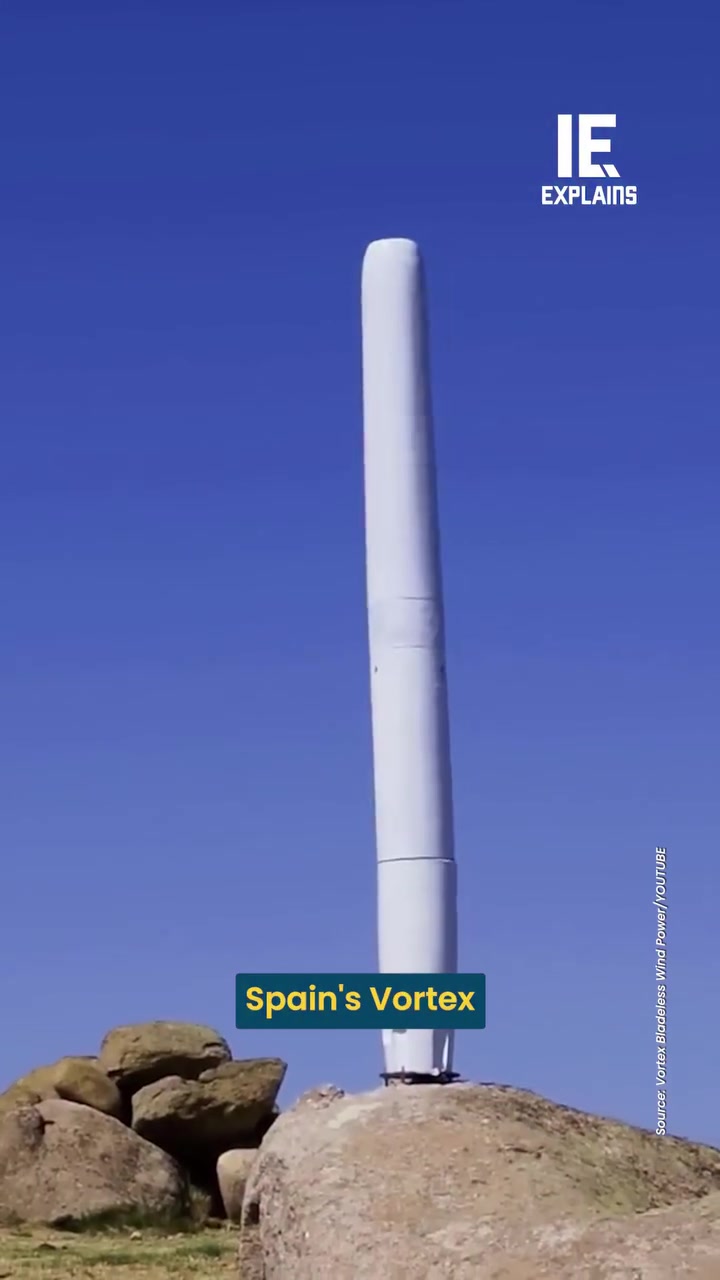
Spain's Vortex Bladeless has spent over a decade developing a wind power generator that doesn't use blades to harness wind energy. Vortex designs the generator with a hollow mast of carbon, fiber, and fiberglass on a flexible carbon rod which sways perpendicular to the wind. The device is anchored to a fixed base and doesn’t have a shaft, gearbox, bearings, or lubrication. The advantages are simple: it's near-silent and harmless to birds.
What It Is
A Vortex turbine stands tall and alone in the wind. The cylindrical design has no blades. The mast is constructed from carbon, fiber, and fiberglass and is secured to a fixed base. This design sways in the wind rather than spinning. At the base, coils and magnets move past each other. This movement induces a current, generating electricity without the need for complex, mechanical parts. This innovative device stands to revolutionize how we think about wind power. The design was inspired by the von Kármán Vortex Street. This phenomenon occurs when wind flows past a cylinder, creating alternating swirls that produce a small sideways force on the object. By matching the frequency of this motion to the mast’s natural frequency, the device is able to oscillate with maximum efficiency. The magnets inside the mast do a double job: not only do they help generate electricity, but they also act as a tuning system, adjusting the mast's apparent stiffness. This allows the turbine to stay in sync with the wind across a wide range of speeds.
The Aerodynamic Counterpoint
This technology might not require a high-tech lab to get its unexpected origins. Effectively, these turbines transform a long-known phenomenon associated with bridges and chimneys. Not traditionally considered in the cosmetically competitive landscape of wind power, the Vortex turbine emphasizes using natural phenomena in a novel approach. The company claims that its design delivers 53% lower operational costs, with near silent operation, simple construction, and no risk to birds.
How it Works: Bladeless to the Bone
The core of the Vortex turbine is its bladeless design. Unlike traditional wind turbines, it doesn’t require moving mechanical parts like shafts, gearboxes, or bearings. The rotating blades that characterize traditional turbines are replaced by a stationary, oscillating mast. When wind hits the turbine, it causes the mast to sway perpendicular to the wind flow. This movement is converted into electrical energy through the interaction of coils and magnets at the base of the mast. The swaying motion moves the magnets past the coils, inducing an electric current. The magnets also serve a second purpose, acting as a tuning system. By adjusting the apparent stiffness of the mast, they help keep the turbine in sync with a wider range of wind speeds, improving overall efficiency.
Breaking the Size Barrier
The catch here is the current size limitation. The flagship prototype, the Vortex Tacoma, stands at just 2.75 meters tall and weighs about 15 kilograms, producing only 100 watts. The company has plans for a 1 kilowatt version, which would stand between 9 to 13 meters tall. However, scaling up the technology to a size that can efficiently produce a kilowatt of power remains a challenge.
The Vortex Tacoma: The Tiniest Dynamo
The Vortex Tacoma is a testament to the potential power of Vortex's technology. Despite its small size — 2.75 meters tall — it already generates 100 watts of power. This makes it a promising candidate for small-scale applications, such as powering individual homes or small communities. However, the company has plans for a larger version that could produce 1 kilowatt of power, which would be more suitable for larger-scale applications. The 1 kilowatt version is still on the drawing board, and scaling up the technology remains a challenge.
Practical Applications
Feasible designs like the Vortex Tacoma offer tangible benefits right now. The turbine's quiet operation and bird-friendly design make it ideal for residential areas or environmentally sensitive locations. Quick and easy to install, it can be a stepping-stone to wider implementation. Consider the turbine's practical applications before investing:
- Small-Scale Power Generation: Ideal for homes, small businesses, or remote locations where grid power isn't accessible.
- Educational Demonstrations: Perfect for schools or educational institutions to demonstrate renewable energy concepts.
- Environmentally Sensitive Areas: Its quiet operation and lack of rotating blades make it suitable for locations near wildlife habitats or residential areas.
Small Steps Toward Big Energy
The Vortex turbine marks a decisive step forward in wind energy technology. It represents a shift towards more efficient, safer, and quieter wind power generation. The bladeless design, inspired by the von Kármán Vortex Street, is both innovative and practical. While the technology is still in its early stages, the potential for widespread adoption is undeniable. As the company works to scale up the technology, the future of wind power could very well be bladeless.
Questions readers ask
How does the Vortex Bladeless turbine generate electricity without blades?
The Vortex Bladeless turbine generates electricity through a unique mechanism. The cylindrical mast sways perpendicular to the wind flow, and this movement causes magnets inside the mast to move past coils at the base. The interaction between the magnets and coils induces an electric current, thereby generating electricity without the need for traditional, moving mechanical parts like blades, shafts, or gearboxes.
What is the von Kármán Vortex Street, and how does it relate to the Vortex turbine?
The von Kármán Vortex Street is a phenomenon that occurs when wind flows past a cylinder, creating alternating swirls that produce a small sideways force. The Vortex turbine mimics this natural phenomenon. By matching the frequency of these swirls to the mast’s natural frequency, the turbine can oscillate with maximum efficiency, converting the wind's energy into electrical power.
How does the Vortex turbine compare to traditional wind turbines in terms of operational costs and environmental impact?
The Vortex turbine claims to deliver 53% lower operational costs compared to traditional wind turbines. This is due to its simple construction, which eliminates the need for complex mechanical parts, bearings, and lubrication. Additionally, it operates silently and poses no risk to birds, making it more environmentally friendly.
What are the advantages of the Vortex turbine's bladeless design?
The bladeless design of the Vortex turbine offers several advantages. It eliminates the need for moving mechanical parts, making it simpler to construct and maintain. The design is also near-silent, which reduces noise pollution, and it is harmless to birds, addressing a significant environmental concern associated with traditional wind turbines.
Why is the Vortex turbine currently limited in size, and what are the plans for scaling up?
The current size limitation of the Vortex turbine is due to the technical challenges of scaling up the technology. The flagship prototype, the Vortex Tacoma, is quite small, standing at 2.75 meters tall and producing only 100 watts. The company has plans for a 1 kilowatt version, which would be much larger, standing between 9 to 13 meters tall. However, scaling up to a size that can compete with traditional wind turbines will require further development and testing.
Related deep dives
Similar reads based on topic and creator.


Recent articles
Fresh deep dives from the latest Reels we unpacked.


Comments
Be the first to comment.