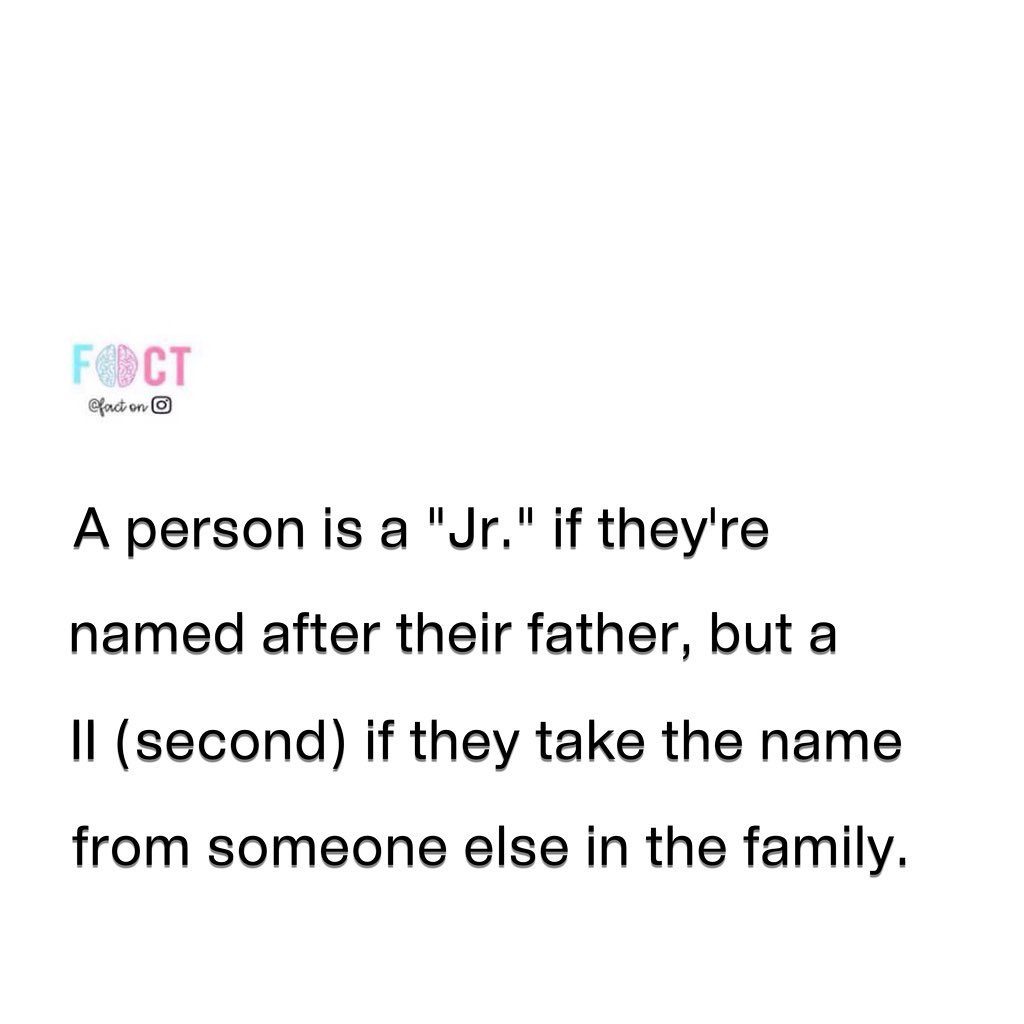
The suffixes "Jr." and "II" can be confusing, but understanding the origins and meanings of these name suffixes can help clear up any misunderstandings. Let's delve into the history and uses of these suffixes.
Context / Why this matters
Name suffixes like "Jr." and "II" are more than just formalities; they carry significant cultural and familial weight. Knowing when and why to use them can help you navigate social and professional interactions with greater ease.
Main discussion
The origins of "Jr."
The suffix "Jr." stands for "Junior." It is used to distinguish a son from his father when they share the same given name. This suffix is primarily used in English-speaking cultures and is often found in legal documents, official records, and formal correspondence. The use of "Jr." dates back to medieval times, when it was common for families to pass down names through generations. The suffix ensured that the younger individual could be easily identified from the elder.
When to use "Jr."
The "Jr." suffix is typically used when a son is named after his father. For example, if a man named John Smith has a son also named John, the son might be referred to as John Smith Jr. This distinction helps to avoid confusion, especially in legal and official contexts. It's important to note that "Jr." is not used for daughters; instead, they might use other suffixes like "III" or "IV" if they follow a family naming tradition.
The origins of "II."
The suffix "II" stands for "Second." It is used when a person takes the same name from someone other than his father, such as a grandfather, uncle, or other family member. This suffix is also used in English-speaking cultures and serves a similar purpose to "Jr." but is not limited to father-son relationships.
When to use "II."
The "II" suffix is used when a person takes the same name from another family member, typically an ancestor or a sibling. For example, if a man named William Brown has a son named William, and that son also has a son named William, the grandson might be referred to as William Brown II. This distinction helps to keep track of multiple individuals with the same name in a family, especially in large or multi-generational families.
Practical tips
When using these suffixes, remember that they are not interchangeable. "Jr." is specifically for father-son relationships, while "II" can be used for any family member with the same name. Here are some practical tips to keep in mind:
- Consistency is key. Once a suffix is adopted, it should be used consistently in all official and formal contexts.
- Check with the family. If you're unsure about which suffix to use, it's always a good idea to check with the family members involved.
- Avoid assumptions. Do not assume that because a man is named after his father, he automatically uses "Jr." Some families may choose not to use any suffix at all.
Important takeaways
Understanding the origins and uses of "Jr." and "II" can help you navigate family dynamics, legal documents, and official records with greater ease. Here are the key takeaways:
- “Jr.” is used when a son is named after his father.
- “II” is used when a person takes the same name from another family member, not just the father.
- These suffixes help to avoid confusion in both personal and professional contexts.
Conclusion
While name suffixes like "Jr." and "II" might seem minor, they play a significant role in identifying individuals within families and maintaining clear records. By understanding their origins and proper usage, you can ensure that names are used correctly and respectfully.
Questions readers ask
What does the suffix 'Jr.' stand for and when is it used?
The suffix 'Jr.' stands for 'Junior.' It is used to distinguish a son from his father when they share an identical given name. For example, if John has a son named John, the son's full name would be John Smith Jr. and his father would be John Smith. This suffix is commonly used in English-speaking cultures and is often found in legal documents, official records, and formal correspondence.
How does the suffix 'II' differ from 'Jr.?
The suffix 'II' is the Latin word for two, and it signifies that the person is the second in the family with that name. Unlike 'Jr,' which specifically denotes a son being named after his father, 'II' can be used for any individual who shares a name with another family member, regardless of gender. For example, John Smith II could be a son, brother, or nephew of another John Smith. If a family has both a Jr. and a II in the same generation, it means the Jr. was given the name first, followed by the II.
Can a woman use the suffix 'Jr.' or 'II'?
Traditionally, these suffixes have been used for men, as they were originally created to differentiate fathers and sons with the same name. However, in modern times, it's becoming more common for women to use these suffixes as well, especially in cases where there are multiple generations with the same name. For example, if a woman named Elizabeth has a daughter named Elizabeth, the daughter could be Elizabeth Smith Jr. or Elizabeth Smith II, depending on the family's preference and naming traditions.
How do you address someone with the suffix 'Jr.' or 'II' in a letter or conversation?
When addressing someone with the suffix 'Jr.' or 'II' in a letter or conversation, you should always include the suffix. For example, if you are writing to John Smith Jr., you should address him as 'Mr. John Smith Jr.' In conversation, you can simply refer to him as 'Mr. Smith Jr.' or 'John Jr.' depending on the context and your relationship. The same applies to those with the suffix 'II.'
What happens if there is a third generation with the same name?
If there is a third generation with the same name, the third individual can be designated as 'III' (the Latin word for three). For example, if John Smith has a son named John, who in turn has a son named John, the youngest generation would be John Smith III. However, some families may choose to use Roman numerals (e.g., John Smith II) or other naming conventions to differentiate generations.
Can the suffix 'Jr.' be used if the father and son have different middle names?
The suffix 'Jr.' is specifically used to denote that a son is named after his father, regardless of middle names. If the son and father share the same first and middle name, the son's full name can be written as 'John Adam Smith, Jr.' If they have different middle names, but the first name is the same, the son can still be referred to as 'John Smith, Jr.' as long as the first name is the same.
Can anyone use the suffix 'Jr.' or 'II' if they share a name with another family member?
The suffixes 'Jr.' and 'II' are typically associated with direct lineages, such as father-son or grandfather-grandson. However, some families may choose to use these suffixes for any family member who shares a name, such as cousins, brothers, or uncles. If you are unsure whether to use a suffix, it's best to ask the individual or consult with family members. Each family's naming conventions may differ, and it's essential to respect those traditions.
Related deep dives
Similar reads based on topic and creator.


Recent articles
Fresh deep dives from the latest Reels we unpacked.




Comments
Be the first to comment.