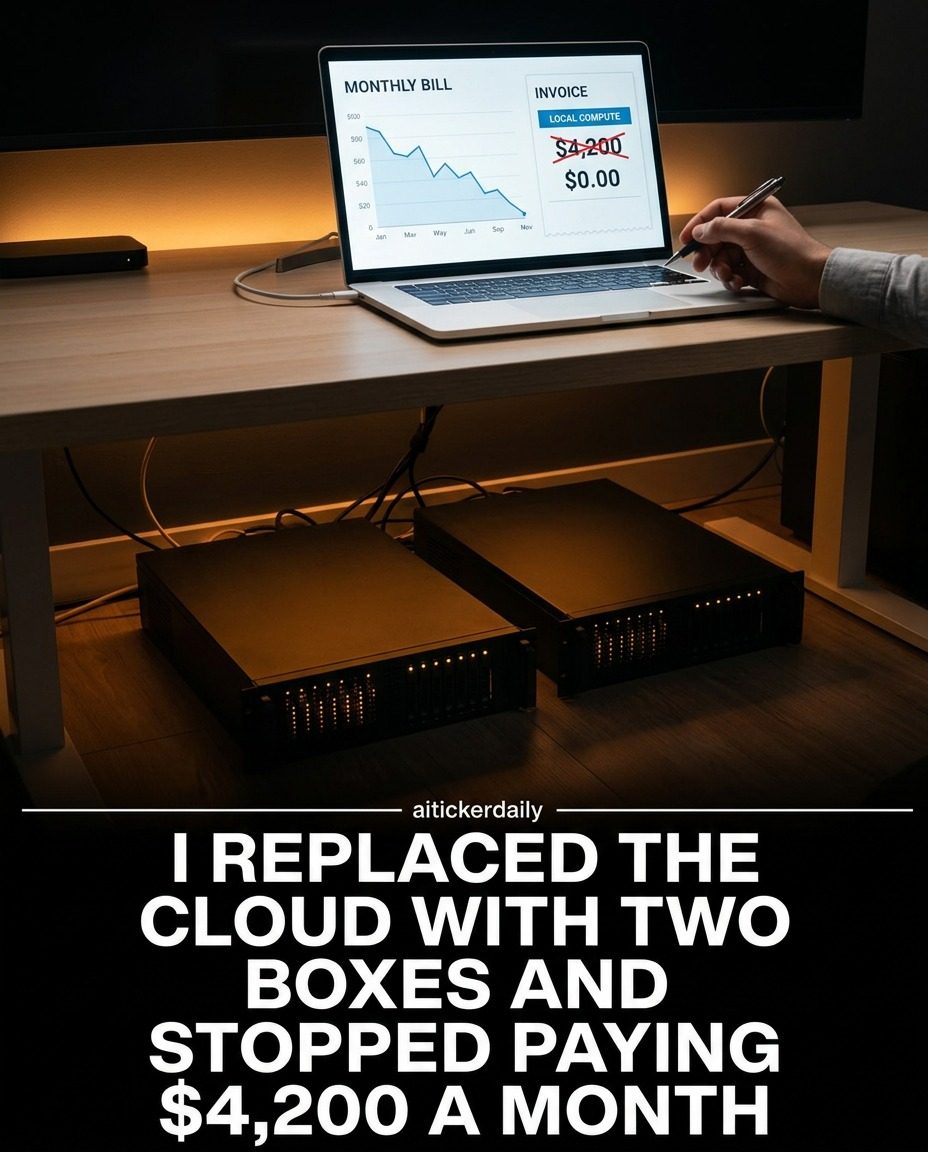
Cloud Cost Savings with On-Premises Servers
Migrating from cloud services to on-premises solutions can significantly reduce operational costs. By replacing cloud services with two physical machines, it's possible to eliminate various expenses like GPU hosting, egress fees, object storage, and managed endpoints. This shift can lead to near-zero marginal costs, making on-premises solutions an attractive alternative for many businesses.
Why This Matters
Cloud computing has revolutionized the way businesses manage their infrastructure. However, the associated costs can quickly escalate, especially for organizations with high computational needs. Understanding the components of cloud spending—compute, storage, networking, and managed services—is crucial for making informed decisions about cost optimization.
Main Discussion
Understanding Cloud Costs
Cloud computing services typically include a range of charges, from compute and storage to networking and managed services. Each of these components can add up, leading to substantial monthly bills. For instance, GPU hosting, egress fees, object storage, and managed endpoints are significant contributors to overall cloud expenses.
The On-Premises Advantage
Switching to on-premises servers can offer a more cost-effective solution. By containerizing, monitoring, and automating updates, businesses can self-host their applications and infrastructure. This approach not only reduces costs but also provides better control over the operational environment.
Components of Cloud Costs
- Compute: This refers to the processing power required to run applications and services. In the cloud, compute costs can escalate quickly, especially for resource-intensive tasks.
- Storage: Data storage is another significant cost component. Cloud providers charge for the amount of data stored and the frequency of access.
- Networking: Networking costs include data transfer fees, such as egress charges for data leaving the cloud.
- Managed Services: These services provide additional support, such as automatic backups, scaling, and maintenance. While convenient, they add to the overall cost.
Containerization and Automation
Containerization involves packaging an application and its dependencies into a single unit, making it easier to manage and deploy. By containerizing applications, businesses can streamline their operations and reduce costs associated with managed services.
Monitoring and automation are also critical. Automating updates and monitoring system performance ensures that the infrastructure remains efficient and secure, minimizing downtime and reducing the need for manual interventions.
Observability for Operational Efficiency
Observability is the ability to understand the internal states of a system by examining its outputs. It helps in identifying and resolving issues such as CPU, memory, and latency problems. By implementing observability, businesses can proactively address performance bottlenecks and ensure that their on-premises infrastructure operates smoothly.
Practical Tips
Assess Your Cloud Spend
- Conduct a Cost Audit: Begin by analyzing your current cloud spending. Identify the major cost components and areas where costs can be reduced.
- Optimize Resource Usage: Ensure that you are not over-provisioning resources. Use monitoring tools to track usage and scale resources accordingly.
- Evaluate Managed Services: Determine if managed services are necessary or if they can be replaced with in-house solutions.
Transition to On-Premises Solutions
- Plan Your Migration: Develop a comprehensive plan for migrating to on-premises servers. This includes assessing hardware requirements, containerizing applications, and setting up monitoring and automation.
- Invest in Reliable Hardware: Choose high-quality, reliable hardware that can handle your computational needs. Consider factors like scalability, durability, and energy efficiency.
- Implement Observability: Set up monitoring tools to track system performance and address issues proactively.
Optimize Operational Efficiency
- Automate Updates: Automate the process of updating your infrastructure to ensure that it remains secure and up-to-date.
- Containerize and Monitor: Containerize your applications and use monitoring tools to track their performance. This will help in identifying and resolving issues quickly.
Important Takeaways
Cost Savings
Transitioning to on-premises servers can result in significant cost savings. By eliminating expenses related to GPU hosting, egress fees, object storage, and managed endpoints, businesses can achieve near-zero marginal costs.
Operational Control
On-premises solutions provide better control over the operational environment. This includes the ability to monitor and automate updates, ensuring that the infrastructure remains efficient and secure.
Observability
Observability is crucial for maintaining operational efficiency. By tracking system performance and addressing issues proactively, businesses can minimize downtime and ensure smooth operation.
Conclusion
Migrating from cloud services to on-premises solutions can offer substantial cost savings and operational benefits. By understanding the components of cloud costs, implementing containerization and automation, and leveraging observability, businesses can achieve significant savings and improve their operational efficiency. Whether you're a small startup or a large enterprise, transitioning to on-premises servers can be a strategic move towards cost optimization and operational control.
Questions readers ask
What are the primary costs that can be reduced by switching to on-premises servers?
Primary costs that can be reduced include GPU hosting, egress fees, object storage, and managed endpoints. These costs are often significant components of cloud spending and can be minimized with on-premises solutions.
How many on-premises servers are needed to replace cloud services and achieve significant savings?
The article suggests that just two on-premises servers can replace multiple cloud services, leading to a monthly savings of over $4,200. This makes the transition to on-premises solutions feasible for many businesses.
What does the term 'near-zero marginal costs' mean in the context of on-premises servers?
Near-zero marginal costs refer to the low additional costs incurred for each extra unit of output. In this context, it means that once the initial investment in on-premises servers is made, the ongoing costs for additional storage or computational tasks are minimal.
What are egress fees, and how can they be reduced with on-premises servers?
Egress fees are the charges incurred when data is transferred out of a cloud service. By using on-premises servers, businesses can avoid these fees, as data transfer within the local network does not incur additional costs.
What are the benefits of analyzing cloud costs before making a switch to on-premises servers?
Analyzing cloud costs helps businesses understand the breakdown of their spending, including compute, storage, networking, and managed services. This analysis can reveal areas where significant savings can be achieved by transitioning to on-premises solutions, making the decision more informed and cost-effective.
Related deep dives
Similar reads based on topic and creator.




Recent articles
Fresh deep dives from the latest Reels we unpacked.




Comments
Be the first to comment.