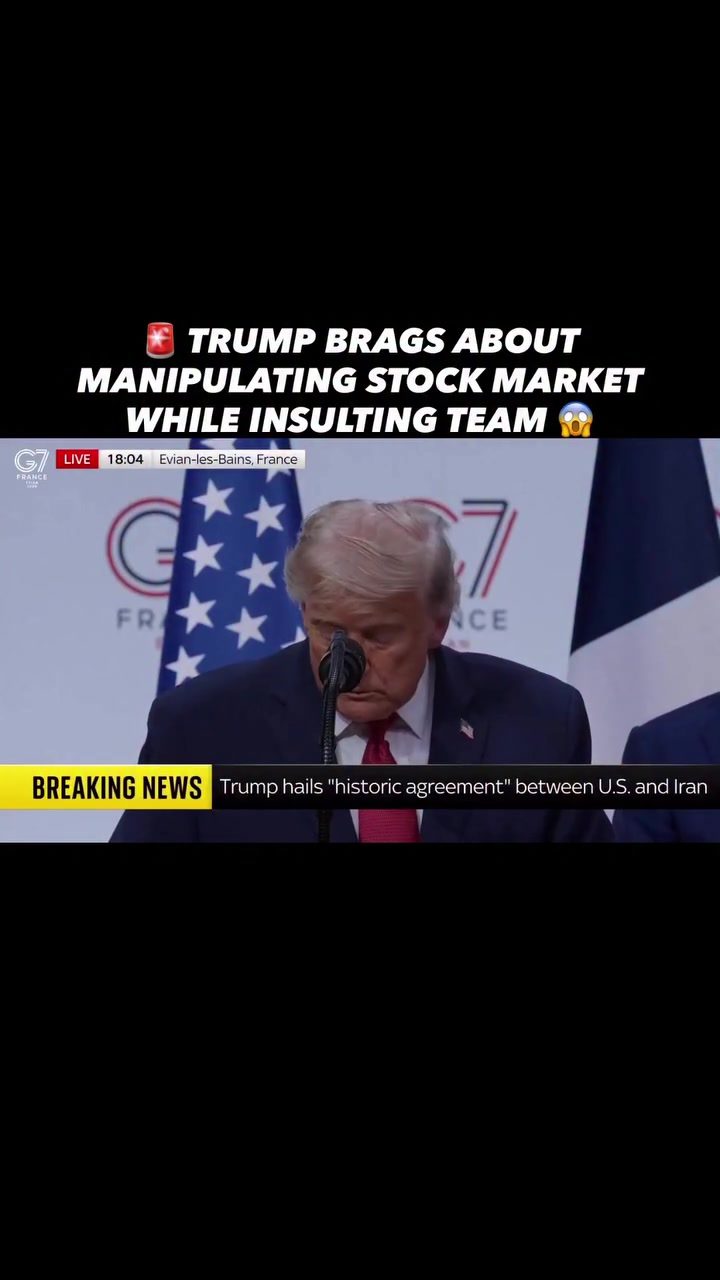
Why Trump's Words at the G7 Summit Matters
Political leaders often seek to shape public perception, but former President Donald Trump's remarks at the G7 summit in Evian-les-Bains, France, took this to a different level. During his speech, Trump openly discussed the real-time impact of his words on the stock market, particularly in relation to the U.S. and Iran's negotiations. This revelation raises several questions about the intersection of political rhetoric and financial markets.
Context / Why This Matters
At the heart of this conversation is the power of political influence over the stock market. The claim that Trump's words alone could move the market in significant ways highlights a few key issues. First, it underscores the delicate balance between political discourse and economic stability. Second, it brings into focus the role of public perception and confidence in shaping financial outcomes. Whether you view this as a testament to Trump's political acumen or a sign of potential market manipulation, the underlying message is clear: presidential rhetoric is not just a matter of policy, but of economic impact.
Main Discussion
The Influence of Political Speech on the Stock Market
Trump's comments at the G7 summit suggested that the mere possibility of a peace deal between the U.S. and Iran could cause the stock market to "shoot up like a rocket ship." Conversely, any hint of a failed negotiation would lead to a significant drop. This dynamic is not entirely new. Political stability and international relations are well-known factors that can influence market behavior.
The Role of Market Sentiment
Market sentiment, the overall feeling or tone of investors, is a critical driver of stock market movements. Positive sentiment can drive prices up, while negative sentiment can lead to sell-offs. Trump's statements, whether about peace negotiations or other issues, tapped into this sentiment, illustrating how political rhetoric can sway market participants. For instance, when Trump mentioned the U.S. working on a peace deal, investor optimism likely surged, pushing the market upward. Conversely, negative statements might have triggered fear and uncertainty, leading to sell-offs.
The Historical Context of Market Reactions
Throughout history, political events have influenced market movements. For example, geopolitical tensions, election results, and policy announcements often lead to significant market reactions. The 2008 financial crisis, the Brexit referendum, and the 2016 U.S. presidential election are just a few instances where political events had a profound impact on financial markets.
Practical Tips
For Market Participants
- Stay Informed: Keep an eye on major political events and statements, particularly those from influential leaders, who can sway market sentiment.
- Diversify Your Portfolio: While it's impossible to predict every market-moving event, diversification can help mitigate risk.
- Understand the Context: The impact of political rhetoric on the market is often context-dependent. Analyzing the broader economic landscape and geopolitical situation can provide more insight.
For Political Observers
- Monitor Public Statements: Pay close attention to what leaders are saying, especially in high-stakes negotiations or during significant events like G7 summits.
- Understand Market Dynamics: While political rhetoric can influence markets, it's not the only factor. A holistic understanding of market dynamics can offer a clearer picture.
Important Takeaways
- Political rhetoric, especially from influential leaders, can have a significant impact on market movements.
- Market sentiment, driven by optimism or pessimism, plays a crucial role in how investors react to political news.
- The impact of political events on financial markets is well documented, but not always predictable.
Conclusion
The connection between political rhetoric and the stock market is a multifaceted issue. Trump's comments at the G7 summit highlighted how words from a world leader can influence market movements. This dynamic underscores the need for market participants and political observers to stay informed and understand the broader context of political events and market behavior. Whether seen as a strategic move or a cause for concern, the influence of political discourse on financial markets is a critical factor that cannot be overlooked.
Questions readers ask
How did Trump's G7 remarks influence the stock market?
During the G7 summit, Trump's remarks about U.S.-Iran negotiations caused noticeable fluctuations in the stock market. His words had the power to boost or dampen market sentiment, leading to volatility and shifts in stock prices, highlighting the significant influence of political rhetoric on financial markets. Specifically, his comments impacted the market's perception of geopolitical risks and opportunities, leading to tangible effects on investor behavior and stock performance.
What is the significance of the G7 summit in the context of Trump's financial influence?
The G7 summit served as a platform for Trump to demonstrate the real-time impact of his words on the stock market. By discussing the U.S.-Iran negotiations, Trump showed how political rhetoric can immediately affect market sentiment, underscoring the delicate balance between political discourse and financial outcomes. This summit highlighted the potential for presidential speech to influence global financial markets, particularly in times of geopolitical tension.
Did Trump's speech at the G7 summit contribute to stock market volatility?
Trump's speech at the G7 summit definitely contributed to stock market volatility. His comments on the U.S.-Iran negotiations created uncertainty and fluctuations in the market, as investors responded to the potential geopolitical implications. The volatility was a direct result of the market's sensitivity to Trump's words, illustrating how political rhetoric can drive short-term market movements and create an atmosphere of uncertainty.
What role did Trump's remarks about Iran play in the market's reaction at the G7 summit?
Trump's remarks about Iran were a significant factor in the market's reaction at the G7 summit. His discussion of U.S.-Iran negotiations led to a swift response from investors, causing fluctuations in stock prices. The market's reaction reflected the perception of geopolitical risks and opportunities associated with Trump's comments, showcasing how political rhetoric can translate into tangible market movements, particularly in sensitive negotiations.
Can presidential speeches manipulate the stock market?
Presidential speeches, particularly those by Trump, can have a significant impact on the stock market. By shaping public perception and market sentiment, a president's words can influence investor behavior and drive market movements. This was evident at the G7 summit, where Trump's remarks about U.S.-Iran negotiations led to immediate and noticeable changes in the stock market, highlighting the potential for political rhetoric to manipulate market outcomes. However, the extent and longevity of this manipulation can vary depending on the context and market conditions.
What does the market reaction at the G7 summit tell us about Trump's financial influence?
The market reaction at the G7 summit provides a clear illustration of Trump's financial influence. His words had the power to move the market, demonstrating how political rhetoric can impact global financial outcomes. The immediate and noticeable shifts in stock prices and market sentiment in response to his remarks underscores the significant sway that a president's speech can hold over the stock market, particularly in the context of geopolitical negotiations.
How did the G7 summit impact stocks, specifically in relation to Trump's Iran negotiations comments?
The G7 summit had a direct impact on stocks, particularly due to Trump's comments on U.S.-Iran negotiations. His remarks created market volatility and influenced stock prices, as investors responded to the potential geopolitical implications. The summit served as a flashpoint for how presidential speeches can shape market sentiment and drive significant stock market movements, particularly in times of uncertainty and geopolitical tension.
Recent articles
Fresh deep dives from the latest Reels we unpacked.




Comments
Be the first to comment.