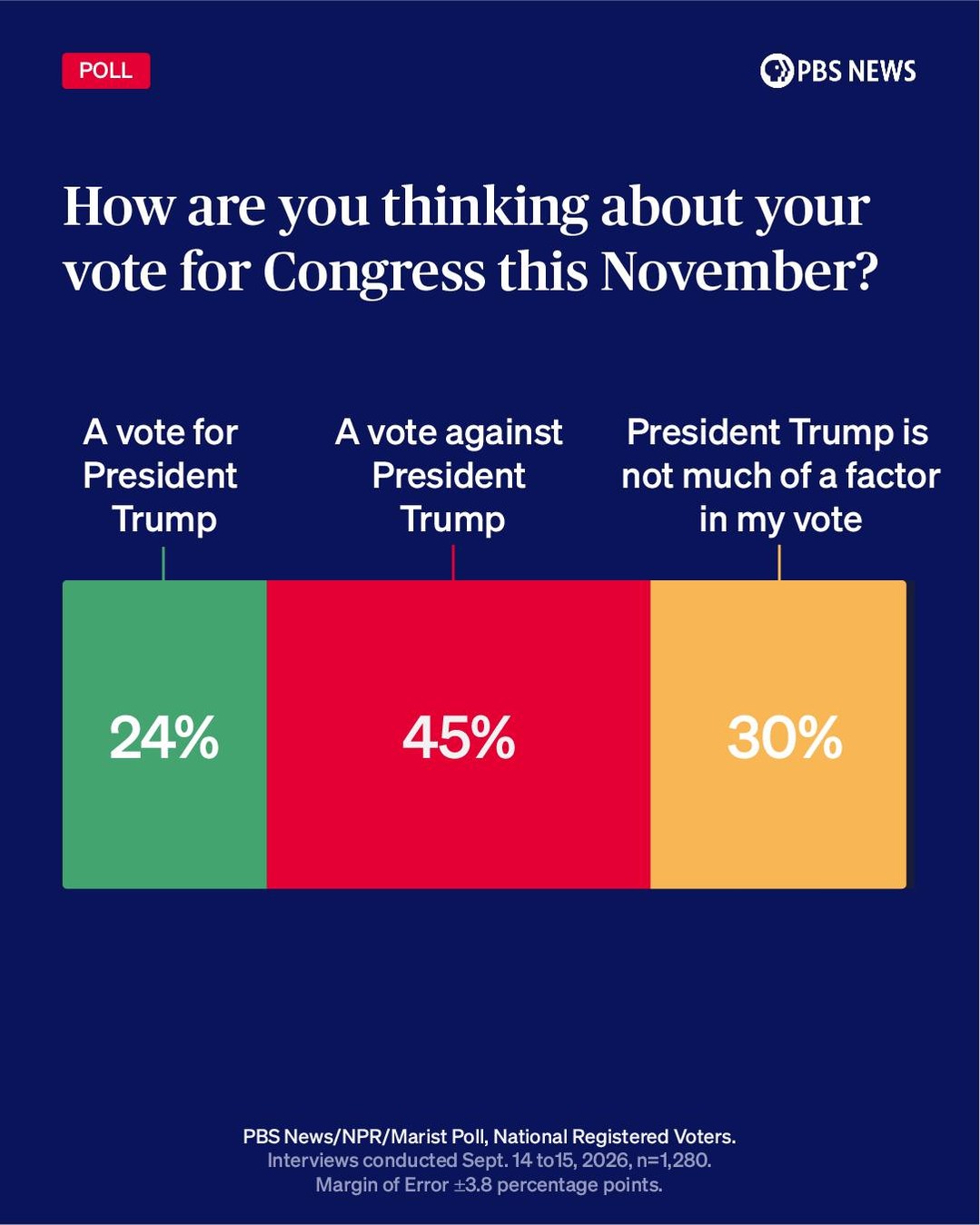
A recent poll conducted by PBS News, NPR, and the Marist Poll reveals a striking split among registered voters on the influence of President Trump in the upcoming congressional elections. Forty-five percent of those surveyed described their vote as "a vote against President Trump," while only 24% saw their vote as "a vote for President Trump." This division among voters on whether and how to voice support or opposition to the former president shows a nuanced approach to the powers of incumbency in this midterm election year. How the president’s influence is perceived by voters is complex.
The Midterm Mantra
The poll presents three key interpretations of voter sentiment: support, opposition, and indifference. Voters are not just choosing a candidate; they are considering their vote in the broader context of the president's influence. The three categories give voters a range of ways to articulate their thoughts on Trump's role. "A vote for President Trump" reflects enthusiastic support for the president, while "a vote against President Trump" positions the vote as a direct repudiation. “President Trump is not much of a factor” minimizes his influence. Each vote is loaded with meaning. No previous question quite captures the public's opinion on how the president should influence the vote in such direct ways. Each vote is a statement.
The Changing Role of Presidential Influence
Presidential primaries and general elections are often intertwined with obsessive questions of personal character, energy, and leadership. But midterm elections can offer a clearer glimpse into how voters perceive the incumbent's influence. Voter candor is more possible in this environment, especially when the president is no longer in office. Polling studies on voter behavior in midterms has found voters do indeed consider the president's influence. The poll traces the path of two distinct concepts. These are mutual — voters are considering power and influence, and they are considering their vote in the context of policy and direction. How they articulate that decision matters. Forty-five percent of voters see their vote as "a vote against President Trump" positions the vote as a direct repudiation of the administration. This is a concrete statement. 30% of voters see the administration as irrelevant, which positions the vote as one that is not about Trump. The vote is for a candidate. Neither is seen as a passive submission to inevitability. The poll captures a specific voter sentiment, shaped by a previous presidency, and offers a ballot box expression of that sentiment.
Pollsters' Specifications: The Polling Question
A nuanced question invites a nuanced response. The three potential answers gave voters an opportunity to speak out about the president's influence in a variety of ways. The midterm election poll questions open a window to public sentiment about Trump’s influence. It shows how much Trump is front and center in voters' minds. This is not just about the candidate. The poll designed the question differently to ask voters about their campaign calculus. "How are you thinking about your vote for Congress this November?" opens up voter sentiment and gives them space to express it. This wording is unique; it frames the question as voters' perceptive stance, rather than a direct opinion of a candidate. It isn't about the policies of a candidate. This is about voter perception of the influence of the previous president.
The Marist Poll Methodology
The Marist Poll surveyed 1,280 registered voters. The margin of error was ±3.8 percentage points. The interviews were conducted between September 14 and 15. This method allows for broad participation and a wide range of voter opinions. The large sample and small margin of error means it's a statistically relevant survey. Such a large survey could cover up small pockets of sentiment, but it gives a compelling picture of the larger electorate. Registered voters are the people who will participate in the November election.
The Balance of Power
The results present a three-way split. The 45% see the vote as a referendum and explicit opposition; twenty-four percent see their vote as a referendum of support for the president. Thirty percent of voters see this as irrelevant to their choice of representative. This adds up to 100%. For voters, this could be about eliminating or reinforcing the former president's influence. The findings are a mix of partisan support, anti-Trump sentiment, and a more realistic, policy-focused stance. Where the voters' motivations lie is fascinating. Voters are not always swayed by partisan influence. Forty-five percent see Trump as a key factor: a driver, a reactor, a defining factor. Thirty percent see him as irrelevant. This is voter sentiment. This logic is surprising. Trump supporters — and opponents — and other politicians might find themselves in surprising territory this midterm.
Practical Considerations for Voters and Analysts
- Engage with the question: The question itself is a powerful tool for voters to communicate. It's an opportunity to make a definitive statement, even before the vote is cast.
- Understand the results: This isn't just a poll question asking about the influence of the previous president. The specific responses: "a vote for, "a vote against," and "not a factor" — make voters' decisions clearer. This is where the nuance comes in. In two ways, this poll is revealing. First, it demonstrates the breadth of Trump’s divide in a way that's not often seen in polls. Second, it shows the nuances of a voter's decision-making. The percentage points of voters' statements, the phrasing, the directness of the questions are another layer of insight on how voters think about the president and Trump's influence. This is a significant note, in terms of how voters approach the upcoming elections.
Questions readers ask
What exactly did the poll by PBS, NPR, and Marist reveal about voter sentiments for the 2026 congressional elections?
The poll showed that 45% of registered voters see their 2026 congressional vote as a direct repudiation of former President Trump, while 24% view it as a vote in support of him. The remaining 30% consider Trump to be irrelevant to their voting decision, indicating a range of sentiments towards his influence.
How does this poll differentiate between support, opposition, and indifference towards Trump's influence?
The poll categorizes voter sentiment into three groups: those voting for Trump, those voting against him, and those for whom Trump is not a significant factor. This approach allows voters to express their views on Trump's role in a nuanced way, reflecting both their enthusiasm and opposition to his influence.
Why is the 2026 midterm election a unique opportunity to gauge voter sentiment on Trump's influence?
Midterm elections, especially when the president is no longer in office, allow for a clearer view of how voters perceive the incumbent's influence. This is because voters can be more candid and consider the president's influence in a more direct way, without the immediate pressures of a presidential election.
What is the significance of the question asked in the poll, and how does it differ from previous polling methods?
The poll question, which asks voters how they are thinking about their vote for Congress in the context of Trump's influence, is designed to capture a more nuanced understanding of voter sentiment. Unlike previous polls, it directly addresses the role of Trump in voter decision-making, providing a clearer picture of public opinion on his influence.
How does the poll reflect the changing role of presidential influence in midterm elections?
The poll highlights that midterm elections offer a unique lens into how voters perceive the incumbent's influence, especially when the president is not in office. Voter candor is more possible, and the poll captures distinct sentiments of support, opposition, and indifference towards Trump, reflecting a broader consideration of policy and direction.
Can voters' responses to this poll be considered a definitive measure of Trump's influence on the 2026 election?
While the poll provides valuable insights into voter sentiment, it is not a definitive measure. The responses reflect a snapshot of public opinion at a specific time and may evolve as the election approaches. However, it does indicate a significant role for Trump's influence in shaping voter decisions, which could impact the election outcomes.
What does it mean for 30% of voters to see the administration as irrelevant to their vote?
For 30% of voters, seeing the administration as irrelevant means their vote is based on other factors, such as the candidate's qualifications, policy positions, or local issues. This group is not making a statement about Trump's influence, indicating a focus on other aspects of the election.
Related deep dives
Similar reads based on topic and creator.



Recent articles
Fresh deep dives from the latest Reels we unpacked.




Comments
Be the first to comment.