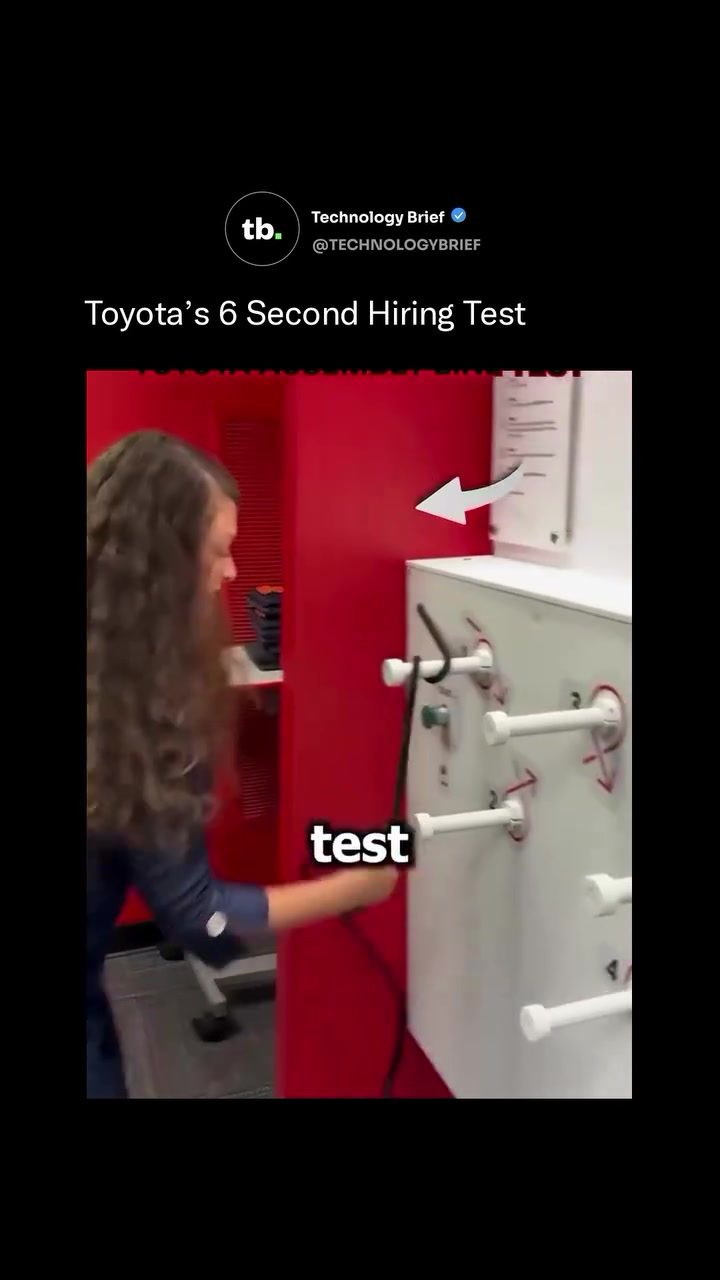
Toyota's Uniquely Challenging Hiring Test
Toyota's hiring process for assembly line workers includes a unique and rigorous test that assesses candidates' speed, precision, and problem-solving abilities. This rope-threading test requires applicants to wind a rope around a series of pegs in the correct pattern within just six seconds. The test is not merely a random game; it's designed to simulate the speed and precision needed on a real Toyota assembly line.
Why This Matters
The automotive industry demands high levels of precision and efficiency. Toyota's hiring test reflects the company's commitment to maintaining these standards. The test ensures that new hires can keep up with the demanding pace of the assembly line, where workers repeat the same precise movements thousands of times per shift. Even a small delay or error can slow down the entire production process, making speed and consistency crucial for maintaining efficiency.
The Toyota Production System
This level of discipline is built into Toyota’s broader production philosophy, known as the Toyota Production System. This system emphasizes efficiency, quality control, and continuous improvement. One of the most famous elements of this system is the Andon cord, a rope that any worker can pull to stop the entire line if a defect is spotted. This puts quality control directly in the hands of every worker, ensuring that issues are addressed promptly.
The 6-Second Test
The rope-threading test is a microcosm of the Toyota Production System. It assesses hand speed, motor control, and precision—all essential skills for assembly line workers. Candidates must complete the task within six seconds to pass, reflecting the high-speed environment of a real assembly line. This test is designed to simulate the exact movements and precision required on the job, ensuring that new hires can meet the demands from day one.
Simulating Assembly Line Conditions
The test involves a wiring puzzle, where candidates must thread a rope around a series of pegs in a specific pattern. This task requires quick thinking and precise movements, simulating the repetitive and meticulous work done on the assembly line. The digital timer adds to the pressure, ensuring that candidates must work under the same time constraints they would face in a real work environment.
Assessing Key Skills
The 6-second time limit is not arbitrary. It mirrors the tight deadlines and high expectations of an assembly line. Toyota workers must perform the same exact movements thousands of times per shift, making speed and consistency paramount. The test evaluates:
- Hand Speed: The ability to perform tasks quickly without sacrificing accuracy.
- Motor Control: Precise control over hand movements, essential for repetitive tasks.
- Problem-Solving Skills: Quickly identifying the correct sequence and pattern to complete the task.
The Importance of Speed and Precision
On Toyota’s assembly lines, workers must repeat the same precise movements thousands of times per shift. One small mistake or delay can slow down the entire production process, leading to inefficiencies and potential defects. This is why Toyota places such a strong emphasis on speed and consistency in their hiring process. The 6-second test ensures that new hires are well-prepared to handle the demands of the job from the very first day.
Practical Tips for Aspiring Candidates
If you're considering applying for a position at Toyota's assembly line, here are some practical tips to help you prepare for the 6-second test:
Practice Fine Motor Skills
Engage in activities that improve your hand-eye coordination and fine motor skills. This could include tasks like threading needles, assembling small models, or playing games that require precision.
Improve Reaction Time
Practice speed and reaction time exercises. This could be anything from simple hand-eye coordination games to more structured activities like typing tests. The goal is to improve your ability to react quickly and accurately.
Understand the Pattern
Familiarize yourself with the specific patterns and movements required in the test. While you won't be able to predict the exact test, understanding the general principles will help you perform better under pressure.
Stay Calm Under Pressure
The test is designed to be challenging, so it's important to stay calm and focused. Practice mindfulness techniques to improve your ability to handle high-pressure situations.
Get Enough Rest
Ensure you are well-rested before taking the test. Fatigue can slow down your reaction time and impair your motor control, making it harder to complete the task within the time limit.
Important Takeaways
Toyota’s 6-second hiring test is more than just a hurdle to clear; it’s a reflection of the company’s commitment to efficiency, quality, and continuous improvement. The test assesses crucial skills that are essential for success on the assembly line, including hand speed, motor control, and problem-solving abilities. By simulating real-world conditions, it ensures that new hires are well-prepared to meet the demands of the job from day one.
Conclusion
The rope-threading test is a critical component of Toyota’s hiring process, designed to assess the speed, precision, and problem-solving skills needed for assembly line work. It reflects the company’s broader production philosophy, which emphasizes efficiency, quality control, and continuous improvement. For aspiring candidates, understanding the importance of these skills and practicing them regularly can significantly improve their chances of success.
Questions readers ask
How was the six-second test developed?
The six-second test was developed by Toyota to mimic the fast-paced and precise nature of their assembly line work. It was created to give hiring managers a concise way to evaluate a candidate's dexterity, speed, and problem-solving abilities, ensuring they can meet the demands of the assembly line.
What qualities does the rope-threading test evaluate?
The rope-threading test evaluates a candidate's speed, precision, and problem-solving skills. More specifically, it assesses their ability to perform repetitive, precise movements swiftly and accurately, which are crucial for maintaining the high standards of Toyota's production system.
How does the test reflect Toyota's production system?
The test reflects Toyota's production system by emphasizing the importance of efficiency and quality. It ensures that new hires can meet the demanding pace of the assembly line, where precision and speed are key to maintaining the high standards of the production process.
Can I practice to improve my chances of passing the test?
While Toyota does not provide specific practice materials, you can improve your chances by practicing hand-eye coordination and dexterity exercises. Focusing on tasks that require quick, precise movements can help prepare you for the test's unique challenges.
What happens if I fail the six-second test?
If a candidate fails the six-second test, it may indicate that they might struggle with the speed and precision required for assembly line work. However, failing the test does not necessarily disqualify a candidate from other roles within the company.
Are there other assessments in Toyota's hiring process for assembly line workers?
Yes, in addition to the six-second test, Toyota's hiring process includes other assessments such as interviews and physical evaluations. These assessments collectively ensure that candidates can meet the demands of the assembly line and contribute to Toyota's production system.
How does the test contribute to overall productivity?
The test contributes to overall productivity by ensuring that new hires can maintain the high standards of Toyota's assembly line. By selecting candidates who can perform precise, repetitive tasks quickly, Toyota minimizes errors and maximizes efficiency, thereby enhancing the production line's output.
Recent articles
Fresh deep dives from the latest Reels we unpacked.




Comments
Be the first to comment.