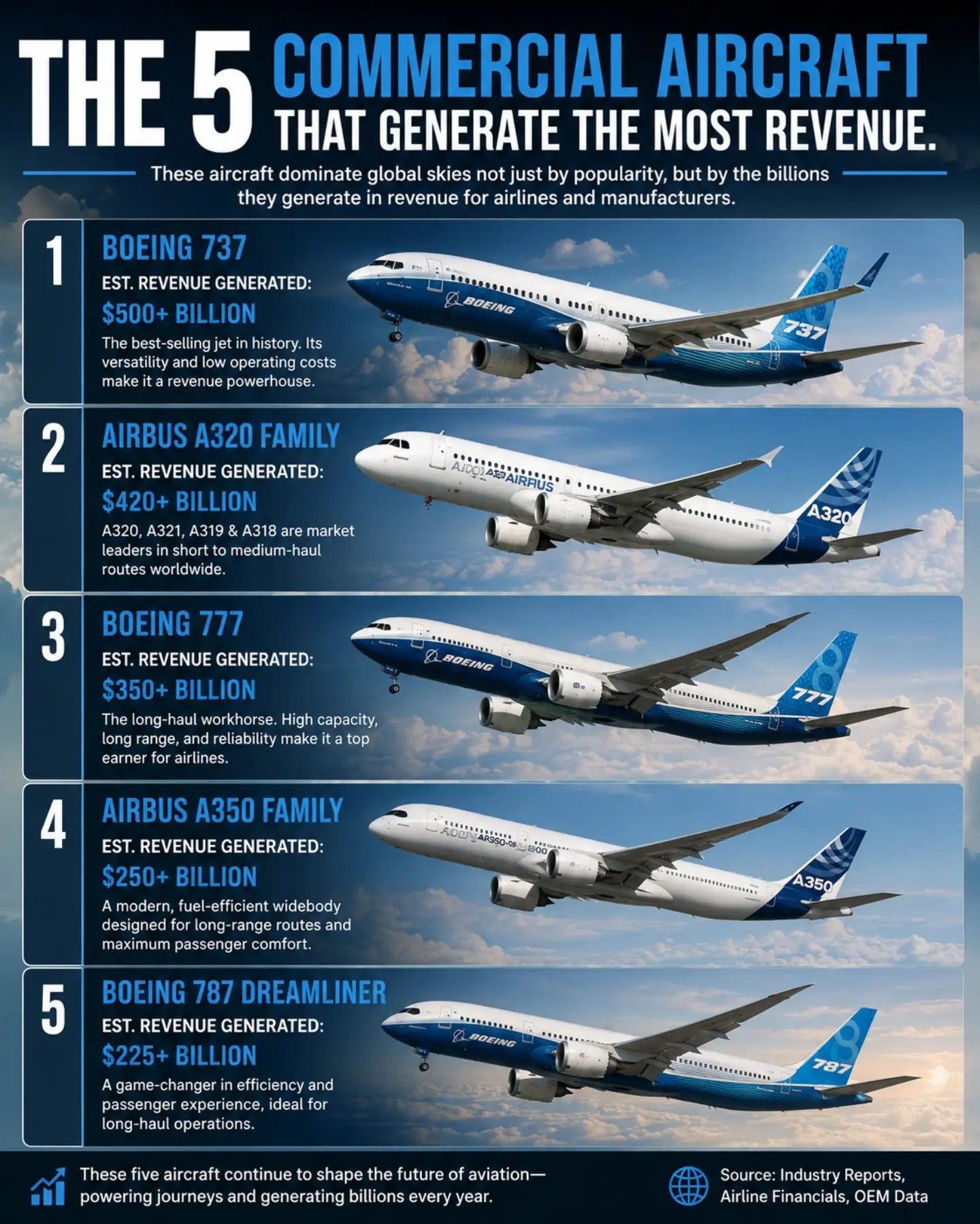
Top 5 Revenue Generating Commercial Aircraft
Commercial aircraft are the backbone of global aviation, facilitating passenger and cargo transport on an unprecedented scale. The financial success of these aircraft is a testament to their efficiency, reliability, and passenger appeal. Understanding the top revenue-generating commercial aircraft provides valuable insights into the dynamics of the aviation industry.
Context / Why this matters
The aviation industry is a significant economic driver, contributing trillions of dollars to global GDP. The commercial aircraft sector, in particular, plays a crucial role in connecting people and goods across the globe. The revenue generated by these aircraft is not just a measure of financial success but also an indicator of their operational efficiency, passenger demand, and market leadership.
Key Revenue Generators
Boeing 737
The Boeing 737 is an iconic aircraft that has dominated the narrow-body market for decades. Estimated to have generated over $500 billion in revenue, the 737's success can be attributed to its versatility, reliability, and low operating costs. Its ability to serve both short- and medium-haul routes makes it a favorite among airlines worldwide.
The 737's popularity is also due to its robust aftermarket support and extensive fleet size, ensuring consistent revenue streams for Boeing and its maintenance and service providers. The aircraft's modern variants, such as the 737 MAX, continue to drive sales and revenue, further cementing its position as a top revenue generator.
Airbus A320 Family
The Airbus A320 family, including the A318, A319, A320, and A321, is another powerhouse in the commercial aviation sector. With an estimated revenue of over $420 billion, the A320 family's success is driven by its fuel efficiency, passenger comfort, and advanced technology. The A320neo, in particular, has been a game-changer with its improved fuel consumption and reduced emissions, making it a top choice for environmentally conscious airlines.
The A320 family's versatility in serving various route lengths and passenger capacities has contributed significantly to its revenue generation. Additionally, the family's strong order book ensures a steady revenue stream for Airbus in the coming years.
Boeing 777
The Boeing 777 is a powerhouse in the wide-body market, with an estimated revenue of over $350 billion. Known for its long-range capabilities, efficient operations, and spacious cabins, the 777 has been a popular choice for long-haul routes. The 777X, the latest variant, promises even greater fuel efficiency and passenger comfort, further boosting its revenue potential.
The 777's success can also be attributed to its strong performance in the cargo market, with the 777F (Freighter) variant being a popular choice for air cargo operators. This dual-passenger and cargo capability has significantly contributed to the 777's revenue generation.
Airbus A350 Family
The Airbus A350 family, comprising the A350-900, A350-1000, and the upcoming A350F (Freighter), has generated over $250 billion in revenue. The A350's popularity is driven by its advanced design, fuel efficiency, and passenger comfort. The aircraft's composite materials and advanced aerodynamics make it one of the most efficient wide-body aircraft in the market.
The A350 family's success is also bolstered by its strong order book, with airlines around the world opting for its long-range capabilities and passenger comfort. The upcoming A350F is expected to further boost the family's revenue generation by tapping into the growing air cargo market.
Boeing 787 Dreamliner
The Boeing 787 Dreamliner, with an estimated revenue of over $225 billion, is renowned for its advanced technology, fuel efficiency, and passenger comfort. The Dreamliner's composite construction reduces weight and improves fuel consumption, making it a popular choice for long-haul routes.
The 787's success is also driven by its unique features, such as larger windows, higher cabin pressure, and improved humidity, which enhance passenger comfort. These features have contributed to the 787's popularity among passengers and airlines alike, ensuring a steady revenue stream for Boeing.
Practical Tips for Airlines
Choosing the right aircraft is crucial for an airline's financial success and operational efficiency. Here are some practical tips for airlines when selecting commercial aircraft:
Assess Fleet Needs
Evaluate your fleet's needs based on the routes you operate, passenger demand, and cargo requirements. Different aircraft models cater to different market segments, so choosing the right one is essential for maximizing revenue and minimizing costs.
Consider Fuel Efficiency
Fuel costs are a significant expense for airlines. Opting for aircraft with advanced engine technology, composite materials, and aerodynamic designs can significantly reduce fuel consumption and operating costs.
Prioritize Passenger Comfort
Passenger comfort is a key factor in an airline's success. Aircraft with features like larger windows, higher cabin pressure, and improved humidity can enhance passenger experience and satisfaction, leading to increased loyalty and revenue.
Evaluate Maintenance Costs
Maintenance costs can significantly impact an airline's financial performance. Choosing aircraft with robust aftermarket support, readily available spare parts, and low maintenance requirements can help minimize these costs and maximize revenue.
Consider Versatility
Aircraft that can serve multiple route lengths and passenger capacities offer greater flexibility and can contribute to higher revenue. Opting for versatile aircraft can help airlines adapt to changing market demands and maximize their fleet's utilization.
Important Takeaways
The top revenue-generating commercial aircraft—Boeing 737, Airbus A320 Family, Boeing 777, Airbus A350 Family, and Boeing 787 Dreamliner—stand out due to their operational efficiency, passenger appeal, and market leadership. Understanding the factors that contribute to their success can provide valuable insights for airlines and aviation enthusiasts alike.
Conclusion
The global aviation industry relies on commercial aircraft to facilitate the transport of passengers and cargo. The financial success of these aircraft is a testament to their efficiency, reliability, and passenger appeal. By understanding the top revenue-generating commercial aircraft and the factors that contribute to their success, airlines can make informed decisions to maximize their fleet's potential and drive financial growth. The commercial aircraft sector continues to evolve, with new technologies and innovations shaping its future. Keeping an eye on these trends and leveraging the insights from the top revenue-generating aircraft can help airlines stay competitive and thrive in the dynamic aviation industry.
Questions readers ask
What makes the Boeing 737 and Airbus A320 family the top revenue-generating commercial aircraft?
The Boeing 737 and Airbus A320 family lead in revenue generation due to their proven reliability and fuel efficiency. These aircraft are designed to minimize operational costs and maximize passenger comfort, making them popular choices for airlines worldwide.
How do airlines benefit from operating the top revenue-generating aircraft?
Airlines benefit from operating top revenue-generating aircraft through lower operational costs, higher passenger demand, and increased cargo capacity. These aircraft are designed for efficiency, reducing fuel and maintenance costs, and their popularity among passengers ensures high occupancy rates.
What factors contribute to the financial success of commercial aircraft?
The financial success of commercial aircraft is influenced by their operational efficiency, passenger appeal, and market demand. Aircraft that offer lower fuel consumption, reduced maintenance needs, and high passenger satisfaction tend to generate more revenue for airlines.
How does the Boeing 737 compare to the Airbus A320 family in terms of revenue generation?
Both the Boeing 737 and Airbus A320 family are highly competitive in revenue generation. The Boeing 737 is known for its robustness and versatility, while the Airbus A320 family offers advanced technology and fuel efficiency. Their market share often depends on regional preferences and airline fleet strategies.
Why are the top revenue-generating aircraft crucial for global aviation?
Top revenue-generating aircraft are crucial for global aviation as they facilitate efficient passenger and cargo transport, connect global markets, and drive economic growth. Their reliability and efficiency ensure that airlines can operate profitably, supporting the broader aviation ecosystem.
What role does passenger appeal play in the revenue generation of commercial aircraft?
Passenger appeal is a significant factor in the revenue generation of commercial aircraft. Aircraft that offer comfort, modern amenities, and a smooth flying experience attract more passengers, leading to higher occupancy rates and increased revenue for airlines.
How do airlines determine the most profitable aircraft for their fleet?
Airlines determine the most profitable aircraft for their fleet by analyzing factors such as fuel efficiency, maintenance costs, passenger demand, and operational flexibility. They also consider the aircraft's ability to cater to specific routes and market segments, ensuring that the chosen aircraft aligns with their business objectives.
Related deep dives
Similar reads based on topic and creator.



Recent articles
Fresh deep dives from the latest Reels we unpacked.




Comments
Be the first to comment.