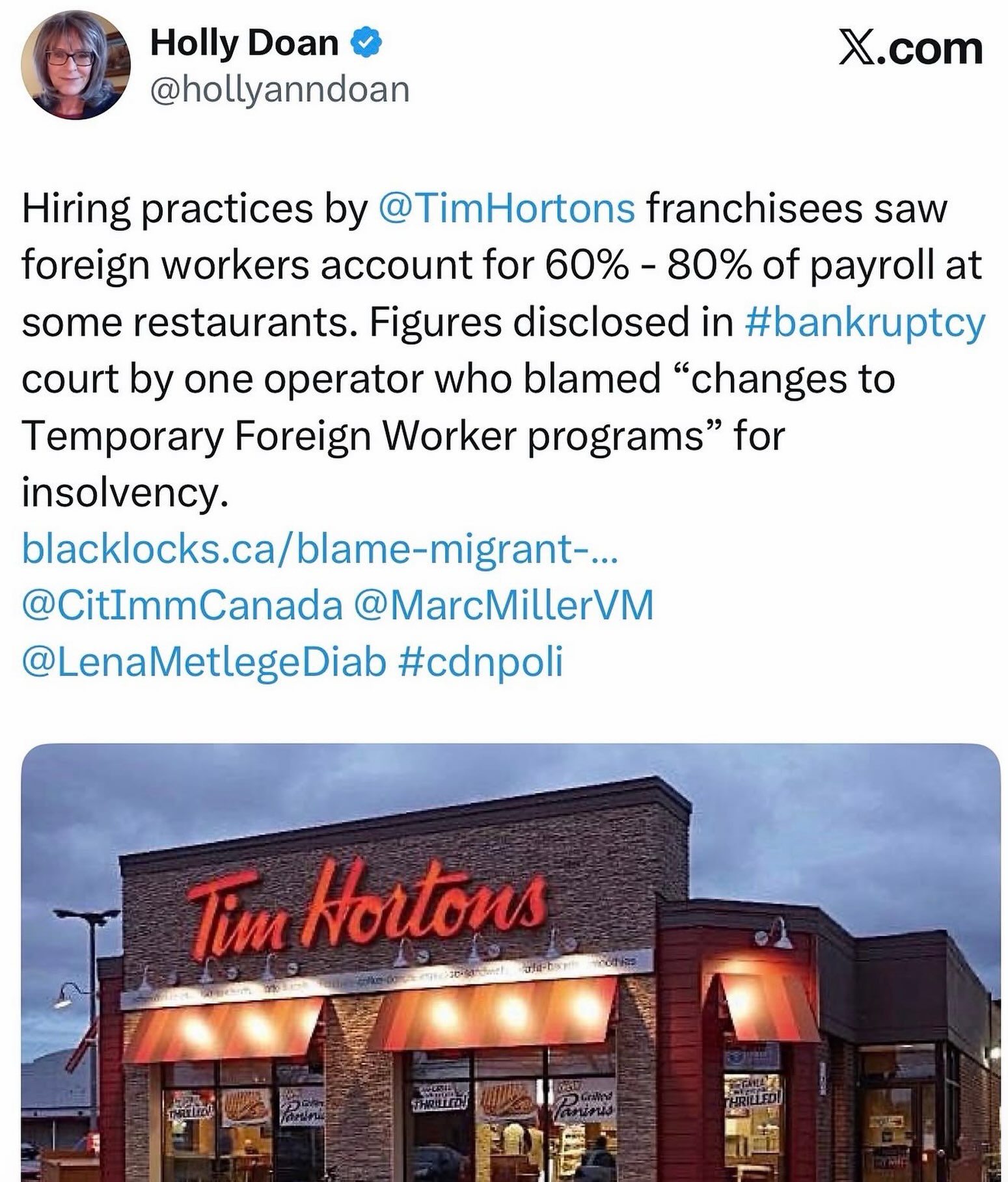
High percentage of foreign workers propel a debate on hiring practices at Tim Horton franchises. A recent screenshot indicates a striking allegation: foreign workers account for 60% to 80% of the payroll in some restaurants.
The Foreign Worker Dilemma in Tim Hortons Franchises
The Tim Hortons franchisee hiring practices came under scrutiny when public data revealed a range of 60% to 80% for foreign workers on the payroll. This situation raises several questions about reliance on foreign labor and its implications. The current situation at Tim Hortons exposes a complex landscape where real-world challenges meet political debate. Tim Hortons franchisees operate as independent small businesses. When they look to hire, they are indeed subject to Canadian immigration laws and regulations. The majority of foreign employees is composed of workers who are part of the Temporary Foreign Worker (TFW) program. The TFW program allows companies to hire foreign workers to fill jobs that can't be filled by Canadian citizens or permanent residents. The franchisee hiring demonstrates how deeply established the program is in critical industries. TFW program-related shifts have forced franchise owners to rethink their hiring practices. This feeds into a narrative around a cash-strapped restaurant environment. Franchise owners often cite various challenges. Some note that the costs involved in hiring domestic workers still make it difficult to maintain profitability. This is due to the combination of minimum wage hikes, benefits, and the general cost of living.
A New Era in Temporary Foreign Worker Policies
Changes to temporary foreign worker programs trigger upheavals in sectors like food services. The allegations cause concern around compliance with newly enforced regulations. A recent disclosure by one Tim Hortons operator, revealed in a bankruptcy court proceeding, showed figures blamed on changes to the Temporary Foreign Worker (TFW) programs. Temporary foreign workers often fill gaps for Tim Hortons. These workers might take on frontline roles in the industry. This is critical as franchises struggle to keep up with labor demands. The trend is fuelled by an aging population and a lack of suitable local workers. In this evolving landscape, businesses have to navigate the complex web of Labor Market Impact Assessment (LMIA) and immigration requirements.
The Rise of the Temporary Foreign Worker Program
In recent years, TFW enrollments have surged. The program has seen significant expansion in industries like food services. This is due to increasing labor shortages among Canadian workers. The trend is particularly evident in sectors where customer service is critical. The TFW program allows Canadian businesses to hire foreign workers to fill temporary labor and skill shortages. Requirements include proving that there is a need that cannot be met by a Canadian citizen. Following this, a Labor Market Impact Assessment (LMIA) needs to be filed. The types of workers who enter the country through the TFW program are part of several categories: high wage, low wage, agricultural workers, and live-in caregivers.
The Temporary Foreign Worker's Impact on Canadian Culture
There are numerous studies that show the impact of foreign workers on the labor market. The influx of foreign workers has caused some friction with domestic workers. Employers are often looking to hire cheaper labor. They can turn to temporary foreign workers. Meanwhile, Canadian workers feel they are being displaced in their own job market. The sight of Tim Hortons restaurant exteriors and the high percentage of foreign workers appearing prominently on Twitter illuminates a broader cultural impasse. Workers hired under the program help meet labor demands. The Can we can see this by the drop in unemployment rates. However, cultural integration and contributions to Canada's economy may also be compromised when temporary foreign workers are not integrated properly.
Controversy within the TFW Program
Tim Hortons' franchisees reveal externalities of the TFW programs. Disclosures have painted a number of issues. They show that the rules around the foreign worker hiring are not straightforward. A tweet showed a screenshot of a report from a Tim Hortons bankruptcy court. It revealed that Canadian Immigration Ministries have even undergone changes in their TFW program. This points to a major shift in how TFW programs are implemented.
Navigating the Path Forward
For those facing hiring uncertainty amidst these rapid changes, here are some starting points:
- Labor Costs – Understand how costs affect your bottom line and plan for future increases in payroll and benefits for all workers. The associated costs are vital factors in this landscape. This will help in understanding which wage class you might fall into. You can also check the government website.
- Bridging the Skill Gap – Consider partnerships with local educational institutions to train potential job seekers. Embrace innovative strategies to attract qualified Canadian workers to help bridge gaps you need to fill.
- Properly Manage Your Immigration Requirements – Ensure that all your paperwork is squared away and that your businesses are meeting all criteria. It’s important to be well-versed in the rules of the TFW program.
- Training Enrollment – Apply to programs that train foreign workers to transition them into Canadian citizenship and permanent residency. This offers a pathway to long-term stability and a more streamlined workforce.
- Implementation of Blacklocks.ca – Bring on board immigration lawyers to actively navigate the web of laws and regulations. This will help mitigate the challenges posed by the TFW program.
Knowing when to switch from temporary foreign workers to permanent residency
As stakes rise, the TFW program gains more attention. Tim Hortons' franchise owner struggles reveal both the extremes and the realities of this system. Foreign workers have been shifting the labor dynamics. The timeline shows that hiring practices have become a vital concern. This is especially true in the restaurant industry. The policies are flawed and inherently tied to the economic system. Expect more businesses to scrutinize Tim Hortons' approach. This will help in shaping future hiring policies.
Questions readers ask
What is the Temporary Foreign Worker (TFW) program and how does it apply to Tim Hortons franchises?
The TFW program allows Canadian businesses, including Tim Hortons franchises, to hire foreign workers to fill temporary labor and skill shortages. Franchises must prove that there is a need that cannot be met by a Canadian citizen or permanent resident and then obtain a Labor Market Impact Assessment (LMIA). This program is a significant part of how Tim Hortons franchises address labor shortages, especially in customer service roles.
Why do some Tim Hortons franchises have such a high percentage of foreign workers?
Tim Hortons franchises often face challenges in hiring domestic workers due to factors like minimum wage hikes, benefits, and the general cost of living. This makes it difficult for franchisees to maintain profitability, leading them to rely heavily on the TFW program to fill labor gaps, which can result in 60% to 80% of their workforce being foreign workers.
What are the implications of relying heavily on foreign workers for Tim Hortons franchises?
Relying heavily on foreign workers can lead to complex legal and regulatory compliance issues, as well as potential public and political scrutiny. It also raises ethical and economic questions about the impact on local labor markets and the sustainability of the business model in the long term.
How do changes in TFW program policies affect Tim Hortons franchises?
Changes in TFW program policies can significantly impact Tim Hortons franchises, as they must navigate new regulatory requirements and potential labor shortages. For example, alterations to the program can lead to increased costs or changes in the availability of foreign workers, forcing franchise owners to adapt their hiring practices.
What are the potential challenges for Tim Hortons franchises in complying with new TFW regulations?
Tim Hortons franchises may face various challenges in complying with new TFW regulations, including the need to conduct thorough Labor Market Impact Assessments (LMIAs) and adjust to changes in visa requirements or quotas. This can add administrative burdens and operational complexities, particularly for smaller franchise owners.
How has the TFW program evolved in recent years and what does this mean for the food service industry?
The TFW program has seen significant expansion in recent years, particularly in industries like food services, due to increasing labor shortages. This trend is likely to continue as the Canadian population ages and sectors like food service struggle to attract and retain domestic workers, making the TFW program a critical component of the industry's labor strategy.
Recent articles
Fresh deep dives from the latest Reels we unpacked.




Comments
Be the first to comment.