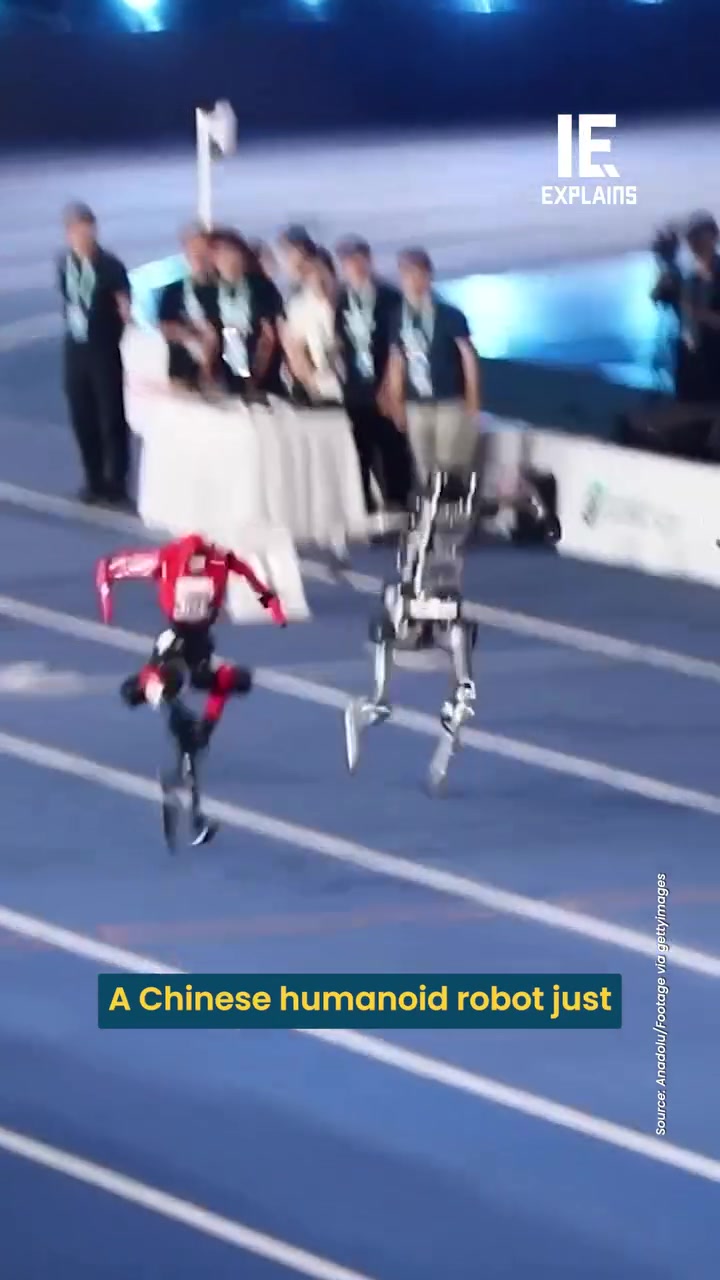
A Chinese humanoid robot, Tiangong Ultra, ran 100 meters in 9.39 seconds on a track in Beijing. This time beats the human world record set by Usain Bolt (9.58 seconds) and comes close to Lightning, a robot made by the technology company Honor, which clocked 9.47 seconds, even though Lightning had previously run 9.32 seconds during pre-game tests.
What is Tiangong Ultra
The Tiangong Ultra is a humanoid robot developed by the Beijing Humanoid Robot Innovation Center. This robot is distinctive for its ability to run 100 meters in just 9.39 seconds, faster than any human record. Built with a height of 1.8 meters and weighing 55 kilograms, Tiangong Ultra showcases advanced control mechanisms that enable it to accelerate rapidly. It is part of a broader wave of robots that are pushing the boundaries of what is physically possible for humanoid machines. Amid the grandeur of this record is a challenge. Tiangong Ultra went off course and into a foam wall. Lightning, another robot, also lost control and had to be carried off. These incidents underscore the development challenges in safely controlling robots like these. Tiangong Ultra's abilities extend beyond just quick sprints. In prior competitions, it has won the first ever humanoid half marathon, a demonstration of its endurance and consistent performance over longer distances.
Why the World Humanoid Robot Games Matter
The World Humanoid Robot Games in Beijing are an arena showcasing accelerated progress in robotics. What began as a nascent challenge for teams in 2010 with a winning 100-meter time of 21.50 seconds, went faster and faster, soon reaching 9.39 seconds in 2024. This signifies a dramatic improvement in robotics technology. Faster, more stable robots are a result of evolving designs and sophisticated control mechanisms. The Games feature more than 2,056 robots from 666 teams and 16 countries. All this progress is not confined to speed. The robots still grapple with basic problems, like stopping safely without falling over. These Games offer a glimpse into a future where humanoid robots become ubiquitous in sports, but also in day-to-day life.
The Rise of Humanoid Robots
Speedsters on the Track
The competitive spirit of the World Humanoid Robot Games is a showcase for humanoid robots. The Tiangong Ultra robot's 9.39-second sprint is a testament to the advancements in robotics. This robot is not just fast but also precise, demonstrating an intricate control system that allows it to handle high speeds. The speed marks a 12.11 second improvement from the previous year. All this while being about 1.8 meters tall and at a weight of 55 kilograms, this robot pushes the limits of what humanoid robots can achieve. The overall context is a sample of what the future holds for robotics, where speed and endurance will be key factors.
Humanoid Robot Making History
The Tiangong Ultra robot is already making history with its remarkable achievements. Its world record sprint in the World Humanoid Robot Games and the previous win in the first-ever humanoid marathon highlight its capability. Humanoids are not confined to simply imitating human movements but also outperforming them in certain tasks. This development is a significant milestone in the field. The innovations that make up this robot are part of a broader trend in robotics.
Control and Precision
However, while speed is their selling point, humanoid robots have challenges in controlling their movements. As quickly as can reach a speed of 14.5 meters per second, the robots often lose control upon approaching the finish line. Tiangong Ultra veered off the track and crashed into a wall, while Lightning fell over after crossing the finish line. This highlights the critical need for better control systems, including precise braking and stability mechanisms. Faster movement means more energy and power, and the robots are still working on distributing and managing large amounts of energy.
The Games: A Global Showcase
The World stage
The World Humanoid Robot Games brought together 2,056 robots from 666 teams across 16 countries. The competition is designed to push the limits of what humanoid robots can achieve, fostering innovation and collaboration among teams from around the globe. This collaboration and competition encourage teams and companies to develop robots, resulting in significant progress.
The countdown Challenge
The 9.39 seconds sprint, alongside Lightning's 9.32, comes from preliminary heats, not the main event, emphasizing the intense competition and the rapid progress of robotics. This is also a testament to the way the robots are advancing every year. The innovation underlying these achievements comes from teams working tirelessly to refine control systems, optimize speed, and ensure stability.
Why You Should Care About These Robotic Speedsters
- Curiosity: There has been a noticeable improvement in the robotics space. The 2024 edition of the World Humanoid Robot Games highlights the rapid advancement of technology and the capabilities of humanoid robots. It is worth paying attention to the strides made by these machines as they push the boundaries.
- Why Invest time: The current focus of humanoid robots is to increase speed. With time, focus will shift to stamina, precision, and endurance. Robots like Tiangong Ultra and Lightning are showcasing the future of what robots will be capable of.
- Safety: Safety First. It's crucial to be aware of the current limitations in controlling robots. Both Tiangong Ultra and Lightning showcased their speed, but both also lost control at the end. Tiangong Ultra veered off the track and crashed, while Lightning fell over. Safety mechanisms are as important as speed control.
The Endurance Challenge
Humanoid robots are not only about speed—stamina is a crucial factor. Tiangong Ultra has already won the world's first-ever humanoid half marathon, showcasing its endurance and ability to maintain consistent performance over longer distances. It's not just about reaching the finish line first but also about sustaining that pace over time. The challenges of controlling robots at high speeds are evident. While speed is a significant accomplishment, stability and precision remain areas of improvement. The Tiangong Ultra robot's incredible sprint time and the Lightning Robot’s performance are examples of the advancements in robotics. The World Humanoid Robot Games underscore the importance of robotics in shaping the future while highlighting the need for further innovation in control systems.
Questions readers ask
How was Tiangong Ultra able to achieve a 100-meter sprint time faster than Usain Bolt?
Tiangong Ultra was able to achieve this remarkable feat due to its advanced control mechanisms and intricate design. The robot is equipped with sophisticated systems that allow it to accelerate rapidly and maintain high speeds, which surpass human capabilities
What role does the World Humanoid Robot Games play in the advancement of robotics?
The World Humanoid Robot Games serve as a platform to showcase the latest advancements in robotics technology. The Games highlight the rapid progress in speed, stability, and endurance of humanoid robots, while also revealing the challenges that still need to be addressed, such as safe stopping mechanisms.
What are some of the challenges faced by humanoid robots like Tiangong Ultra?
Despite their impressive speed, humanoid robots like Tiangong Ultra still face significant challenges. For instance, Tiangong Ultra went off course and into a foam wall during its record sprint, highlighting the difficulties in achieving precise control at high speeds. Additionally, robots often struggle with basic tasks like stopping safely without falling over.
How does Tiangong Ultra compare to other humanoid robots, such as Lightning?
Tiangong Ultra's 9.39-second sprint is faster than Lightning's previous best time of 9.47 seconds, but Lightning had previously run 9.32 seconds during pre-game tests. Both robots demonstrate remarkable speed and control, but Tiangong Ultra's ability to sprint faster than any human world record is particularly noteworthy.
Can Tiangong Ultra's technology be applied to other areas beyond athletics?
The technology behind Tiangong Ultra has potential applications beyond athletics. The advanced control mechanisms and design principles could be adapted for various purposes, such as improving the performance of service robots in everyday life, enhancing industrial automation, or even advancing medical rehabilitation technologies.
Related deep dives
Similar reads based on topic and creator.


Recent articles
Fresh deep dives from the latest Reels we unpacked.


Comments
Be the first to comment.