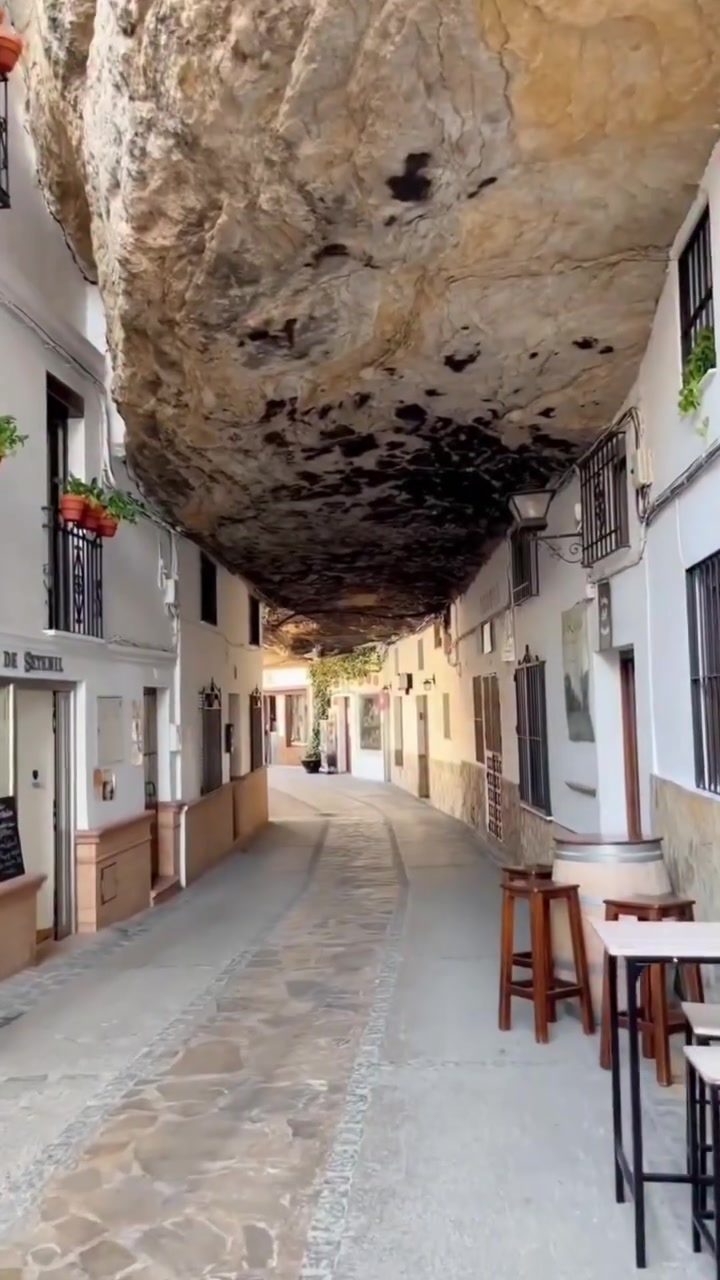
A Town
Under a Rock: The Enigmatic Architecture of Setenil de las Bodegas Nestled into a gorge in southern Spain lies the white village of Setenil de las Bodegas, where the ceiling of a house is as likely to be the underside of an enormous rock overhang. This town is not a relic of the past; It teems with life. Villagers sit for lunch under the colossal stone roofs. This is a place where even the streets have unique identities, known as the Cave of the Sun and the Cave of the Shade.
Building Beneath the Boulders
Setenil de las Bodegas is distinctive for its architectural integration with the natural landscape. Houses are not just built beneath the massive rock overhangs, but the rocks are part of the houses’ roofs. The village itself is nestled in a gorge, with the cliffs forming an integral part of the urban landscape. This architectural style is an organic adaptation to the environment. It is not a surprise that some streets are nearly in perpetual shadow, earning the nicknames Cave of the Sun and Cave of the Shade. The town’s layout lends to microclimates, where sunlight and shade play a key role in daily life. Enormous boulders aren’t just obstacles, but full partners in how people enjoy the day. Local tapas under enormous stones is not just a quirky tourist attraction, but a daily experience.
The Allure of the Unusual
Setenil de las Bodegas invites comparison to other unique villages. Its style is markedly different from the cliffside villages of Normandy, France. Unlike the openly integrated houses of Guatapé, Colombia, Setenil de las Bodegas features houses built under the rock, the cliffs are like sheer boulders, flat on the bottom and the top is uneven. While cities like Petra, Jordan, are carved into cliffs, Setenil de las Bodegas builds under rock overhangs. This distinctive architecture takes years to build. The villagers have adapted their way of living to the natural environment, slowly transforming it over centuries. On-screen text identified the village as "Tersa de Seteñil", an unusual name variation. Some locals refer to the town as Setanil de las Bodegas.
The Evolution of an Architecture
The architecture of Setenil de las Bodegas evolved out of necessity. Overhanging rock formed a natural shelter, so the villagers did not have to build roofs. They constructed the houses in and around the boulders, with the rock serving as the ceiling. Later, this unique style came to define the town, attracting tourists with its peculiar and charming characteristics. The village’s architecture can be traced back to ancient times, when it was a strategic point for military defense and trade. The natural caves and overhangs provided shelter and protection, making it an ideal location for habitation. Over time, the villagers adapted and incorporated the rock formations into their homes, creating a unique and sustainable way of life.
The Charm of the Comingling
The interplay of the natural environment and human habitation makes Setenil de las Bodegas stand out. Houses built under rock overhangs are less about aesthetics, more about how the people live. They’ve adapted their way of living to this environment, and it shows how they have built homes in harmony with the landscape. They’ve integrated their daily life with the environment. The overhanging rocks became an integral part of the homes, providing shade and protection from the elements. People frequently ask what it is like to live in a cave-like village. The architecture has a dual role. It serves as a shelter and a source of coolness. Moreover, the overhanging rocks are not only a structural element, but a psychological one. They make people feel sheltered, possibly even inspired by the colossal stone ceilings. This is not just an architectural marvel, but a way to dwell harmoniously with nature.
The Community Beneath the Rock
The village life in Setenil de las Bodegas is absolutely not frozen in time. It is a living community. Tourists can enjoy tapas and sit for lunch under the rock. Some locals have opened shops and restaurants, catering to visitors and locals alike. The community welcomes visitors to experience the unique way of life. It is not just about architecture; it is about a community that has adapted to its environment. The village’s unique character makes it a must-visit destination for travelers seeking an offbeat and enchanting experience, as well as for those interested in the intersection of architecture and nature.
Where the Earth Meets Architecture
To understand Setenil de las Bodegas, it helps to grasp its context in Andalusia, Spain. This region is known for its dramatic landscapes and rich cultural heritage. The town’s unique architecture fits within a larger narrative of Andalusia’s historical adaptation to its natural surroundings. The village is about 20 minutes from Ronda, and a day trip from Seville or Malaga, making it relatively accessible to travelers.
For The Next Adventure
For someone who’s keen to explore, Setenil de las Bodegas is ideal. It is not just about the warm architecture, but about the experience of living beneath the rocks. You can enjoy the local tapas and soak in the unique atmosphere. This village offers a glimpse into a lifestyle deeply rooted in its natural environment. It’s a place where the earth and architecture come together in harmony.
- Location: Southern Spain, tucked into a gorge, about 20 minutes from Ronda, and accessible on a day trip from Seville or Malaga
- Unique Features: Houses built under rock overhangs, streets known as Cave of the Sun and Cave of the Shade
- Local Cuisine: Enjoy tapas and local dishes in restaurants and cafes nestled under the rock formations
- Activities: Explore the narrow, winding streets, visit local shops, and appreciate the unique architecture
- Accomodation: Opt for a stay in one of the historic cave houses or nearby accommodations to fully experience the village. Setenil de las Bodegas stands as a testament to human ingenuity and adaptability, where nature and architecture coexist in harmony.
Questions readers ask
How do the houses in Setenil de las Bodegas stay cool under the rock overhangs?
The rock overhangs provide natural insulation, keeping the houses cool during the hot summer days. The town’s layout also creates microclimates, where the interplay of sunlight and shade helps regulate the temperature. Some streets are even called the Cave of the Sun and the Cave of the Shade, reflecting how the natural environment influences daily life.
What makes Setenil de las Bodegas unique compared to other cliffside villages like those in Normandy, France, and Guatapé, Colombia?
Setenil de las Bodegas is unique because its houses are built under massive rock overhangs, rather than being integrated into the cliffs or carved out of them. Unlike the cliffside villages in Normandy, the houses in Setenil are not just built on the rock but are covered by it. Compared to Guatapé, where houses are openly integrated, Setenil’s houses are tucked beneath the overhangs, making for a very different aesthetic and lifestyle.
How did the architecture of Setenil de las Bodegas evolve over time?
The architecture evolved out of necessity, with villagers using the natural rock overhangs as shelter. This meant they didn’t have to build roofs, and over time, they constructed their homes in and around the boulders. This unique style, born out of practical needs, eventually became a defining characteristic of the town, attracting tourists with its peculiar and charming qualities.
Can visitors still experience the daily life of the villagers in Setenil de las Bodegas, or is it primarily a tourist attraction?
Visitors can indeed experience the daily life of the villagers. The town is not just a relic of the past—it teems with life. You can sit for lunch under the colossal stone roofs, enjoy local tapas, and walk through streets that have unique identities, like the Cave of the Sun and the Cave of the Shade. It’s a place where the local culture and the unique architecture blend seamlessly.
Are there any similarities between Setenil de las Bodegas and the ancient city of Petra, Jordan?
While both Setenil de las Bodegas and Petra, Jordan, showcase unique architectural integration with natural landscapes, they differ in their approaches. Petra is known for its buildings carved into the cliffs, whereas Setenil de las Bodegas features houses built under rock overhangs. The rock in Petra is used as part of the structure itself, while in Setenil, the rock overhangs are used as natural roofs.
How do the names Cave of the Sun and Cave of the Shade reflect the town’s unique layout?
These names reflect the microclimates created by the town’s layout. Some streets are nearly in perpetual shadow, while others get more sunlight. These differences influence daily life, from how people enjoy their time to the local tapas experience. The names highlight the unique interplay between the natural environment and the village’s architecture.
Related deep dives
Similar reads based on topic and creator.




Recent articles
Fresh deep dives from the latest Reels we unpacked.




Comments
Be the first to comment.