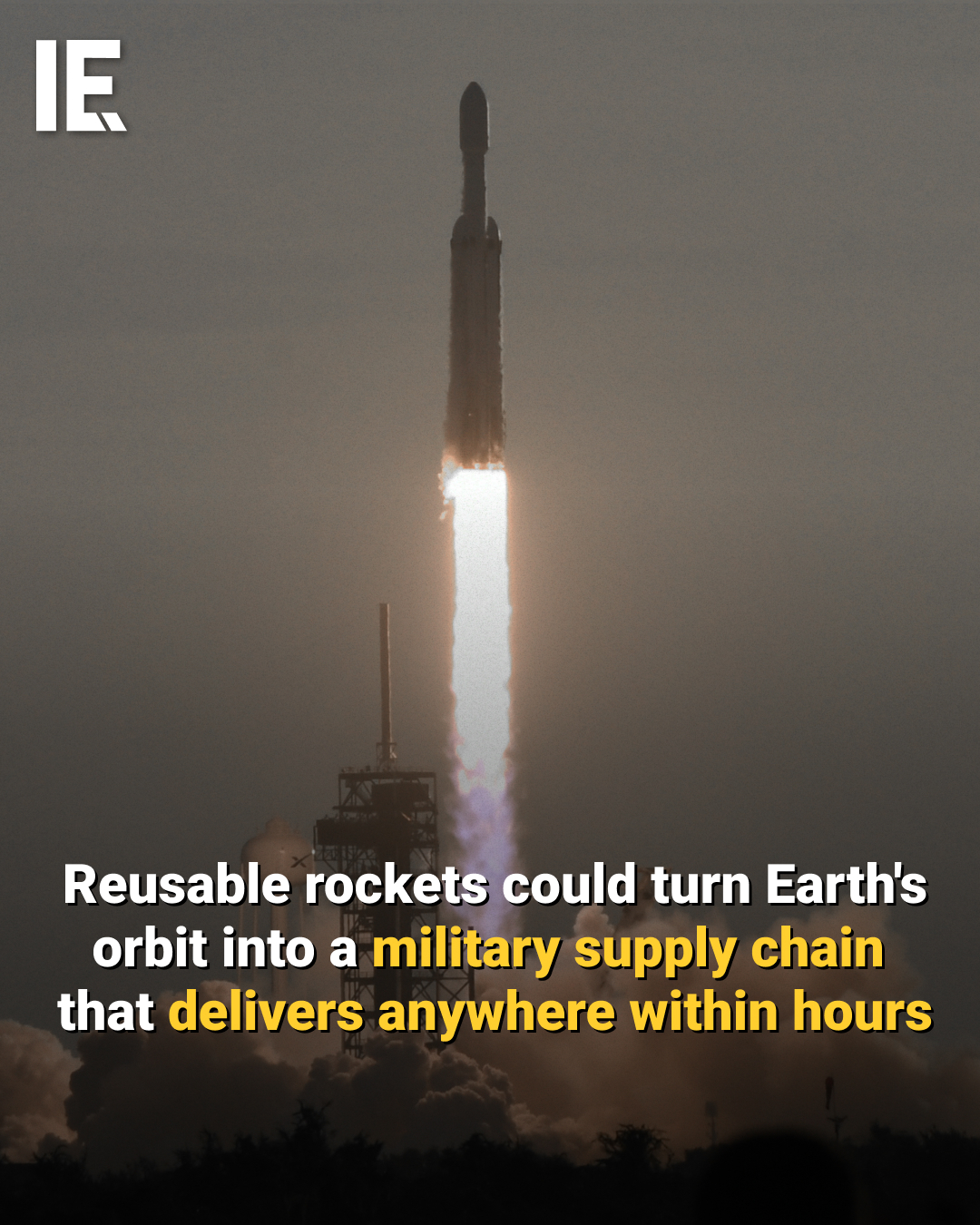
For military strategists, the most exciting conceivable capability — delivering supplies "anywhere within hours" — is not a sci-fi fantasy. The promise of reusable rockets moving cargo to remote corners of the globe — with a potential to radically change the future of logistics — is already within reach. As this increasingly feasible proposition becomes a reality, it presents transformative implications for logistics, with the military being a prime beneficiary.
What are reusable rockets?
A reusable rocket is a type of rocket that can launch payloads into space, land, and then launch again. This is made possible by advance in aerospace engineering. The most prominent feature of a reusable rocket is its capacity to withstand the extreme forces of atmospheric reentry and landing. This means that the rocket does not need to be completely rebuilt after every launch, reducing the cost for each flight. Traditionally, rockets are used to deliver payloads into space and, after completing their mission, discarded. That is a single-use design, which significantly drives up the costs over time. A reusable rocket, on the other hand, transforms the design and economics of space travel. Reusable rockets rely on sophisticated guidance and navigation systems to return and land at a designated site. These rockets are equipped with the ability to adjust their trajectory during atmospheric reentry, stabilizing a descent and a controlled landing. As lift-off and re-entry require a suite of engineering marvels, the promise of repetitive use is a game-changer for the entire industry.
The future of fast global logistics shifts on a rocket trail
The emerging possibility of reusable rockets turning Earth’s orbit into a global, rapid-response military supply chain is a significant milestone, said the caption. This is a real-world development happening now and a trend in the making. This makes possible a scenario where a standard cargo can be transported to any point of the globe within hours. The potential addition of reusable rockets to a transport fleet could revolutionize military logistics across every scale of operation. The prospect of reusable rockets serving as a rapid military logistics network would deliver much-needed supplies to hard-to-reach points. These are areas where traditional transport methods cannot reach or are limited by terrain, climate, or political instability. This break-of-bulk problem has always resulted in significant logistic delays and costs. The stability and responsiveness of such a system could change the very nature of global supply chains. Additionally, the rapid turnaround and multiple use of reusable rockets would significantly enhance the ability to quickly respond emergency situations, such as natural disasters. What could be faster: a cargo flight from Houston to Kathmandu or a reusable rocket from Houston to Kathmandu?.
Making a rocket reusable
The process involves multiple complex launch hardware systems — these include the engines, fuel tanks, and payload.
Aeronautical performance
A reusable rocket is designed to be sturdy and durable to withstand repeated launches, reentry, and landings. The structural design of the rocket must be able to survive the extreme stresses and temperatures during various phases of its mission. The reusable rocket must also be lightweight, though sturdy. This is done through a reduction of weight via materials research and can include lightweight metals. This is done through a reduction of weight via materials research and can include lightweight metals in the construction of the rockets.
Guided landing elements
To make a rocket reusable, guidance, navigation, and control become critical. In contrast to expendable rockets, a reusable rocket must be able to perform a series of maneuvers to control its descent and land safely. Such a rocket needs to be able to re-enter the atmosphere, reduce its velocity to avoid overheating, and maneuver to a landing site. In order to deliver the payload to the right destination, the rocket must be able to control its trajectory to some degree. Additionally, it must also withstand the physical stress of launching and landing in a safe and controlled manner.
Materials research and development
A reusable rocket needs to survive the forces of reentry and impact. Research and development into heat-resistant materials to protect the rocket's internal structure from the intense heat of reentry play a crucial role. The typical materials used in the construction of the spacecraft are aluminum and titanium.
Rethinking the logistics of space travel
In the case of reusable rockets, the logistics of space travel are redefined. The logistics of reusing a rocket instead of building a new one each time can result in reduced costs and increased efficiency. This is both by reducing the waste associated with expendable rockets and by reusing the same hardware multiple times.
Ditching the throw-aways
Dubbed the modern dynamism of flight, reusable rockets offer significant efficiency and cost advantages as compared to conventional, single-use launchers. The most significant benefit of reusable rockets is the cost savings. The cost of building a new rocket for each flight is substantial, and can be tens to hundred of millions of dollars. However, by reusing the same rocket multiple times, a significant portion of these costs can be avoided. This reduces the cost of launching payloads into space. By reducing the cost per flight, reusable rockets make space more accessible. As space missions will become more feasible, we can expect to see more frequent launches and an increase in space-related activities. Given the great potential of reusable rockets, the new milestone of cost reduction may well be the future of space travel.
Accessing the next frontier
Military supply chains are one of the clearest beneficiaries. The logistics industry would be impacted in a significant way by a shift to reusable rockets. Faster and cheaper transportation can lead to significant changes in production, distribution, and inventory management. Always a boon for logistics operations, especially in remote and challenging environments, reusable rockets could lower costs and increase efficiency. Military logistics are complicated by the range of challenging conditions. Reusable rockets can help by delivering necessary supplies quickly to isolated areas. This can be particularly useful in humanitarian efforts, where timely delivery of supplies can make a significant difference. Industries like aerospace, defense, and energy can benefit significantly from reusable rockets. Reusable rockets are capable of launching satellites, cargo, and even people into space and returning safely to Earth. This is why an accessible space logistics chain could become a vital component of the military's global strategy.
Questions readers ask
What makes reusable rockets different from traditional rockets?
Reusable rockets can launch, land, and launch again, unlike traditional single-use rockets. This is possible due to advancements in aerospace engineering that allow these rockets to withstand the extreme forces of atmospheric reentry and landing, making them more cost-effective over time.
How do reusable rockets change the game for military logistics?
Reusable rockets can deliver supplies to remote or hard-to-reach areas within hours, which is a game-changer for military logistics. This capability can significantly reduce logistic delays and costs, especially in areas where traditional transport methods are limited by terrain, climate, or political instability.
Can reusable rockets be used for emergency response besides military logistics?
Yes, the rapid turnaround and multiple use of reusable rockets can enhance the ability to quickly respond to emergency situations, such as natural disasters. For example, a reusable rocket could potentially deliver cargo from Houston to Kathmandu faster than a traditional cargo flight.
What are the key components that make a rocket reusable?
The key components include the engines, fuel tanks, and payload systems. These are designed to be sturdy and durable to withstand repeated launches, reentry, and landings, which is a complex process. The rockets also rely on sophisticated guidance and navigation systems to return and land at a designated site.
What does it mean for the future of global logistics if reusable rockets become widely available?
If reusable rockets become widely available, they could revolutionize global supply chains by enabling rapid-response military supply chains and enhancing the ability to quickly respond to emergency situations. This could change the very nature of global supply chains, making them more stable and responsive.
Related deep dives
Similar reads based on topic and creator.


Recent articles
Fresh deep dives from the latest Reels we unpacked.

Comments
Be the first to comment.