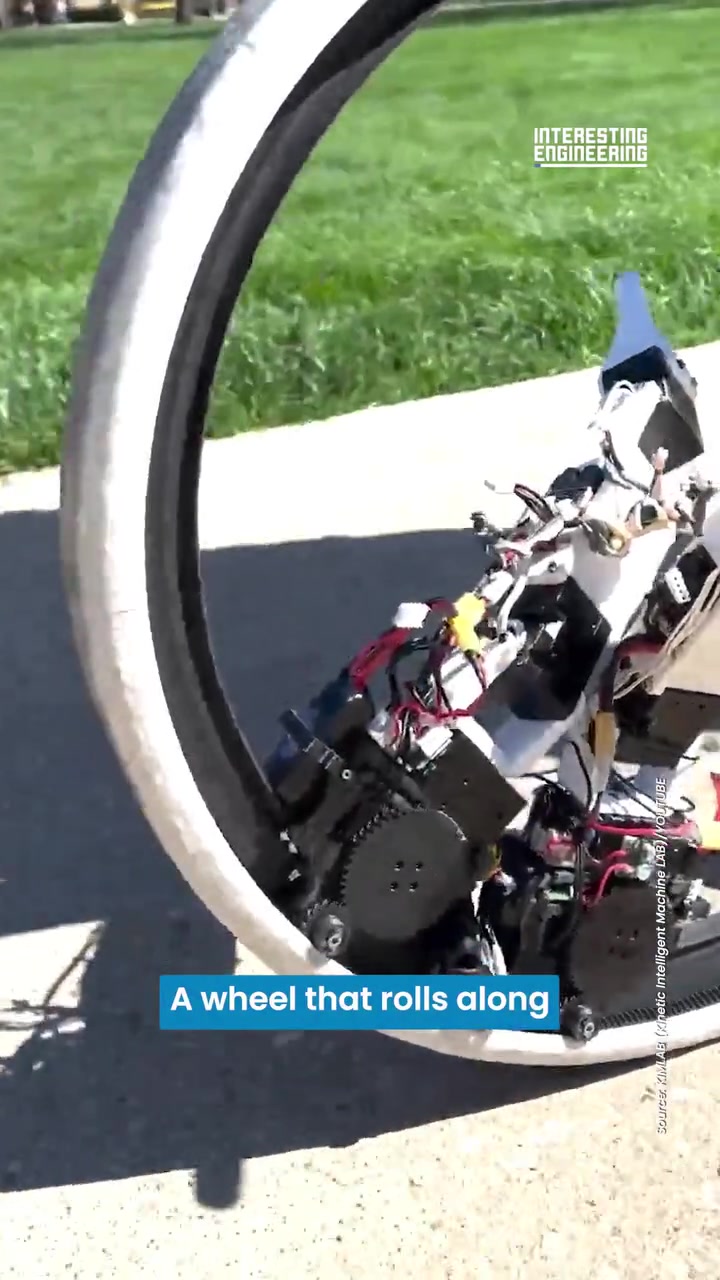
A rolling monocycle morphs into a walking quadruped — the most striking feat of RingBot Quad, a kinetic machine created by KimLab at the University of Illinois Urbana-Champaign. The device switches between a wheel and four legs by flipping its mode.
RingBot Quad: One Wheel, Four Legs
RingBot Quad is a monocycle, a single ring-shaped wheel that serves as both the body and the locomotion device. It lacks a central axle for a motor to turn. Four powered modules inside the ring push it forward by applying torque to the rim. Each module is topped with an articulated leg. If a wheel cannot climb over obstacles, the legs can drop and the ring becomes a frame, a quadruped. The legs walk around a kerb. The front half of the RingBot is just a frame — there's nothing inside it. The first generation of RingBots, in 2024, managed about 5 km an hour on two legs, which were mostly stationary. The robot could be self-balancing or it could lean and turn. Rather than being a wheel or a walker, RingBot Quad is always rolling — even when walking. This gives it a compact footprint, easily turning side to side and helping it stay stable when it's not rolling. When in walking mode, a mode switch is pushed to release the legs. These legs work by coordinating four separate motors, each with its own battery. They can also be used to climb over obstacles. The legs of RingBot Quad are like mistake-proof scaffolding — they deploy when the RingBot is moving slowly or stationary, and they tuck back up when the RingBot is moving faster. During driving mode, the legs stay tucked and shift the weight from side to side. The RingBot leans into a turn. The RingBot's movement is controlled by a computer, adjusting the speed of each motor and the position of the legs — more like a dance than a predetermined path. The RingBot's body is made from steel, giving it the durability needed to withstand the forces it generates.
Rolling up to Social Robotics
What sets RingBot Quad apart from robotics is its not merely a device built for a science museum. It could find applications in social robotics, disaster recovery, or even in the search for extraterrestrial life. Robots capable of traversing all-terrain environments are desirable for tasks such as exploring dangerous or difficult-to-access areas. In some environments, a wheel can flip over or get stuck in mud or sand — but the legs of RingBot Quad help it climb obstacles and get unstuck. RingBot Quad could adapt to multiple environments, from traversing uneven terrain for agricultural management to operating in disaster zones. The robot's adaptability could also support the development of extraterrestrial rovers, capable of traversing alien landscapes. Beyond its practical applications, RingBot Quad serves as an educational tool, showcasing the principles of mechanics, robotics, and control systems.
The Dancing Quadruped
Four Legs and a Wheel
The legs of RingBot Quad are articulated, which allows them to move in a range of motions. Each leg is controlled by a separate motor, and the motors are controlled by a computer. The robot's body is made of steel, giving it the durability needed to withstand the forces it generates.
Modules and Torque
Each module inside the RingBot has its own battery and motor, which push torque into the rim to roll the whole thing. The legs are deployed and released when the RingBot is stationary or moving slowly. In walking mode, the legs take the full weight.
Learn to Move
RingBot Quad evolved from a previous generation of RingBots. The first RingBot, in 2024, moved at five kilometers an hour. It had two legs and the legs were not always in a real stance. The latest Robot that was available, RingBot Quad, managed to move all four legs at once to move the wheels around. The RingBot's movement is a complex process, and the robot must be able to control its speed and the position of its legs.
Walk, Wheel, or Both
The mode flips between the legs and the wheels dropping and taking the full weight of the robot. There is no set path or predetermined way that the robot moves. Instead, the RingBot adjusts its speed and the position of its legs in real-time, based on the environment and the desired path. In driving mode, the legs stay tucked and shift the weight side to side. The RingBot leans into a turn. In walking mode, the legs drop and take the full weight of the robot. The RingBot's movement is a complex process, and the robot must be able to control its speed and the position of its legs. It must also be able to adjust its movement in real-time, based on the environment and the desired path.
A Convincing Concept, if a Bit of a Clunk
- Check the balance. As it rolls, the RingBot must balance the weight of its body. One of the factors that determines whether an object can stand up and balance is its center of mass. The RingBot has a single center of mass in the middle of it, which makes it stable to roll along. But the RingBot can also move by dropping its legs and having them hold up the body.
- Watch for rocks and cracks. The RingBot can navigate over a variety of surfaces, including uneven terrain and obstacles. The legs of the RingBot are capable of lifting the body and the wheel over obstacles and rocks
- Keep an eye on the power supply. The RingBot requires a significant amount of power to operate. The robot has four separate motors, each with its own battery. The motors are controlled by a computer, and the robot's movement is a complex process.
- Be ready to let it solve its own problems. The RingBot is a proof of concept, and it is still being developed. It is a compact robot and is capable of navigating a variety of terrains.
Popping the Wheels with KimLab
The team at KimLab Keeps improving this robot. The first RingBot, in 2024, managed to move at five kilometers an hour. The wireless control is connected to the computer and the legs are powered by a radio control. The robot was shown at the International Conference on Robotics and Automation (ICRA) in Vienna. This robot would likely be improved upon in the coming years. RingBot Quad showcases a unique engineering concept that integrates mechanical components for complex movement patterns. It is a remarkable and graceful demonstration of kinetic machines.
Questions readers ask
What makes RingBot Quad unique compared to other robots?
RingBot Quad stands out because it can seamlessly switch between a monocycle and a four-legged walker. This versatility allows it to handle a variety of terrains and obstacles, making it useful for tasks like disaster recovery or extraterrestrial exploration. Unlike other robots, RingBot Quad is always rolling, even when walking, which helps it maintain stability and maneuverability.
How does RingBot Quad manage to move as a monocycle without a central axle?
RingBot Quad uses four powered modules inside its ring-shaped wheel. These modules apply torque to the rim, pushing the monocycle forward. This design eliminates the need for a central axle and allows for smooth, efficient movement.
What happens when RingBot Quad encounters an obstacle it can't roll over?
When RingBot Quad encounters an obstacle that its wheel can't overcome, it switches to walking mode. The legs deploy from the ring, transforming the device into a quadruped. The legs are controlled by separate motors and can coordinate to climb over obstacles or navigate difficult terrain.
Can RingBot Quad be used for tasks beyond research and education?
Yes, RingBot Quad has practical applications beyond research and education. Its adaptability makes it suitable for social robotics, disaster recovery, and even the search for extraterrestrial life. The robot's ability to traverse various terrains and obstacles could be invaluable in dangerous or difficult-to-access areas.
What materials are used to build RingBot Quad, and why?
RingBot Quad's body is made from steel, chosen for its durability. This material can withstand the forces generated by the robot's movement, ensuring it remains robust and reliable during various tasks.
Related deep dives
Similar reads based on topic and creator.




Recent articles
Fresh deep dives from the latest Reels we unpacked.




Comments
Be the first to comment.