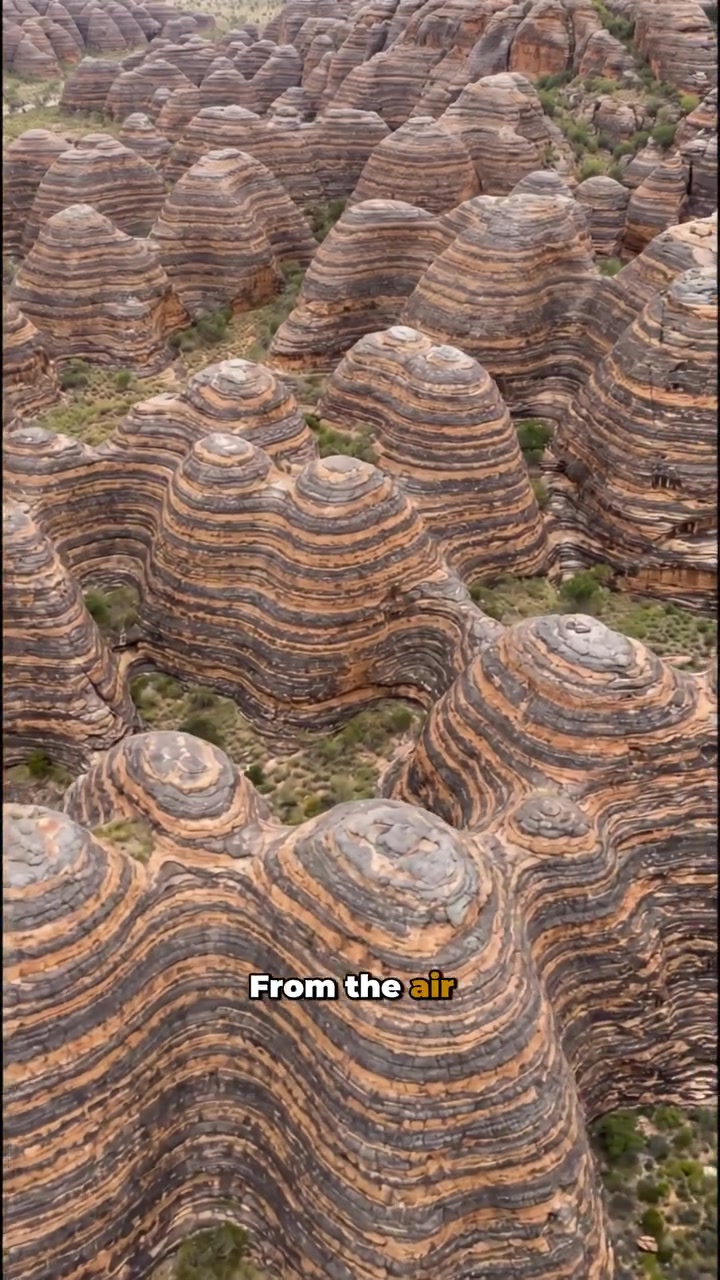
The Bungle Bungles, also known as the Purnululu National Park, is a geological marvel located in the remote Kimberley region of Western Australia, where striped stone towers stretch across 174 square miles of outback. These beehive-shaped domes are a mystery: no human built them, no human painted them, yet they rise from the earth, banded in alternating hues of orange and black. The towers are a result of time, tectonic shifts, wind and rain, and tiny living organisms. The Gija people have lived alongside the formations for more than 20,000 years, and they only began to attract outsider attention in the 1980s. The formations are unique not only for their appearance, but also because of what they represent. Much of the world's most stunning structures require human builders and tools. The Bungle Bungles require only water, sediment, and time.
The Unbuilt Architecture of the Outback
The Bungle Bungles towers are natural geological phenomena, formed millions of years ago from sedimentary rock. The orange and black bands that stripe the towers are layers of differential erosion: orange layers of iron-rich rocks, and black layers of cyanobacteria. These bands run the length of the towers, following geological strata. Over the course of time, the harder rock layers of the formation are exposed and weathered more slowly, thus forming the domes we see today, with softer layers gradually stripped away by wind and rain. The orange layers are formed from iron that oxidizes and stains the porous sandstone, "The orange layers are iron, stained into sandstone that dries out fast." Meanwhile, the black layers are colonies of cyanobacteria, living on the outside of the towers where they absorb moisture. "The dark stripes are alive — they're cyanobacteria, and that living crust is the only thing holding the soft sandstone underneath together; scratch it away, and the tower begins to crumble". Without this living crust, the softer rock layers would erode away much more quickly.
Ancient Landscapes: A World Unseen
The formations are a stark reminder of just how much more there is to the world than human creation. Ancient and unknown, they're only one of many geological wonders that far surpass human construction in terms of age, size, and sheer majesty.
Otherworldly Views
The striped formations tower above the landscape, standing out even in aerial photographs. The towers come in a variety of shapes and sizes, all with their own unique stripes. Each tower is different from its neighbors, but all are united in their striking stripes. The orange and black layers give them their unique look, and even from the ground, the formations are hard to capture with a photograph due to their imposing size. It is easy to feel small among the Bungle Bungles.
The Rock That Holds Life
The Bungle Bungles towers are home to a diversity of wildlife as well. The black stripes on the towers aren't just decoration: they house supportive and healthy colonies of cyanobacteria. They absorb moisture, which then helps to hold the softer sediment in place. The towers would crumble without the support provided by these tiny living beings.
Rocky Residents
The Bungle Bungles are also home to an array of animal life. Ecosystems thrive in the gullies and caves between the towers and birds like peregrine falcons and birds of prey often nest on the highest points, as well as many mammals and reptiles. The towers are a unique and essential habitat for the wildlife in the area. The Bungle Bungles are an entire natural ecosystem and a testament to the tenacity of life in the harsher climates of the Australian outback.
What It Would Be Like to Visit the Land of the Living Towers
The Bungle Bungles towers are located in the Kimberley region of Western Australia. The best time to visit is during the driest season, from April to September. This allows the easiest access to the towers, mainly by 4WD. Make sure to outfit with appropriate hiking gear, water, and enough food and shelter to last the trip. Satellite phones and emergency beacons are also a good idea, as there are no mobile phone towers .There are guided tours available, but those who prefer to hike will also find plenty of trails and routes that will bring them to the most spectacular towers.
- Trail selection: Ranging from 1.5 to 20km, some trails lead you up close and personal to the towers, while others offer longer, more challenging routes.
- Air tours: While staying on the ground will let you experience towers up-close, a helicopter or airplane tour will let you see the scope of the formations, as there are no roads to drive.
- **"Bring a hat and sunscreen: The Kimberly region is intense sunlight. Without protection, you could be very uncomfortable during your visit.
How to be a Steward of the Land
The Purnululu National Park is home to many of the world's most beautiful natural wonders. But they’re also incredibly fragile, and it’s up to the people who visit them to protect them. While vendors and even tour operators will tout the unique experience of climbing the towers, many naturalists and conservation groups suggest that it is best to leave the living Bungles alone. The rock formations are not only susceptible to erosion, but the cyanobacteria living within are easily disrupted. “It looks built. It is not. It looks like rock. It is rock wearing something alive. So what are you actually looking at?” In practice, this means that if you visit the towers of the Bungle Bungles, you are encouraged to stay on established trails and pathways that help prevent the trampling of the vegetation that sustains the towers. It is important to preserve not only the towers but also the delicate ecosystems that thrive in, and near, the towers. As the Gija people have known for 20,000 years, the towers are a sacred and fragile part of the landscape.
Questions readers ask
How did the Bungle Bungles form?
The Bungle Bungles were formed over millions of years through a combination of sedimentary deposition, tectonic shifts, and weathering. The distinct stripes are a result of differential erosion, with orange layers of iron-rich rocks and black layers of cyanobacteria. The harder rock layers erode more slowly, creating the domed shapes we see today.
What role do the cyanobacteria play in the Bungle Bungles?
The cyanobacteria are crucial for the stability of the Bungle Bungles. They form the black layers on the towers, absorbing moisture and helping to hold the softer sandstone layers together. Without these living organisms, the towers would erode much more quickly.
Can visitors climb the Bungle Bungles towers?
There are no official guidelines or designated climbing paths in the park. Climbing the towers is not recommended. The towers are fragile and the cyanobacteria are crucial for their stability, so it’s best to admire them from a distance to preserve this natural wonder.
What kind of wildlife can be found in the Bungle Bungles?
The Bungle Bungles are home to a variety of wildlife, including unique species of birds, reptiles, and mammals. The cyanobacteria on the towers support a diverse ecosystem, and the park is also known for its unique flora, including rare plant species.
How old are the Bungle Bungles?
The Bungle Bungles are estimated to be millions of years old, formed through geological processes that started long before human civilization. The Gija people have lived in the area for over 20,000 years, but the formations themselves are far older.
What makes the Bungle Bungles unique compared to other geological formations?
The Bungle Bungles are unique due to their distinctive striped appearance and the fact that they are entirely natural, formed without human intervention. Unlike many other geological wonders, the Bungle Bungles require only water, sediment, and time to maintain their striking formations.
Are there any other natural formations like the Bungle Bungles in Australia?
While there are other unique geological formations in Australia, such as the Twelve Apostles and Uluru, the Bungle Bungles are distinctive due to their striped appearance and the role of cyanobacteria in their formation. There are no other formations quite like them in Australia or elsewhere in the world.
Related deep dives
Similar reads based on topic and creator.



Recent articles
Fresh deep dives from the latest Reels we unpacked.




Comments
Be the first to comment.