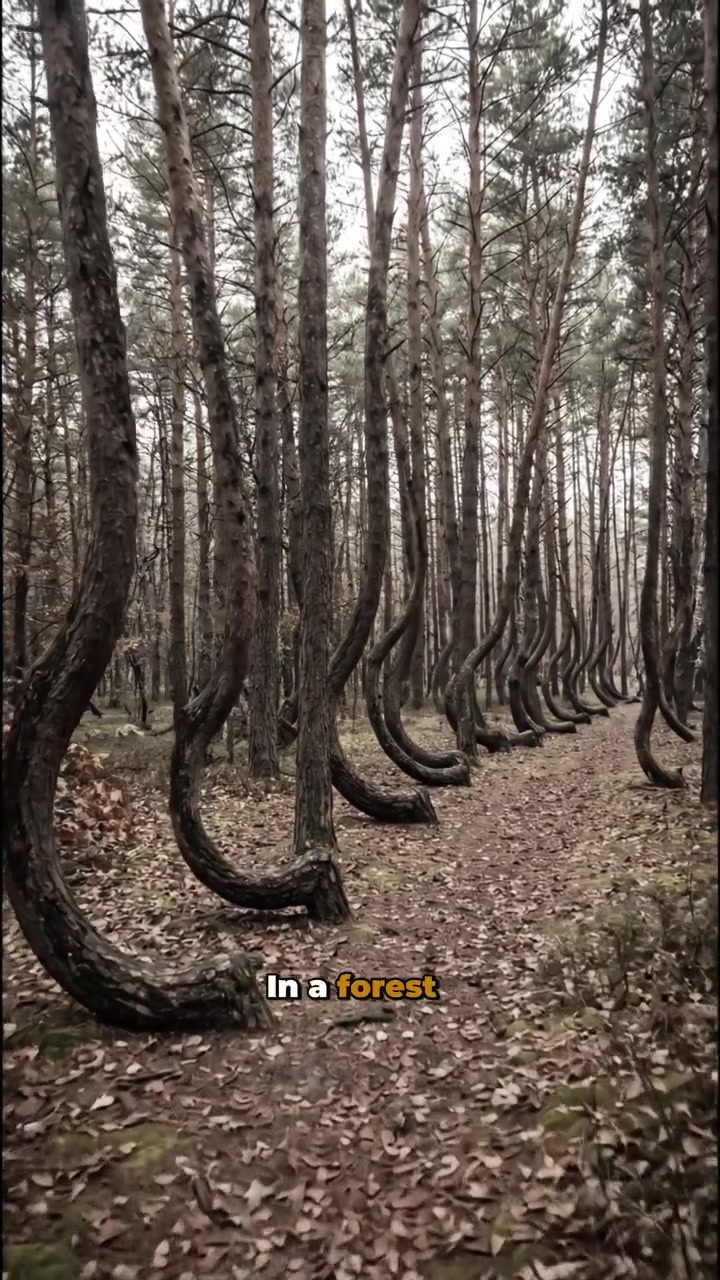
Near the village of Gryfino in Poland, a forest stands as an enigmatic landmark. Amongst the dense trees, 400 pine trunks curve sharply at a 90-degree angle, then ascend skyward in near-perfect uniformity. This forest, known as the Crooked Forest, is a peculiar phenomenon where the trees all bend in the same direction, with other trees in the area growing straight.
Bending truths: what is Crooked Forest? 400 trees bend in sync
The Crooked Forest is an odd natural phenomenon in Poland. Each tree has a distinct 90-degree curve near the base, after which it grows straight upward. This is especially striking because the trees were planted around 1930, and all bend in the exact same shape, all in the same direction. The trunks' uniform curvature is the source of the forest's mystique. All the trees in the area grow straight, but these 400 pine trees all curve in the same direction, like silent but crooked sentinels, each with a unique but identical northern lean. There are many theories for why these trees grew so unusually, but none have been widely accepted as proven facts.
Nature's weirdness: what makes the Crooked Forest unique
The Crooked Forest defies conventional explanations, unlike other unusual forests such as Norway's tilted trees. It is in a relatively undisturbed area, making natural factors like animals or weather the likely source. However, these factors would plant the trees in random directions, not uniformly as in the Crooked Forest. The trees are believed to have been planted around 1930, a time of relative stability. The village around the forest was abandoned during World War II, and the cause of the trees' unusual growth pattern vanished with the villagers. Theories range from manual shaping for timber to environmental causes, but this forest is unique in how the 400 trees don't follow typical explanations.
A closer look: angles of investigation
Planting pattern
When considering the methods of planting, it is clear that whoever planted the trees had a distinct pattern in mind. If the trees were planted naturally, the seedlings and saplings would have grown in random directions. If a farmer bent them for timber, they would be shaped uniformly. However, the exact reason for why the trees were planted in an identical manner and why the planting never spread to other trees is unknown. This suggests that the forest is a product of careful planning and execution.
Theoretical explanations
Several theories attempt to explain the unique curvature of the Crooked Forest. The farmer theory speculates that locals bent the trunks to grow curved wood. However, curvature evidence indicates the trees were either planted in locked soil crevices or directed to curve by manual intervention. Theories point to manual bending for timber or environmental anomalies, such as snow or wind.
Historical ties
World War II disruptions in Poland are puzzling. The trees were planted before the war. However, Polish villages were abandoned during WWII. The villagers who may have answers about what shaped the trees went with them, leaving only mystery.
The March of Mystery: theories to consider
Local farmer
Some speculate that farmers bent the trees to create curved lumber, as this would be a profitable business. However, this theory doesn't account for the exact uniformity of the trees's curvature. While the farmer theory may hold some truth, it suggests a local connection, but the locals may have kept the solution a secret. Theories involving wind or snow fail to explain the uniform curvature of the trees. Wind would have scattered the trees, and snow would have bent them in different directions.
Environmental factors
Natural environmental factors such as wind or snow don't provide suitable explanations for the uniformity of the trees. Wind would have bent the trees at random, and snow would have caused different patterns. Among theories of natural causes, this theory is the one most easily dismissed.
Crooked Forest tours
The Crooked Forest's mystery draws visitors from all over the world, eager to see the site of the peculiar natural phenomenon. The forest is accessible as part of a guided tour, with bus tours available throughout the year. The forest is a popular tourist destination, and visitors can hike among the trees and take in the atmosphere. Visitors should note that since the trees are located in a forest that is not accessible by car, they'll have to walk a while. There is no fee to enter the forest, but the visitor drop-off point is a distance from the forest, and visitors should respect the environment.
Questions readers ask
What exactly causes the trees in the Crooked Forest to bend at such precise angles?
The exact cause of the trees' 90-degree bend is still unknown. However, it is hypothesized that it could be due to manual shaping for timber, or environmental factors like snow or wind. The 400 trees in the forest curve in the exact same shape, all in the same direction, which suggests deliberate intervention. But there is no definitive or widely accepted explanation.
Why do the trees in the Crooked Forest all bend in the same direction?
The uniformity of the trees' direction is one of the most puzzling aspects. While other trees in the area grow straight, these 400 pines all lean northward. This consistency suggests a deliberate and systematic process, whether natural or human-induced, but the exact reason remains a mystery.
When were the trees in the Crooked Forest planted, and why does that matter?
The trees were planted around 1930. This timeline is significant because it predates World War II, during which the surrounding village was abandoned. The villagers who might have known the reason behind the trees' unique growth pattern are no longer there to provide answers.
Are there other forests with similarly bent trees, and if so, how does the Crooked Forest compare?
The Crooked Forest is unique in that no other forest has 400 trees bending in unison at 90-degree angles. Other unusual forests, like Norway's tilted trees, do not exhibit the same level of uniformity or precision in their tree growth patterns.
How have scientists or researchers tried to explain the Crooked Forest phenomenon?
Researchers have proposed several theories, including manual shaping by farmers for timber, environmental anomalies like snow or wind, or the trees being planted in locked soil crevices. However, none of these theories have been widely accepted as the definitive explanation for the trees' unusual growth pattern.
Related deep dives
Similar reads based on topic and creator.




Recent articles
Fresh deep dives from the latest Reels we unpacked.




Comments
Be the first to comment.