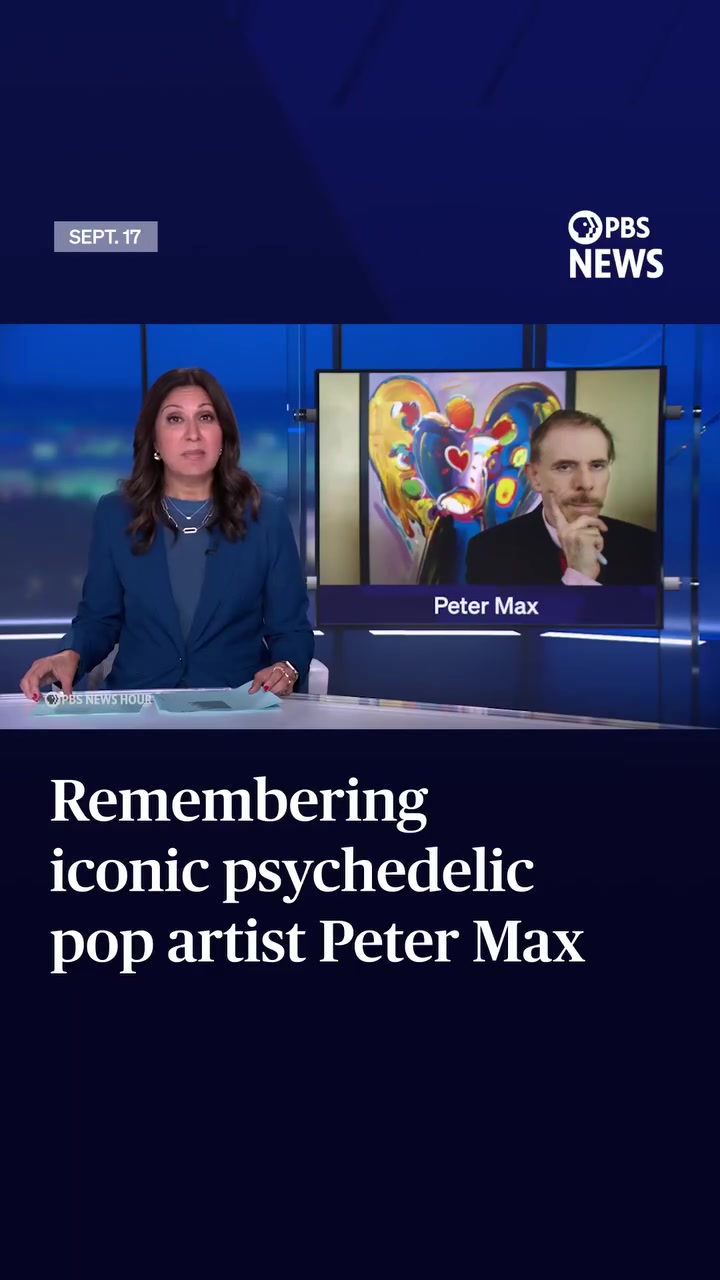
Stunningly bold, vibrant — the psychedelic pop of Peter Max
The artist Peter Max — with his sky-high flower power art — died last week. Viewers of PBS NEWS received a visual feast of swirling brushstrokes, psychedelic landscapes, and vibrant scenes that captured the very essence of the 1960s. His works, from iconic murals to posters and even cruise ships, have a boldness that cannot be overlooked.
Max's distinctive beaming styleWhat it is
At first glance, Peter Max’s art seems wild, vividly unfurling beyond the canvas. However, it’s a specific type of wild. Max's distinct style, psychedelic pop, has a unique composition: a loud mix of bright pinks, blues, and greens. His lines blend into a swirling kaleidoscope of colors, mostly from his palette of geometric shapes. Max took iconic American symbols like the Statue of Liberty or the White House and gave them a vibrant makeover. His art is an antithesis to monotony, a juxtaposition of color and simplicity, standing out from classic art with vividly zesty hues. To call his artwork a 'wake-up call' would be an understatement; it is a full awakening. Max approached his work with a sense of flow: "Sometimes when you're taking a walk, you know where you're going," he said in an interview with PBS in 2013. "Sometimes you're just going for a walk. You don't know where you're going." He didn’t always plan out his pieces in intricate detail. Sometimes he drew spontaneously, letting his creativity unfold on the canvas without a defined plan. At other times, he intuitively knew a painting’s direction as he drew. As a boy, Peter Max was born in Berlin, Germany. But after seeing swastikas in the streets, he and his family fled to Israel. Young Peter Max fled again, for the US, in 1938, aged 14, and settled in New York. This turbulence may have only fueled his creativity. It was in New York that he perfected his art. He took inspiration from his surroundings, translating the iconic — and the mundane — into a vivid, colorful world. Max's art is a love letter to the 1960s and boomer culture, portraying the era’s values vividly through bold, vibrant strokes.
The 1960s streakMax’s art echoes a cultural wave
This style has a deeper meaning beyond blues and pinks. Peter Max’s psychedelic pop art mirrors the counterculture movement in the 1960s. The "flower power" movement embraced peace and love, and Max's art was a visual manifestation of this sentiment. His work embodies the era's spirit — where imagination took flight, and creativity flourished. The freedom and rebellion of the 1960s were reflected in his art. Max himself was a witness to and participant in the burgeoning counterculture. His work didn’t just follow trends, but was an active reflection of societal values. Max's vibrant pop art captured the essence of the hippie movement, making it a timeless icon. From rock posters to cruise ships, Max's work left a mark on the decade and the culture.
The Max collectionThe intricate brushstroke
Peter Max created an astonishing 50 million pieces of art. This includes posters, postage stamps, posters, and even cruise ship facades, which you might have seen in your mail or on your vacay. Max's brushstroke was a dreamy, kaleidoscopic journey, capturing the vibrant essence of the 1960s. His work adorned everything from small posters to an enormous cruise ship and even a plane. Max’s versatility was likely why he became an international sensation, with art seen all over the world. The depth of his work was also groundbreaking. Max's canvases often depicted more than meets the eye. The artist often hid small details within his paintings, encouraging viewers to explore and find them.
The Max ProcessA stroke-by-stroke guide
Max's process often began with a flash of inspiration. He would start drawing, letting his creativity flow. However, sometimes his work began with a theme, such as his iconic portrait of US President Kennedy. “When I drew this, I didn’t know what I was drawing,” he once explained. “But I drew a planet and another big planet and something the size of Earth with a big sage behind there, you know, and I just loved where I went with it“.
Max's worksThe range of Splendor
Max’s psychedelic style lent itself to many themes. His interpretations of iconic scenes, such as the Statue of Liberty or the U.S. Presidents, are instantly recognizable. However, Max's art wasn't confined to just American history, for example, his portrait of the Taylor Swift. Max’s work is — or was — a blend of simplicity and complexity. His use of bright colors and geometric patterns in tandem with simple scenarios created an artwork that seems to come to life. This explosion of vivid colors, whirls, and swirls offered a show-stopping visual experience.
* Discovering Peter Max’s Magic*
Peter Max’s success exists in his intermingling of art and everyday objects. If you’re looking for some Max pieces, you have a few options:
- The Internet: Check out sites like eBay or Etsy. Here, you can find prints, posters, and art by Peter Max (or replicas, at least).
- Exhibitions: Take a trip to exhibits showcasing his work. Sometimes you might find them in local galleries or museum exhibitions. For example, the Mystical Art of Peter Max at the American Culture Museum.
- Art Collectors: Baer Maxwell’s private collection is also a rich repository of Max’s art. However, it might take some extra digging to get in.
- Pieces: The most common items with Max’s artwork are postcards, prints, posters, and mugs. They might not always be easy to find, but if you’re on the lookout, you might come across some.
The Max legacyLooking at the bright side
Peter Max's works continue to live vibrantly; viewed in museums, collections, and on everyday household items. It is a testament to his enduring legacy and artistic prowess. Max’s art, magical and dreamlike, lives on in vibrant hues, interpreting the past, and leaving us with a feeling of warmth and hope. You might see a muse in his abstract landscapes, or a hint of joy — seemingly timeless. The work of Peter Max — his unique style, and the impact he has had on the art world — continues to inspire and intrigue. His influence is evident in today's art, music, and even fashion. As we pay tribute to the life and work of Peter Max, let us also celebrate his enduring legacy, a beacon of hope and inspiration. Max didn’t just breathe life into the canvas, but into the lives of many.
Questions readers ask
What exactly is psychedelic pop art, and how does Peter Max's work fit into this category?
Psychedelic pop art is a genre that combines vibrant colors, swirling patterns, and often includes geometric shapes. Peter Max's work fits into this category because of his use of bright, contrasting colors and his unique, flowing style. He took iconic American symbols and gave them a psychedelic makeover, making his art instantly recognizable as psychedelic pop.
How did Peter Max's early life experiences influence his art?
Peter Max's early life was marked by turbulence, fleeing Nazi Germany and then moving to the US. These experiences may have influenced his art by fueling his creativity and giving him a unique perspective. His art often reflects the values and spirit of the 1960s, a time when he was living in New York and perfecting his craft.
What made Peter Max's art so distinctive?
Peter Max's art is distinctive due to its bold, vibrant colors and swirling, kaleidoscopic patterns. He often used geometric shapes and transformed iconic American symbols into vivid, colorful pieces. His spontaneous and intuitive approach to art also set him apart, as he sometimes didn't have a predefined plan for his pieces.
How did Peter Max's art reflect the cultural values of the 1960s?
Peter Max's art was a visual manifestation of the 'flower power' movement and the counterculture of the 1960s. His work embodied the era's spirit of peace, love, and creativity. It reflected the freedom and rebellion of the time, making it a timeless icon of the hippie movement.
What kinds of art did Peter Max create?
Peter Max created a wide range of art, including posters, postage stamps, and even cruise ship facades. His work was incredibly prolific, with an estimated 50 million pieces created throughout his career. His art can be found in various mediums, from iconic murals to everyday items like postage stamps.
Related deep dives
Similar reads based on topic and creator.

Recent articles
Fresh deep dives from the latest Reels we unpacked.



Comments
Be the first to comment.