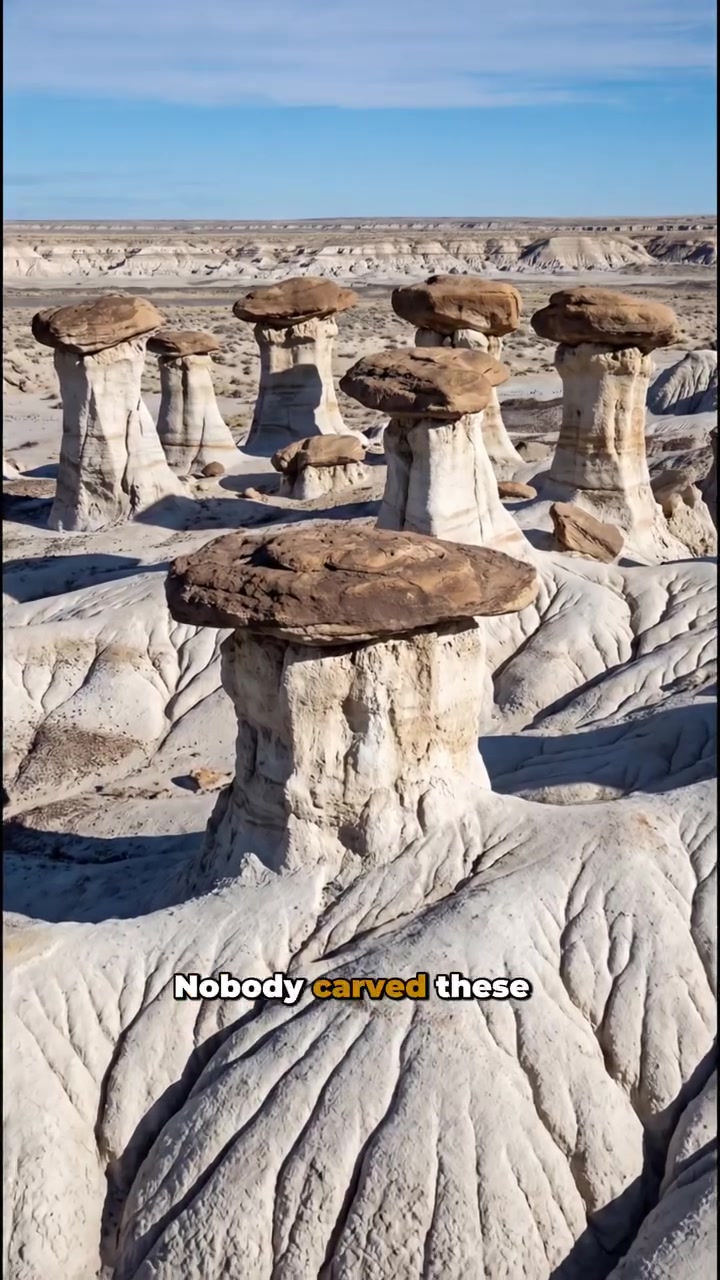
The badlands of northwestern New Mexico hide more than a post-apocalyptic landscape. Hidden in the massive rock formations is a 74-million-year-old story.
The Sculpted Rocks of Bisti
These rocks, which are common in the Bisti Badlands of New Mexico, appear hand-carved, to say they are magnificent is an understatement. They are sculpted into mushroom shapes, their tops capping layers of soft sandstone. Once they stood taller, but the wind and rain have slowly worn away at them, leaving behind only what the wind could not reach, creating these natural wonders. These sagas etched into stone can be traced back to the Late Cretaceous Period. 74 million years ago, when "this desert was a maze of swamps and rivers along the shore of an inland sea” and “the bones of its creatures are still buried here." Their bones survived the million-year process that turned their ancient world into the barren landscape it is today, these are the rocks that show us their stories. It is not the land’s beauty that makes it so interesting, it is its life. This was a place that was full of life — and death. The very rock is a history book. The bones of animals that lived here can still be found in the rock. These formations were once a swampland where the dinosaurs roamed. One of these dinosaurs was a tyrannosaur found in 1997, and it shares a story of its own. The gargantuan beast, about 30 feet long and weighing roughly three tons, was discovered by a volunteer on a weekend fossil trip. It was so large and so heavy that the Army National Guard had to airlift the bones out, carrying them by helicopter. These bones have revealed stories of the tyrannosaurs’ life and “the wounds it lived through".
The Mysteries of the Prehistoric Fossil Record
The discovery of the dinosaur’s bones and its distinctive scars has long piqued the curiosity of scientists in the fossil community. The mystery concerning the unknown attacker is intertwined with the broader efforts of paleontologists to uncover the details of the ancient world. Prehistoric life is a rich tapestry of predator and prey, and the Bisti Beast is a crucial thread weaving through the fabric of this geological record. The peculiar absence of other large carnivores from the fossil record of the same period has left scientists puzzled. According to the New Mexico Museum of Natural History, this tyrannosaur was not the only one carrying the scars of a life and death struggle. Other adolescent specimens carry similar scars. How they survived these battles is more than a mystery. One hypothesis suggests that the tyrannosaurs' distinctive hunting techniques and anatomical features, could have contributed to their survival. "They were ambush predators, well-adapted to taking down even larger prey. Hunting in packs could have been a successful strategy, allowing them to take down prey much larger than themselves, and another dinosaur may have been the answer. However, the hardened skulls and sharp teeth of other predators such as the allosaurus could have been fatal for a 30-foot predator.
The Mysterious Life of the Triceratops
The most popular of the herds they hunt was the Triceratops, a horned herbivore that could weigh up to 12 tons. It is a natural conclusion that the Triceratops would have been a meal for the T-Rex. The Triceratops is known for its distinctive physical features, which could have been adaptive for its environment. Its three massive horns on its skull and its oversized, toothless beak, the fossil record shows that the Triceratops was definitely prey for the T-Rex. The film shows a bone within which lies a fossilized animal skull. The scene transitions to the audience being shown different types of rocks and hills, highlighting the geological marvels of the Bisti Badlands. The final shot is a close-up of a Triceratops skull.
The Hunt Continues
The fossil record does not just show a snapshot of the lives of the animals but their predators as well. To understand the predator-prey relationship, we need to consider the early Cretaceous period. The Triceratops’ defenses were distinctly unique. Triceratops was herbivores with thick skin. Scientists believe they may have hunted in packs. The Triceratops's large, bony frills and horns provided them with protection against predators. The Triceratops's horns, which were used for fighting, bled the predator. Some theories suggest that the horns of the Triceratops may have been used for fighting between each other, but not as a centerline for predators. The Triceratops’s horns were located on the sides of its skull, and scientists believe the horns were used in combat.
Killing Machines
One hypothesis posits that these scars could have originated from saber-toothed predators, the dinosaur closest in body size and hunting technique to a T-Rex. These hunters were equipped with retractable saber teeth that could slay even the largest prey—such as a giant predator. Their hunting techniques could have resulted in significant wounds. The Triceratops's thick skin provided some protection, but it could not provide enough defense against the Tyrant Lizard King's sharp teeth. The bones of the Triceratops show evidence of horrendous injuries; their predators likely had distinctive hunting techniques that allowed them to defeat such large prey.
Surviving Predators
This stubborn fight shows the story of these giants. So what could wound a 30-foot predator and let it live? There are a few theories, but they are all just that — theories. “The wounds it lived through. A younger one, about half its size, also carries scar” The Bisti Beast, later named Bistahieversor sealeyi, was an intriguing find. The unusual discovery of another young tyrannosaur with similar scars raises further questions. Was it an accident, or evidence of a dangerous habitat? Was I the result of a territorial fight or a wounded animal?" The New Mexico Museum of Natural History announced the discovery of this particular specimen." They added that the scars were evidence that these tyrannosaurs were hunters.
The Timeline of Discovery
In 1997, a volunteer on a weekend fossil trip found a site. It was a tyrannosaur, about 30 feet long and around three tons. The spot was so remote that the Army National Guard had to airlift the bones out of the site so that it would be available for study. The National Guard discovered the fossilized remains of the tyrannosaur. The volcanic rock surrounding the skull is indicative of a "stratigraphic layering". The Tyrannosaurus rex is a ground-dwelling creature, and the strata indicate that the ground was flat and low and wet. The volcanic rock layers would indicate that the t-rex lived in a V-shape formation of islands and volcanoes. The badlands of northwestern New Mexico are full of strange formations, the most unusual of which are the mushroom-shaped rock formations. They are all made of sandstone, which is much softer than the surrounding volcanic rock which shields them from the wind and rain water erosion. This sandstone is also much lighter and more porous than the surrounding rock, which allows the wind and rain to erode the surrounding rock, but the sandstone remains.
Planning Your Trip to the Bisti Badlands
The Bisti Badlands is never a long drive, but it is always best to stop by the trailhead and get yourself ready for the wild ride. If you are driving in the summer you will need a truck or a high-clearance vehicle, and you can even look forward to the thrill of the splash of a season. If you are a walker, you are walking into an unforgettable experience. If you are a solo traveller, go to the visitor center and get a map, and you can check with the locals, but leave out your car. The park is not fenced in, so it is best to check with a ranger. In the summer, you can expect to start with a hike. Locals know that the best way to avoid the scorching sun is to carry an umbrella. In the summer, you can drive the Bisti and the De-Na-Zin Wilderness parks, but you must first see the visitor center and get an area map. Heed all signs and stay on trails if you are a solo traveler. You can get to the Bisti from everywhere, but the best way to avoid the heat is to visit during the morning and evening hours and go hiking in the afternoon. The visitor center is open all year, and you can call ahead for hours. The Bisti maps are free, but you will have to ask for a map, and the maps are available as a brochure. If there is a wildfire, you can check road closings and other restrictions. Check the local fire risk and weather before you go, and you may also want to check the road conditions before you go to the Bisti. The Bisti Badlands are designated as a wilderness area, so make sure you have a good water source and other supplies. In the summer, you can camp in and near the Bisti Badlands. This summer the summer fires made it difficult to go to the wilderness area, but the National Park Service has lifted the closure, and you can now return to your hike.
Questions readers ask
What makes the Bisti Badlands unique compared to other badlands?
The Bisti Badlands in New Mexico are unique due to their ancient fossils and geological formations. The rocks here are sculpted into distinctive shapes by wind and rain, and they contain a rich record of life from the Late Cretaceous Period. This includes the discovery of a 30-foot tyrannosaur, which provides insights into the ancient ecosystem and the creatures that once roamed the area.
How were the fossils in Bisti Badlands preserved for so long?
The fossils in Bisti Badlands have been preserved for millions of years due to the slow process of erosion and the unique geological conditions. The rock formations were once part of a swampland, and the bones of the creatures that lived there were buried and preserved over time. This process turned the ancient world into the barren landscape we see today, but the fossils remain intact, providing a window into the past.
What do the scars on the tyrannosaur fossils tell us about prehistoric life?
The scars on the tyrannosaur fossils found in Bisti Badlands reveal the violent and competitive nature of prehistoric life. These scars suggest that the tyrannosaurs engaged in fierce battles, possibly with other large predators or rivals. The fact that these scars were found on both adult and adolescent specimens indicates that these battles were a common and crucial part of their survival, and have provided scientists with valuable insights into the predator-prey dynamics of the Late Cretaceous Period.
How were the tyrannosaur fossils discovered and extracted from Bisti Badlands?
The tyrannosaur fossils were discovered by a volunteer on a weekend fossil trip in 1997. Due to their size and weight, the bones required special extraction methods. The Army National Guard had to airlift the bones out using a helicopter, highlighting the significance and challenge of recovering such large and important specimens.
What makes the discovery of the tyrannosaur in Bisti Badlands significant?
The discovery of the tyrannosaur in Bisti Badlands is significant for several reasons. Firstly, it provides a rare glimpse into the life of one of the most iconic dinosaurs. Secondly, its distinctive scars offer insights into the predatory behaviors and survival strategies of these creatures. Lastly, the discovery has sparked ongoing scientific research into the broader ecosystem of the Late Cretaceous Period, making it a pivotal find in paleontology.
Related deep dives
Similar reads based on topic and creator.




Recent articles
Fresh deep dives from the latest Reels we unpacked.



Comments
Be the first to comment.