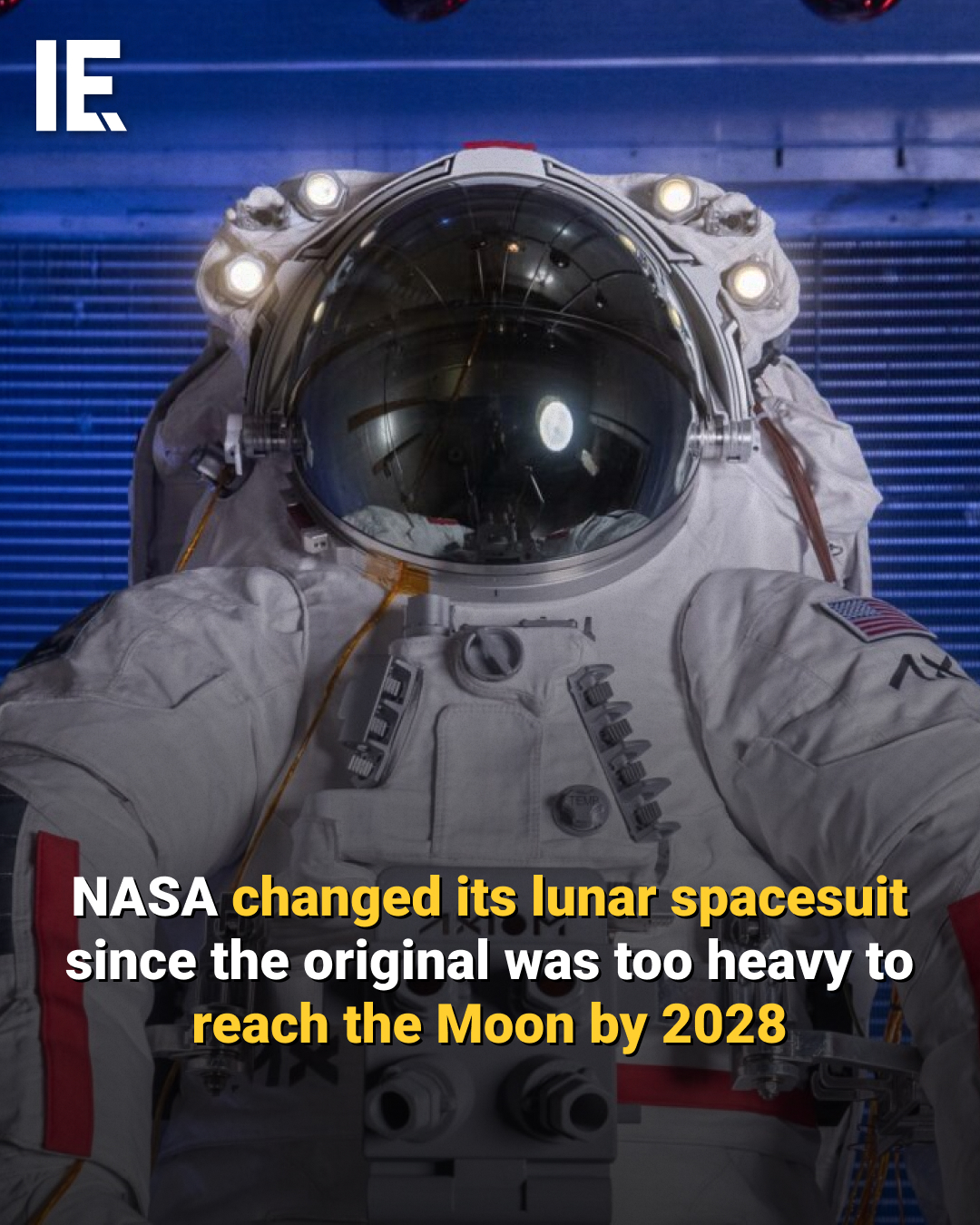
NASA has redesigned lunar spacesuits. Text overlay states, "NASA changed its lunar spacesuit since the original was too heavy to reach the Moon by 2028." As NASA prepares to re-establish a human presence on the Moon, including efforts to send the first woman lunar astronaut, weight is a major factor. In the 1960s NASA took a similar approach to suit re-design for the Apollo program.
The Spacesuit that Blazes a Trail to the Lunar Surface
The astronauts in the Apollo program used a suit that was designed for spacewalks in microgravity. The Apollo suit was a custom version of the pressure suit of the United States Air Force. NASA has improved the suit, but some of the key elements remain the same. The spacesuit is a mobile life support system for an astronaut operating outside their spacecraft. The suit operates as a micro-environment to keep the astronaut alive and healthy under harsh extraterrestrial conditions. The original NASA suit weighed 179 pounds (81 kg) without life support. The new lunar suit could weigh up to 220 pounds (100 kg). The new design includes a joint bearing system that allows the astronauts to walk, bend, kneel, and explore the lunar surface more efficiently. The sleeves are designed to bend backwards. There are more joints in the new suit to provide a greater range of flexibility. The goal of the 2028 mission is to build upon the knowledge and technology gained during the Apollo program. With the new suit, NASA will be able to do so more efficiently. The new suit is designed to facilitate movement across lunar soil, handle lunar rocks and dust, and reduce fatigue and discomfort. There are four parts of a functional spacesuit: The suit
- It is a shell for the astronaut and provides mobility and protection. The primary life support system (PLSS)
- It is the backpack and provides oxygen, cooling and removes carbon dioxide. The liquid cooling and ventilation garment (LCVG)
- It is made of synthetic fabric and is worn underneath the suit. The thermal garment
- It is a combination of the PLSS and LCVG, and is designed to keep the astronaut comfortable.
A Spacesuit Tailored to Lunar Terrain
Spacesuits have been modernized over the years to adapt to the needs of missions. More than 50 years ago, astronauts from the Apollo program performed spacewalk operations with the Apollo astronaut suit. NASA spent more than 1 million dollars to create and test the suit. As NASA prepares to venture to the Moon in 2028, the goal is to explore the lunar surface with a suit that is flexible and allows the astronauts to move efficiently. The Apollo suit is space-optimized to provide the astronauts with the mobility to navigate around the lunar surface. NASA's new suit is designed to offer a greater degree of flexibility and support as astronauts perform tasks on the lunar surface. The new design is meant to be more efficient, comfortable, and flexible. The suit allows for a greater range of flexibility and supports complex tasks that must be performed in low gravity or zero gravity. The new suit allows the astronauts to walk, bend, kneel, and explore the lunar surface more efficiently and reduce the potential for injury.
The Art of Mobility
Astronauts in space live and work in zero gravity. Sucking is the key to keeping astronauts alive. It is one of the most important factors to consider when astronauts go on spacewalks. To thrive in space, astronauts need to keep their health under control. Since there is no gravity in space, the astronauts need to maintain their posture, work, and health. Sucking is essential for astronauts to breathe. Sucking is a key element to assist astronauts during their operation.
Adapting for the Moon’s Low-gravity
The helmet of the new suit is a sphere of composite material that weighs less than a kilogram. The visor of the helmet is made of a special material that can withstand the pressure of the lunar surface. The helmet is connected to the suit using a hydraulic fitting that allows for liquid suction. The helmet is connected to the suit at the neck. It is connected to a duct that allows for the flow of liquid. The suit has a safety switch, which allows the astronaut to maintain the suit's flexibility while moving.
Challenges and Risks
The new spacesuit is riskier to reduce. The new design has many new components that are more complex and expensive to develop and validate. New challenges with the development of the new suit is a lunar dust that can cause problems including for the joints and seals
What the astronauts will need
The improved quality and mobility of the new suit will give NASA a strong point to consider the new spacesuit for lunar missions in the future. The suit is for astronauts to work effectively on the lunar surface. The suit is designed to help astronauts carry out a range of tasks on the lunar surface, such as collecting samples and performing experiments. The suit is designed for the astronaut to work on the lunar surface, which is important for future lunar missions.
If you’re the first woman to walk on the moon
Questions readers ask
How does the new lunar spacesuit differ from the Apollo-era suit?
The new lunar spacesuit is designed to be more flexible and efficient for exploring the lunar surface. It includes a joint bearing system that allows for better mobility, such as walking, bending, and kneeling. The new suit also has more joints and sleeves that bend backward, providing a greater range of motion compared to the Apollo suit, which was primarily designed for spacewalks in microgravity.
Why is weight a critical factor in designing the new lunar spacesuit?
Weight is a major factor because the new suit needs to be light enough to facilitate lunar exploration efficiently. The original Apollo suit weighed 179 pounds without life support, and the new suit could weigh up to 220 pounds. Reducing weight helps in managing fuel consumption and overall mission efficiency, which is crucial for the 2028 mission.
What are the key components of the new lunar spacesuit?
The new lunar spacesuit consists of four main parts: the suit itself, which provides mobility and protection; the primary life support system (PLSS), a backpack that supplies oxygen and removes carbon dioxide; the liquid cooling and ventilation garment (LCVG), worn underneath the suit; and the thermal garment, which combines the PLSS and LCVG to keep the astronaut comfortable.
How does the new spacesuit handle the challenges of the lunar terrain?
The new spacesuit is designed to facilitate movement across lunar soil, handle lunar rocks and dust, and reduce fatigue and discomfort. It includes features like a joint bearing system and more flexible joints, which allow astronauts to perform complex tasks more efficiently in the low gravity of the lunar surface.
What is the goal of the 2028 mission in relation to the new lunar spacesuit?
The goal of the 2028 mission is to build upon the knowledge and technology gained during the Apollo program. With the new spacesuit, NASA aims to explore the lunar surface more efficiently, allowing astronauts to perform tasks with greater flexibility and comfort.
Related deep dives
Similar reads based on topic and creator.




Recent articles
Fresh deep dives from the latest Reels we unpacked.




Comments
Be the first to comment.