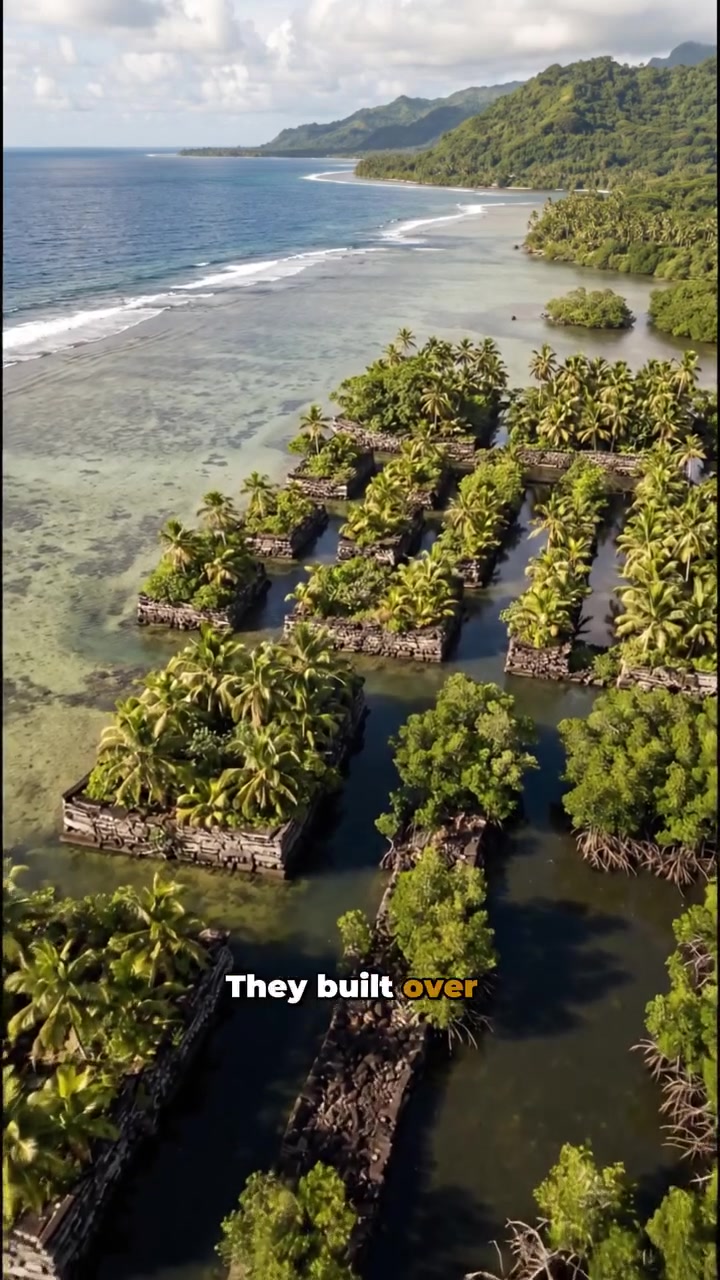
Off the coast of Pohnpei in Micronesia, there's no lost city of Atlantis. Nan Madol, however, is no legend. This ancient wonder comprises 92 artificial islands built on top of a coral reef. It's a place where 750,000 tons of basalt columns were carefully placed by an advanced civilization, with no mortar, and vehicles or animals to help. The only problem: no one knows how. Nan Madol remains one of the most confounding archaeological mysteries in history.
The Venice of the Pacific
Nan Madol, often called the "Venice of the Pacific," is a city built by a mysterious ancient civilization. It consists of over 90 artificial islands, which were constructed by stacking massive basalt columns. The city's islands are separated by canals, which were navigated by canoe, and the walls are made of columns laid down like logs. They are placed in a crosswise pattern, alternating directions around the city. Loose stones are used to fill the gaps, with no mortar. The heaviest columns weigh up to 50 tons and were transported from quarries and dropped into the coral reef. The city is an architectural marvel to start. The basalt columns were originally quarried on the opposite side of the island. The heaviest stones weigh approximately 50 tons and the structure features 750,000 tons of stone. The walls are not simply carved blocks, but massive columns of basalt, stacked like logs with alternating horizontal and vertical layers. It is a sophisticated example of advanced engineering and mathematics.
The Stonework of a Vanished Civilization
Consider the location and the materials. Coral reefs are actually made of limestone, not basalt. Michelet's quarry source is even more dramatic. The basalt came from the other side of the island. These massive stones were then transported and dropped into the lagoon. It is an impressive feat for ancient builders wanting to build a civilization on a coral reef. They moved these massive blocks of basalt without any mortar, and none of the islands are made by cutting the basalt in stone blocks. There are no such motors, or carts, or animals were used to move these stones. Nan Madol poses a significant puzzle. "The U.S. National Park Service says exactly how these giant columns were moved across water and stacked into the lagoon with a single word: 'unknown.'"
Building Techniques for Ancient Concrete Construction
The builders of Nan Madol employed a few techniques that contribute to its enduring mystery. For instance, there are no carved stone blocks used in the city. Columns are stacked in a crosswise pattern, alternating between horizontal and vertical layers. This technique creates a stable structure without the need for mortar. The builders also filled gaps between columns with loose stones by hand. Up to 50 tons of stone were moved by the builders. They had no vehicles, animals, or wheels. Nan Madol stands out for this type of building techniques.
Moving Stones Without Machinery
The fact the builders of Nan Madol moved these stones is one of the significant mysteries. How did builders move stones weighing up to 50 tons without animals, vehicles, or wheels? There are no written records or clues to help scientists answer that question. Only one written record gives a clue: a legend that two brothers could simply make the stones fly through the air. The mystery deepens with the realization that geologically, coral reefs do not provide basalt. Tall basalt columns were transported across the coral reefs for 400 years. They had to transport the materials from elsewhere in the island. No one can give a definite answer, however, to how the basalt was transported.
Floating on the Water
Tropical vegetation helps to hide these city ruins. They show the precision and complexity of the structures. The structures have stood the test of time. They have survived since ship captains first reported their existence to the world in the 18th and 19th centuries. Archaeologists believe that Nan Madol was inhabited from the 8th to the 16th centuries.
How You Can See Nan Madol
To experience Nan Madol, travelers should plan a visit to the island of Pohnpei. Micronesia is the destination. Plane rides are available from Guam or Tokyo, which are the closest airports. The destination is a UNESCO World Heritage Site. It is no secret that Nan Madol's structure hosts the most mysterious ancient civilization. Visiting this place means getting a chance to see some of the world's most enduring mysteries with a diving tour.
Questions readers ask
How did the ancient builders of Nan Madol manage to move such heavy stones without modern machinery or animals?
The builders of Nan Madol moved stones weighing up to 50 tons without any machinery, animals, or wheels, making it one of the most puzzling aspects of the site. The exact methods used remain unknown, but the precision and scale of the construction suggest advanced engineering and organizational skills.
Why is Nan Madol often referred to as the 'Venice of the Pacific'?
Nan Madol is called the 'Venice of the Pacific' because, like Venice, it is a city built on water. It consists of 92 artificial islands constructed on a coral reef, with canals separating the islands, which were navigated by canoe. This unique layout gives it a Venetian-like feel, despite being located in Micronesia.
What materials were used to build Nan Madol, and where did they come from?
Nan Madol was built using massive basalt columns, each weighing up to 50 tons. These columns were quarried on the opposite side of the island from where they were used. The builders transported these stones and placed them on the coral reef without using mortar, creating a stable structure by stacking the columns in a crosswise pattern.
What makes Nan Madol's construction methods so unique and mysterious?
Nan Madol's construction methods are unique because the builders used large basalt columns without mortar, and they moved these columns without any animals, vehicles, or wheels. The precise techniques for moving and placing these stones remain unknown, adding to the site's mystery. The advanced engineering and mathematical skills required to build the city are also noteworthy.
Is Nan Madol accessible to visitors, and if so, how can one get there?
Nan Madol is located off the coast of Pohnpei in Micronesia. It is accessible to visitors, but getting there requires traveling to Pohnpei and then arranging a boat trip to the site. The journey involves navigating through the coral reefs and canals, much like the ancient inhabitants did. Guided tours are available for those interested in exploring this ancient wonder.
Related deep dives
Similar reads based on topic and creator.



Recent articles
Fresh deep dives from the latest Reels we unpacked.




Comments
Be the first to comment.