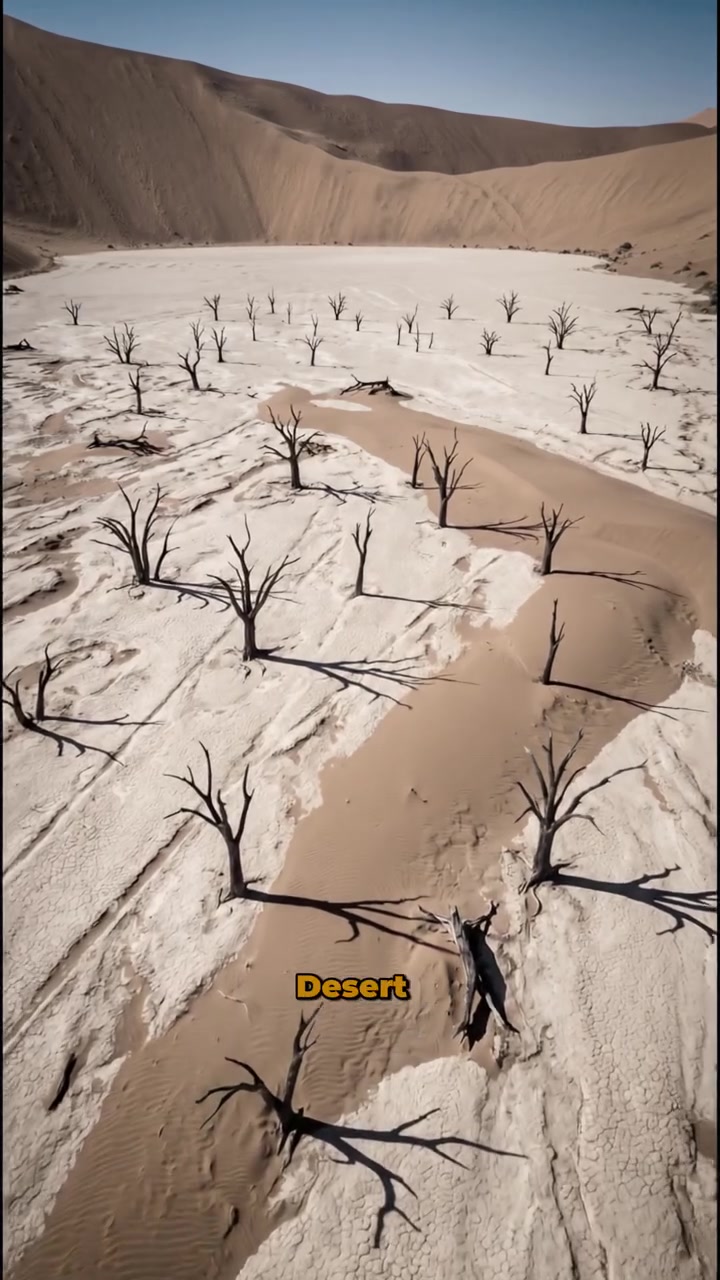
In the Namib Desert of Namibia, a ghostly forest stands defiant. For centuries, trees have remained upright, even though they died 600 years ago. They never turned to stone; they stand as stark silhouettes against the stark beauty of the desert. These trees, known as black camel thorn acacias in Deadvlei, are a stark contrast to their surroundings, a vast white clay pan surrounded by dunes with white sand and cracked earth — one of the highest concentrations of dunes in the world. In the Namib Desert, there are trees that have been dead for about 600 years, but they are still standing. There was a time when a river reached this place, the Tsauchab River; a forest grew where you are looking now. But dunes shifted, cutting off the water source. There was actually a forest on this spot — a floodplain with a river running through it. Then the dunes shifted and cut off this place from the river and the trees died. They died here of thirst. And their black trunks are still standing. The forest, and the wood, is still all in tact. The desert killed them, and then it refused to let them go. They are not petrified or turned to stone; they're wood but it's scorched black by the sun.
These Trees That Never Die
The twisted, black trees of Deadvlei are particularly unusual, since they are located in a place where nothing rots. This image of a desert with nothing but sand dunes and a sea of clay, but trees surround you. They are standing on this cracked white floor that's bone dry. Photographers love to capture the contrast between the vibrant sky, white clay, red dunes and black trees. A forest that died and now clad the clay pan. These trees were alive, but the drought and shifting sand dunes caused the forest to die and the trees to remain in place. And now here we are, centuries later, and the trees are still standing. 600 years ago, the dunes had a river and a forest starting here. Today, these black trees still stand. They are still wood, scorched black by the sun. The dunes will never let them fall. But 600 years ago, the dunes had a river and a forest. Water actually reached this place. The Tsauchab River flooded in and a forest grew. There was actually a forest where you are looking. Then the dunes shifted and cut off this place from the river and the trees slowly died of thirst. Everything around them kept moving. The sand still travels. The shadows still turn. But centuries later, the black trunks are still standing. This is how long dead trees can stand: centuries.
The Namib’s Thirst, Deadly Dunes
The desert is unyieldingly dry. The long-dry trees are surrounded by some of the tallest dunes on Earth, with the white sand of the Empty Quarter to its north. This area’s unique sand and clay substrate prevents trees from decomposing. And the dead trees stand empty and silent, against the dunes and the infinite mountain-like clouds above.
How the Desert Keeps Its Dead
Dead Trees in a Dead World
Deadvlei is a salt pan surrounded by towering dunes in the Namib-Naukluft National Park, located in the Namib Desert the dead trees in Namibia’s Namib Desert. Trees in a hallowed place. The contrast between the tall, towering dunes of the Namib Desert and the dead trees in Deadvlei, where the Tsauchab River once ran. The Namib Desert’s unique conditions are responsible for the trees remaining upright. The black trees don't degrade, only changing appearance as the sun briefly warms the wood and brings interesting contrasts to the landscape. These trees are a mysterious part of what makes the desert so eerie. The sun's relentless intensity creates a constant scorching. This is what makes the Namib so unique; this is not just a desert. And the black trees don’t degrade. Dry, bone-dry. Just big massive sand dunes and a river, and these trees that died.
The Tao of Tree Survival
The Namib Desert’s unique conditions are responsible for the trees remaining upright. In many parts of the world, trees would eventually decompose, but in the Namib, it is in a state of suspended animation: they neither fully decompose nor turn to stone. Sometimes the wood does some moving, but it's all in that vast expanse under the many feet of sand. With the windless nights, the wood stands in stark, silent, and stark contrast to the dunes and the sky. You are looking at a forest that died. It was a forest. They were trees, alive, on this floodplain. They weren’t supposed to end up there. It was on the edge of a river. The windless nights and dry days keep the wood in tact.
Ghostly Landscape
The black trunks reveal the place’s history. The Namib Desert is a natural laboratory for the processes of erosion and sedimentation. When the soil and its sentient beings are all dried out, the sun creates an eerie contrast. The black trunks against the white sand and red dunes is a surreal scene. The tallest sand dunes on Earth surround the dead trees and a lot of the NASA pictures have shown this area. The keen eye can see how the dunes have moved, highlighting the forest’s age. The Tsauchab River once flowed freely, supporting the trees that now stand as their ghosts. The contrast between the black trees and the white sand floor means anything that covers the trees, such as plants, will burn as it ripples over the forest's floor. This makes the trees a stark contrast to their surroundings and makes them stand out beautifully in the harsh desert landscape.
The Namib Desert: The Plane of White Clay and The Black Trees:
The Namib Desert is an uncrowded place. Sand dunes that stretch for miles, and it is also home to giant sand dunes and elephant skeletons. Deceptively, the Namib Desert is one of the oldest deserts in the world: it has been arid for around 55-80 million years. The Namib Desert, there is a field of black trees in Namibia. They are standing on the floor of a cracked white clay pan, surrounded by some of the tallest dunes on Earth. The trees are dead, but they are on the floor of a cracked white clay pan and surrounded by some of the tallest dunes on Earth, and they are sand-covered, but they are still standing. The only thing that changes them is the sun burning them, making the wood black. Other than that, it's just big massive sand dunes and a river, and these trees that died of thirst.
Evolution of the Unending Sands
As a landscape of the Namib Desert, the sand dunes in Namibia are unique. The Namib Desert’s landscape is constantly changing due to the winds that shape the dunes. There are other remarkable sites in the Namib Desert, including the unique sand dunes, the remnants of a shipwreck, and Deadvlei. The dunes shift and change over time, in Nambia, where water once ran through a forest. The Tsauchab River, a river that once flowed through Namibia, now runs dry, but the dunes shift and change over time and leave behind a forest. Wind is also the main force stirring up the Namib Desert’s sand dunes, shifting the desert sands from one place to another and changing its silhouette. In addition, the process of wind erosion is occurring in the Namib Desert. The relentless winds and lack of rain make it difficult for vegetation to grow. The Namib Desert has the oldest desert in the world, the world's highest sand dunes, and many other geological features. This is also where the Deadvlei trees are located. With the Namib-Naukluft Park, the Namib Desert is located in Namibia.
Questions readers ask
What type of trees are the dead trees in the Namib Desert's Deadvlei?
The dead trees in Deadvlei are black camel thorn acacias. They are known for their distinctive black color, which is a result of being scorched by the sun over centuries.
How did the trees in Deadvlei die?
The trees died due to a shift in the sand dunes, which cut off their water source from the Tsauchab River. The drought and lack of water caused the forest to die, leaving the trees standing in place.
Why do the trees in Deadvlei remain standing even though they died 600 years ago?
The unique environment of the Namib Desert, particularly the dry climate and the sand and clay substrate, prevents the trees from decomposing. The dry conditions and lack of moisture mean there are no organisms to break down the wood, so the trees remain standing.
Can visitors see the dead trees in Deadvlei today?
Yes, visitors can see the dead trees in Deadvlei today. It is a popular tourist destination within the Namib-Naukluft National Park. Guided tours are available, and visitors often capture the stunning contrast between the black trees, white clay, and red dunes.
What makes the landscape of Deadvlei so unique?
The landscape of Deadvlei is unique due to its stark contrast of elements: the black, dead trees against the white clay pan and red dunes, and its position as one of the highest concentrations of dunes in the world. The ghostly forest and the surrounding sand dunes create a surreal and visually striking scene.
Are the trees in Deadvlei the only ones of their kind in the Namib Desert?
While the trees in Deadvlei are particularly notable for their age and the unique conditions that keep them standing, there are other dead trees in the Namib Desert. However, the specific combination of factors in Deadvlei makes it a particularly remarkable site.
Related deep dives
Similar reads based on topic and creator.



Recent articles
Fresh deep dives from the latest Reels we unpacked.




Comments
Be the first to comment.