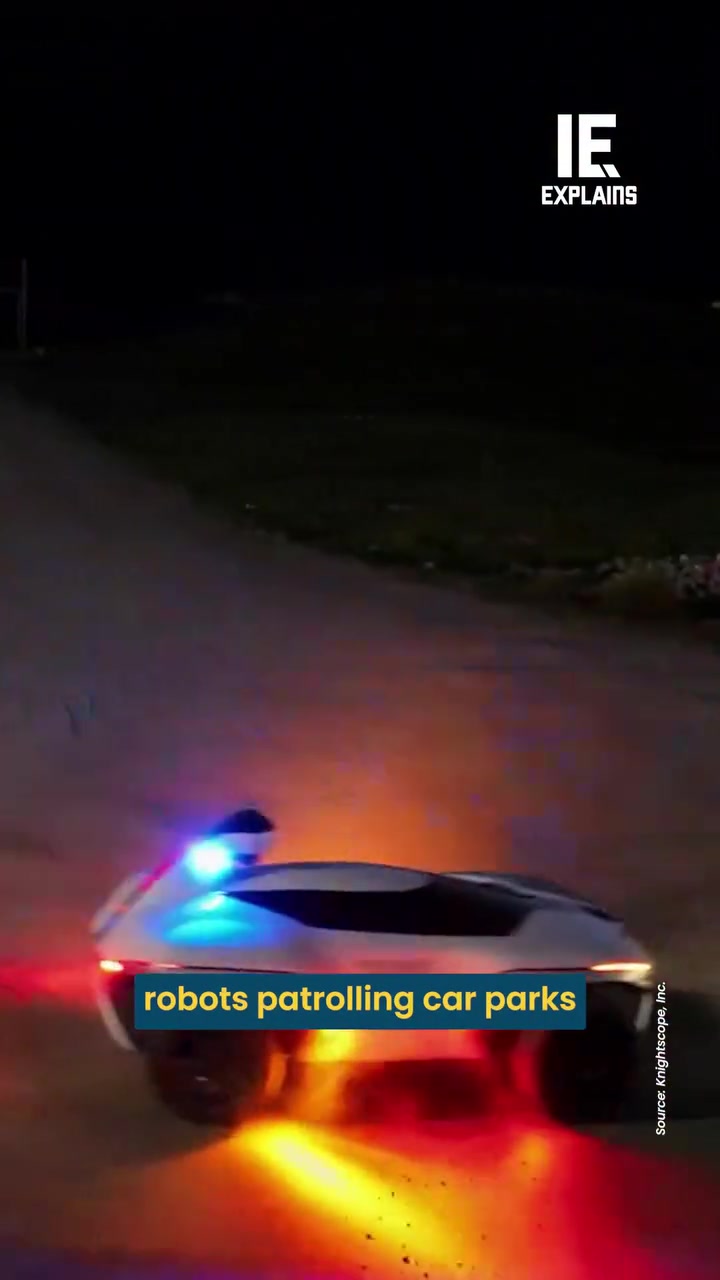
Presenting Knight's Scope
Right now, in car parks across America, autonomous robots weigh more than most of the people they watch. These robots patrol hospital campuses, office buildings, and other large sites, providing a continuous security presence. These are the autonomous robots created by Knightscope, a company that has been developing them since 2013. Knightscope's K5 is the robot you probably seen. The K5 is 5 feet 4 inches tall, has a top speed of 3 miles per hour and weighs 420 pounds. Patrolling at a slow, deliberate pace, to monitor routes, collecting and streaming video and capturing data through a range of sensors. Not only does the K5 dutifully navigate its designated paths, but it also docks itself when the battery runs low, making it a low-maintenance option compared to its human counterparts. The robot carries no weapons and does not chase or apprehend suspects. Instead, its presence is meant to act as a deterrent to criminal activity, a concept known as the "hawk effect." The robot's sensors capture everything and transmit back to a monitoring center, where humans review the data and call the police if necessary. Over six years, Knightscope's has accumulated 4.4 million autonomous hours across 42 states for 434 customers. Knightscope claims that this has resulted in a 46% drop in crime reports at their sites.
Monitoring America’s Spaces
At aerial view, the Knightscope K5 Autonomous Security Robot is part of a broader trend towards leveraging technology for enhanced surveillance and security. This trend reflects America's growing comfort with autonomous systems, especially when they involve the kind of low-speed, predictable, predictable tasks. Autonomous robots, like the Knightscope K5, have been deployed in a variety of settings, including hospitals, corporate campuses, and logistics facilities. This growing acceptance of robots in public and semi-public spaces highlights the public's willingness to trust machines with certain responsibilities. In contrast, the human security guard remains a more dynamic and flexible presence on the scene. The human security guard is often the only presence until something happens, when he or she then leads the response to that threat. This trade-off between technological prowess and human adaptability is a part of the ongoing conversation about automation and human skill. Knightscope's data suggests a continued market appetite for autonomous security solutions, but also highlights the need for careful consideration when applying these tools within society.
The Robotic Sequel
Knightscope unveiled a second generation autonomous robot designed for off-road patrolling. According to Knightscope, this robotic sequel, designed for off-road patrolling, is built to conquer more rugged terrain, including fence lines, airports, logistics yards, and defense installations. Mounted on a rugged all-terrain truck, it stands taller and wider than the K5, with a matte black finish and tougher wheels. It will be deployed in the second half of this year. The K7 aims to extend the capabilities of autonomous security, tackling environments that the K5 cannot navigate. This expansion into off-road environments suggests a growing demand for autonomous security solutions in more challenging terrains.
Advanced Sensory Capabilities
The K5 also features a comprehensive suite of sensors. As it traverses its route, the K5 records 360-degree video and uses LiDAR and thermal imaging to build a detailed map of its surroundings. With the help of a night vision camera and optional automatic number plate reader, the K5's sensors generate a wealth of data about its environment, which is then transmitted back to a human monitoring center. This constant sensor monitoring creates a robust record of events, which can be reviewed later for any incidents. The K5's whole pitch is based on this monitoring. It sees, it records, it reports, and rightfully its presence alone is enough to change how people behave.
The Hawks Effect
The idea behind the K5 is that it doesn't chase or engage with anyone. It simply is present, collecting data. This presence alone is enough to deter crime. This is what's known as the "hawk effect,” defined as a condition in which the awareness of being observed increases the probability of conforming to standards. Meanwhile, humans review the data and decide if a police call is needed. The model comes from manned security models, where guards discourage bad behavior without taking any actions. The K5's constant, visible presence is designed to encourage people to behave better. Knightscope claims this passive role of the K5 has lowered crime rates by 46%.
Reaching the Next Generation
Knightscope's K7 robot is designed to take autonomous security to the next level. Tackling rugged terrains, the K7 is a larger, more rugged version of the K5, but it has the same core capabilities as the K5. That includes 360-degree video, LiDAR, thermal imaging, and night vision, making it as equipped for data collection as the K5. The K7's enhanced off-road capabilities make it well-suited for a variety of challenging environments. The K7 is designed for real-world applications, making it an important addition to the K5. It is also accompanied by a human security guarding firm.
Something Unexpected to Watch for
Knightscope has had a few publicized incidents that may be embarrassing but do not appear to detract from their success. In 2017, a K5 rolled into a fountain in Washington, DC. This incident was not a show-stopper for Knightscope. In 2019, an emergency button was pressed on a K5 in Los Angeles Park during a fight, and the robot instructed the person to step out of the way and carried on patrolling. While these incidents may seem unusual, they underscore several important points about autonomous systems. First, robots like the K5 are still machines, and as such, they are subject to mechanical failures and mishaps. Beyond that, these moments can also reveal the limits of human control and oversight over autonomous systems. Guards are now in control of the data from these machines and how they act on it.
Choosing Autonomous Security
Knightscope's K5 offers several key features that set it apart from traditional security measures, allowing someone with security needs to choose from several key features:
- Data-Driven Security: The K5 robot's comprehensive suite of sensors collects continuous data
- Customizable Routes: These autonomous security robots can be programmed to follow specific routes, ensuring comprehensive coverage of the area
- Automated Docking: Unlike human guards who need breaks, the K5 robot automatically docks itself when the battery runs low
- Remote Monitoring: The K5 streams video and sensor data back to a remote monitoring center, allowing security personnel to review incidents as they happen and escalate them if necessary
- Reduced Labor Costs: Autonomous security robots eliminate the need for human guards, reducing labor costs and increasing efficiency
- Human Security Firm Back Up: This robots come with a human security firm that sees what the robots see. These firms can provide actual security services too
Deploying an autonomous security robot
Robotics isn't for everyone. However, if you want to invest in an autonomous security robot it will require smart evaluation. You will need to be thorough in assessing your security needs to determine the best solution. Make sure to thoroughly review the services offered by the robotics firm to ensure it aligns with your needs. It may be worthwhile to invest in a human security guard or firm as well to back the autonomous security robot. This will allow you to get the benefits of continuous security monitoring, ensure it follows your guidelines and offer additional services like response. Finally, hands on consulting is a great way to learn about the different options available. This will give you an opportunity to ask questions, learn about the technology, and ensure that it's the right fit for you.
Questions readers ask
What exactly does the Knightscope K5 do while patrolling?
The K5 patrols designated routes at a slow pace, collecting and streaming video and capturing data through various sensors. It doesn't chase or apprehend suspects; instead, it acts as a deterrent to criminal activity. If it detects something suspicious, it transmits the data to a monitoring center for human review.
How does the K5 handle its own maintenance?
The K5 is designed to dock itself when its battery runs low, making it a low-maintenance option. This feature allows it to recharge autonomously, ensuring continuous operation without constant human intervention.
What is the 'hawk effect' mentioned in the article?
The 'hawk effect' refers to the deterrent effect of the K5's presence. Just like the presence of a hawk can scare off smaller birds, the presence of the K5 robot can deter potential criminals, reducing the likelihood of criminal activity.
What kind of data does the K5 collect and how is it used?
The K5 collects video footage and data through various sensors. This information is transmitted to a monitoring center where humans review it. If any suspicious activity is detected, the monitoring center can then call the police. This ensures that while the robot handles the surveillance, human intervention is still necessary for decision-making.
How does the K7 differ from the K5?
The K7 is designed for off-road patrolling and can navigate more rugged terrain, including fence lines, airports, logistics yards, and defense installations. It stands taller and wider than the K5, with a matte black finish and tougher wheels, making it suitable for environments that the K5 cannot handle.
Related deep dives
Similar reads based on topic and creator.


Recent articles
Fresh deep dives from the latest Reels we unpacked.
Comments
Be the first to comment.