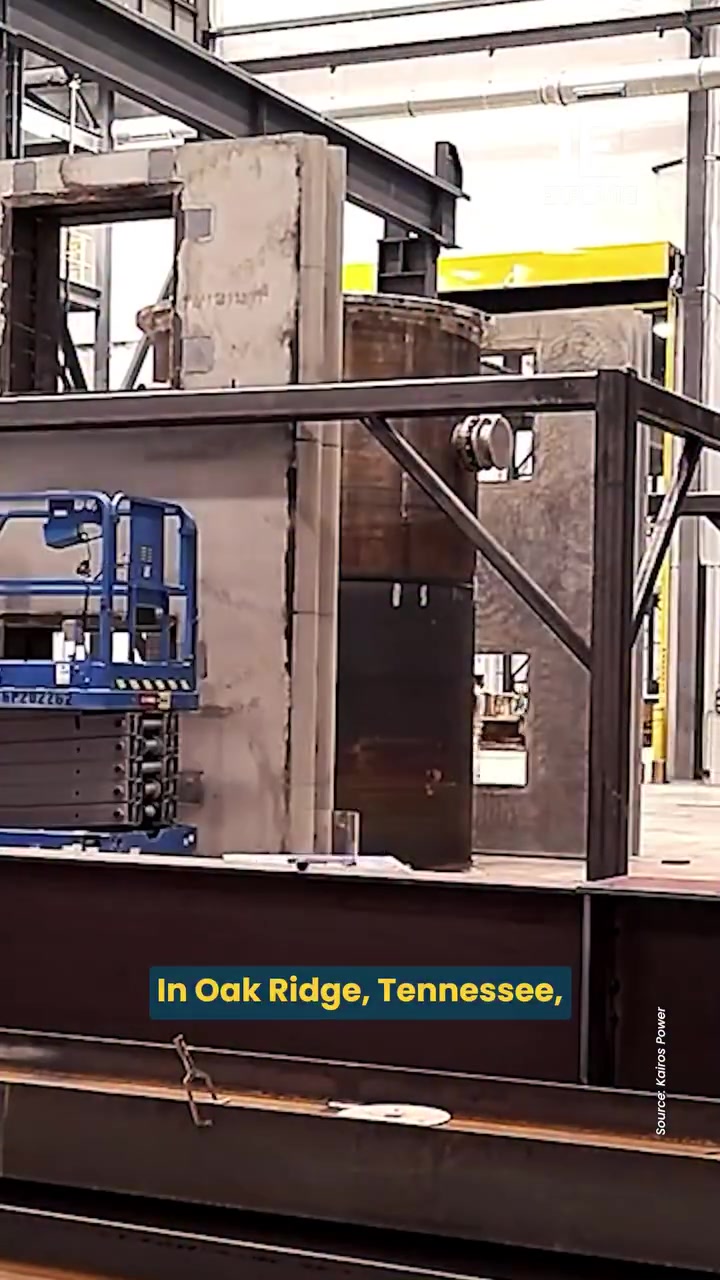
The Hermes nuclear reactors in Oak Ridge, Tennessee, feature something unusual: modular walls and advanced robotics. The first of a kind modular-water-cooled reactor, built by Kairos Power, uses high-density-uranium fuel pebbles to generate clean energy. This is the first phase of testing for ETU-3, a mock-up model of the reactor cavity for the Hermes.
The Modular Water-cooled Reactor
The Hermes reactors are especially distinctive in the nuclear industry for their modular construction. Environmental Testing Unit-3 (ETU-3) would be able to test the reactor cavity on the Hermes—they are creating two plants right next to ETU-3. Its reactor vessel is enclosed in precast concrete shielding. This is unlike other nuclear reactors which traditionally use massive concrete domes to contain the radioactive components. This enclosure of ETU-3 for Hermes is built from 12 modular wall pieces across four different designs. The different wall joints step and curve in a sine wave in order to create complex radiation pathways. The reactor's multiple different types of wall components serve as a unique and novel radiation shield. Once the real hardware is bolted in behind the concrete shields, these modular walls should hold the radiation paths shut. Furthermore, the reactor uses 30,000 dummy fuel pebbles to test the reactor's ability to operate with the fuel loaded. Each pebble has a diameter of 70 millimetres and contains tiny graphite-coated uranium particles. Inside the reactor, the pebbles are held within a barrel, which is submerged in a water pool to absorb the heat generated by the nuclear reactions.
A Pathway to Clean Energy
Expect to see more modular nuclear reactors in future designs. Industry experts believe the modular design will help scale up nuclear power just as it scaled down power generation costs. However, some environmental experts have called for stricter safety standards for nuclear reactors. This is due to mishandled nuclear waste from the increased production of nuclear power. On-screen, ETU-3 shows that robotic tools can connect and disconnect equipment inside the concrete shielding. The tools are used to simulate the connection and disconnection of equipment later on the real reactor. The robotic tools allow for precise movements in tight spaces. Hermes technology has enabled the construction of nuclear reactors without letting humans enter nuclear facilities during the construction and installation phases. This reduces the exposure of workers to dangerous ionizing radiation and increases the pace of installation. The tools are programmed to perform operations like: drilling, welding and handling of heavy equipment.
The Distinctive architecture of ETU-3
Modular Concrete Shielding
The walls of the Hermes nuclear reactors are unique due their innovatively designed modular concrete configuration. Each reactor consists of 12 modular wall pieces and has 4 different designs. This is in contrast to the concrete domes that are traditionally used to enclose the radioactive components of nuclear reactors. Kairos Power has designed the walls to be customizable in this unique way. Each wall fits precisely around the reactor vessel and the technology is patented. The design consists of walls that are made to receive and house the joints. Concrete modules with different shapes allow for the joints to step and curve in a sine wave, allowing for complex radiation pathways.
Theory
Kairos Power’s breakthrough design philosophy is to physically test full-scale prototypes. Once any potential issues are identified and resolved in a controlled environment, the real reactors are built with concrete shielding to ensure operational safety.
Pebble Bed Reactor
Hermes reactor is a pebble bed reactor. The reactor is submerged in water and it uses 30,000 fuel pebbles contained in a barrel. The barrel is submerged in a water pool to absorb the heat generated by the nuclear reactions.
Reactor Maintenance
The robotic equipment in the Hermes nuclear reactors allow for autonomous operation in the reactor cavity of ETU-3. The robotic tools connect and disconnect the equipment inside the concrete shielding, simulating what will happen in the real reactor once it is operational. The exact mechanism of how the robotic tools operate is not known, but the tool's movements are highly precise. The robotic tools could be exchanging parts, drilling, welding or performing other specific actions to simulate the full-scale operation. The robots can operate autonomously, allowing workers to stay safe in inherently hazardous spaces. Until now, workers had to enter the facility to swap parts, but the robots eliminate that need. The robotic tools operate through concrete plugs in the cavity wall and are programmed to perform operations that are needed for the operation of the facility. These tools operate through concrete plugs in the walls without the need for access doors or other openings.
Why Modular Nuclear Reactors Matter
In most power plant systems, humans enter the active zones of reactors to swap out parts. One of the most convincing use cases for nuclear reactors in future designs is the ability to automate routine maintenance tasks. The autonomous operation of the nuclear reactors is especially useful in controlled environments like the Oak Ridge National Laboratory. Automation and modular designs are key to modernizing nuclear power generation for safety and efficiency. Hermes reactors are a prominent example of automation technology used in nuclear reactors. Hermes reactors are designed to operate autonomously. This technology uses robotic tools to connect and disconnect equipment inside the concrete shielding. The tools can operate through concrete plugs in the wall without the need for access doors or other openings. The batteries of Hermes reactors are used to power the TVA grid. However, there are only two reactors in the Hermes Small Modular Reactor (SMR) project.
Replicating The Reactor
Modular Design
It is best to use the professional approach used by the engineers at Kairos Power. They follow a tested method in manufacturing the reactor. The kit they create includes all the 12 modular wall pieces and 4 different designs. According to the engineers, they suggest that it is best to use their own design and not to buy a different part. If a person is feeling adventurous, they suggest fine-tuning the design further.
Robots
It is also possible to replicate the exact robotic tools used in the Hermes nuclear reactor. Kairos Power recommends using their own blueprints to design and build the robotic tools. In the video, the tools connect and disconnect equipment through concrete plugs in the cavity wall. It is possible to fully replicate the tools and the cavity wall in a smaller scale as well.
The Pebble Bed
In terms of the fuel, the reactor uses 30,000 dummy fuel pebbles. This is a relatively large amount of fuel, and it is important to note that the fuel pebbles are not real. The fuel pebbles are replaced with dummy fuel pebbles for testing purposes. The dummy fuel pebbles are not radioactive, and they are used to test the reactor's ability to operate with the fuel loaded. The pebbles can be used to test various functions of the reactor. The fuel pebbles are used to test the reactor's ability to operate with the fuel loaded. The fuel pebbles are also used to test the reactor's ability to shut down safely in the event of an emergency.
Water
Hermes reactors use a pool of water to absorb the heat generated by the nuclear reactions. The water pool is used to absorb the heat generated by the nuclear reactions. The water pool is also used to cool the reactor. The water pool is used to cool the reactor and to absorb the heat generated by the nuclear reactions. The water is exchanged for a new reactor.
The Future of Nuclear Power
Automation will play an important role in the future of nuclear reactors. AI and robotics have the potential to completely replace human workers in these controlled environments. One of the most exciting possibilities for nuclear power is to use robotics to automate routine maintenance tasks. The Hermes reactors are a great example of the ongoing innovation that is happening in the nuclear energy sector.
Questions readers ask
What makes Kairos Power's Hermes reactor different from traditional nuclear reactors?
Kairos Power's Hermes reactor stands out due to its modular construction and advanced robotics. Unlike traditional reactors that use massive concrete domes, Hermes employs 12 modular wall pieces in four different designs, creating complex radiation pathways. This design allows for more precise control and easier assembly.
How does the modular design of the Hermes reactor work?
The modular design of the Hermes reactor involves using 12 modular wall pieces that fit together in a sine wave pattern. These walls serve as a unique radiation shield, and the different designs allow for complex radiation pathways. This modular approach makes the construction process more efficient and scalable.
What are the benefits of using advanced robotics in the construction of the Hermes reactor?
Advanced robotics in the Hermes reactor construction allow for precise movements in tight spaces, enabling the connection and disconnection of equipment without human intervention. This not only increases the pace of installation but also reduces the exposure of workers to dangerous ionizing radiation, enhancing overall safety.
What are the fuel pebbles used in the Hermes reactor, and how do they work?
The Hermes reactor uses high-density-uranium fuel pebbles, each with a diameter of 70 millimeters and containing tiny graphite-coated uranium particles. These pebbles are held within a barrel submerged in a water pool, which absorbs the heat generated by nuclear reactions. The reactor currently uses 30,000 dummy fuel pebbles for testing purposes.
How does the modular design of the Hermes reactor address safety concerns?
The modular design of the Hermes reactor addresses safety concerns by allowing for precise control over radiation pathways and reducing the need for human intervention during construction. The modular walls, once bolted in, should effectively contain radiation, and the use of robotics minimizes worker exposure to ionizing radiation.
What are the potential benefits and drawbacks of scaling up modular nuclear reactors?
Industry experts believe that the modular design of nuclear reactors like Hermes can help scale up nuclear power and reduce costs. However, some environmental experts have called for stricter safety standards due to concerns about mishandled nuclear waste from increased nuclear power production. The modular design aims to address some of these concerns by improving safety and efficiency.
Related deep dives
Similar reads based on topic and creator.




Recent articles
Fresh deep dives from the latest Reels we unpacked.



Comments
Be the first to comment.