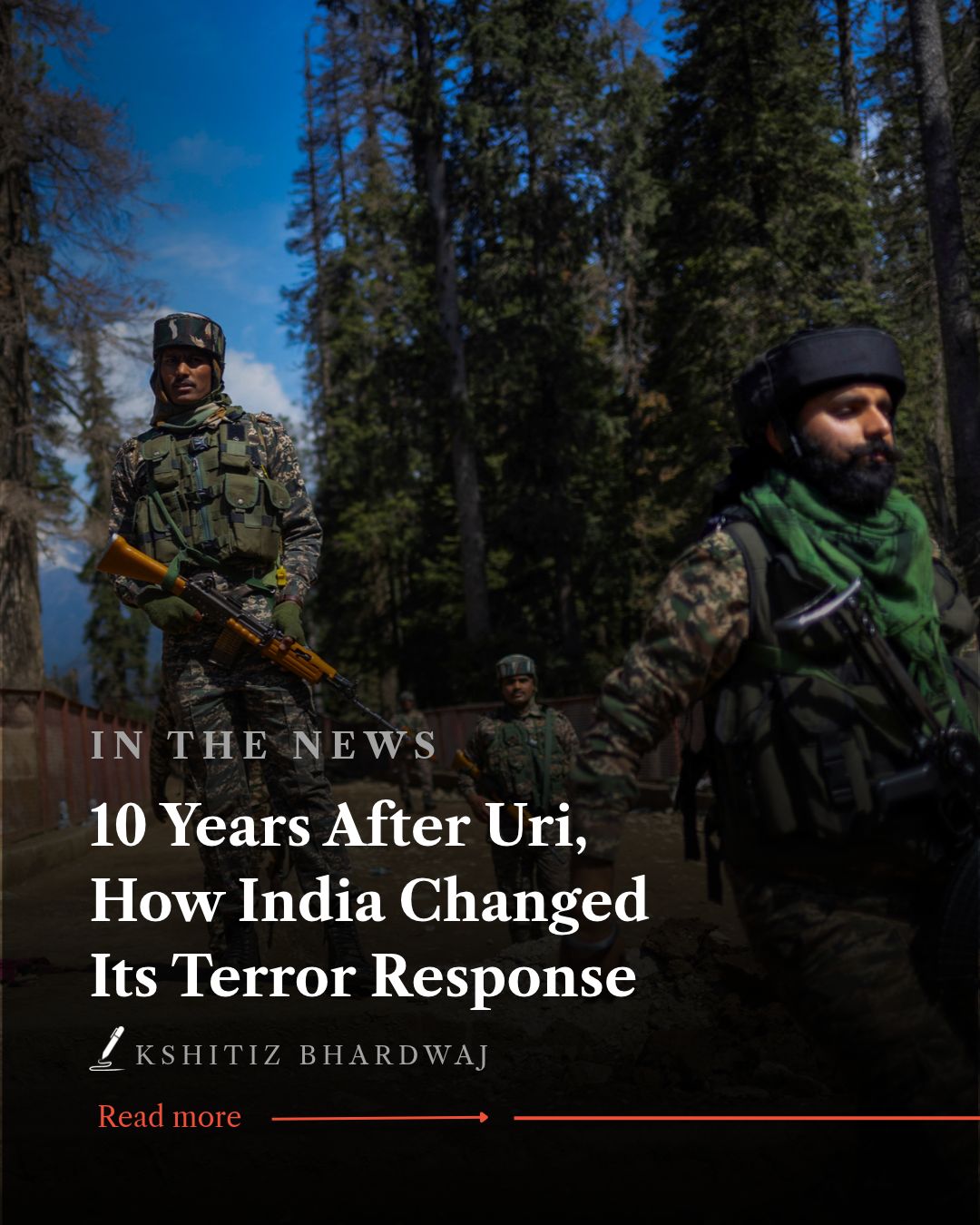
Ten years after the Uri attack, India's terror response has evolved. Instead of simply deciding whether to respond, India's doctrine now weighs how, where, and at what level to retaliate. India's evolving response reflects a somersome dilemma: balancing the necessity to respond to terror with the reality of asymmetric warfare tactics.
India's Evolving Counter Terror Doctrine
India's terror response has evolved more sophisticated. Now it includes a doctrine of strategic restraint and suitable retribution. The post-Uri era saw India impose military costs for major terror attacks from "strategic restraint"—the old way of trying to avoid direct conflict—Besides, the new response means India is now ready to retaliate in a more proportionate and strategic manner. The doctrine shifts from asking whether to retaliate — to how, where, and at what level. For example, a new security doctrine was set up after the strikes on Uri: India showed a willingness to impose military costs for major terror attacks. This approach was expanded after the Pahalgam attack in 2025. In the subsequent operation, code-named Operation Sindoor, India struck nine terrorist sites in Pakistan and Pakistan-occupied Jammu and Kashmir. This is a clear demonstration of the evolution of India’s strategic response to terror attacks. What makes this work distinct is the focus on not just the physical strikes but also the strategic and political messaging behind these actions.
Public Focus Shifts to Deterrence
The public spotlight has turned to deterrence. The evolution of India’s security doctrine has significantly raised the costs of large-scale terror attacks on Indian soil. India’s new approach has shown that deterrence can work but has limits. Another part of this doctrine is to show India’s willingness to punish terrorist incursion at any cost. The new doctrine shifted from its initial strategy of strategic restraint to strategic retribution. The doctrine aims to prevent future attacks while inflicting significant costs on its adversaries. However, India must still deal with the difficult fact that the continued use of asymmetric tactics shows that deterrence alone cannot eliminate the proxy-war threat. Asymmetric tactics involve using unconventional methods to weaken or demoralize an enemy. Terrorist groups are more adept at utilizing these tactics. India must balance its proactive strikes with maintaining a strong defense to counter enemy tactics.
Retaliatory Strikes
An Eye for an Eye
The doctrine centers around the concept of imposing military costs on terrorist groups. Retaliatory strikes have become the norm, and the enemy no longer faces a strategic restraint, it is now ready to inflict immediate military costs. India’s strikes have become a strategic tool, aimed at not just retaliating but also sending a message to terrorist groups and their sponsors that any attack on Indian soil will be met with decisive action. India is demonstrating the willingness to launch operations within its territories and beyond under this new doctrine.
Operation Sindoor
Operation Sindoor, carried out in Pakistan & Pakistan occupied Jammu and Kashmir, stands as a testament to this strategy. Incursions: It was an incursion by India and targeted nine terrorist sites. This is a clear example of how India’s doctrine has evolved to deal with terror threats. Operation Sindoor was a response to the 2025 Pahalgam attack and was a demonstration of the evolution of India’s security doctrine. India carried out retaliatory strikes across the Line of Control, hitting nine terrorist sites.
Development of New Doctrine
2025 Offensive Strikes
The year 2025 has been pivotal. After the Uri attack, India launched offensive strikes in the region. The strikes, coupled with the military costs, inflict on the enemy, indicate a significant shift in India’s response to terror attacks. The strikes were a new doctrine which emphasized retribution of terrorists in a strategic manner.
The Doctrine's Evolution
India’s new doctrine aims to impose military costs for terror attacks. The response is not just physical but also strategic. India is also ready to retaliate at level places. The doctrine emphasizes on targeting terrorists without unnecessary escalation. India’s response has evolved to include strategic and political messaging as well. For example, the strikes were aimed at deterring future attacks and sending a strong message to terrorist groups.
The Complex World of Asymmetric Warfare
The continued use of asymmetric tactics complicates the strategic response. These tactics involve using irregular methods to weaken or demoralize an enemy, including terrorist groups. The use of asymmetric tactics is a significant challenge for India’s military deterrence. The proxy war in the region also poses a significant threat. Asymmetric tactics also include guerilla warfare, paramilitary attacks, and suicide attacks.
How to Evaluate India's Retaliatory Strikes
Evaluating India’s strikes requires a nuanced understanding of the country’s strategic considerations. Consider the following Points:
- Immediate Impact: The immediate military impact to curtail future attacks. The strikes must be evaluated in the context of short-term gains as well as long-term strategic goals. The strikes are a message to terrorists that any attacks will be met with a resilient response.
- 宣示 to terror groups: The doctrine sends a strong message to terrorist groups that retaliatory strikes are on the table, meaning the terrorists have to face direct consequences for their attacks. In this context, the attacks are also a warning to terrorist groups that they will be held accountable for their actions.
- Military Cost: Imposing military costs for terror attacks. The doctrine involves imposing military costs on terrorist groups. The doctrine aims to deter future attacks by making it clear that any attack on Indian soil will be met with decisive action.
- Public Perception: The public perception of the strikes. The public perception of the strikes is also an important factor in evaluating the success of the doctrine. The public must support the retaliatory strikes, and the public perception of the doctrine is a crucial factor in its success.
India's Future Evasion Measures
There is a need to strengthen the defense measures. India’s new doctrine is a significant step, but it is not a panacea. The doctrine’s success depends on a variety of factors, including the continued use of asymmetric tactics by terrorist groups and the evolving nature of proxy wars. India must continue to evolve its doctrine and defense measures to counter the evolving threat of terror attacks. The doctrine must also be supported by strong defense measures. There is a need to strengthen the defense measures, including strengthening the border security and improving the intelligence. A military budget can be allocated to expand the defense measures. The future will involve a greater emphasis on intelligence and defense strategies. India's doctrine has come a long way since the Uri attack. The evolution of India’s counter-terror doctrine is a continuous process.
Questions readers ask
What exactly is the difference between 'strategic restraint' and 'strategic retribution' in India's counter-terror doctrine?
Strategic restraint refers to India's previous approach of trying to avoid direct conflict and respond cautiously to terror attacks. In contrast, strategic retribution involves a more proactive stance, where India is ready to impose military costs and retaliate in a proportionate and strategic manner, such as through targeted strikes like Operation Sindoor. The shift signifies a more assertive response to terror attacks, focusing on both physical strikes and the strategic messaging behind them.
How has India's response to terror attacks changed since the Uri attack in 2016?
Since the Uri attack, India's response has evolved from a simple decision of whether to retaliate to a more nuanced approach that considers how, where, and at what level to retaliate. This evolution includes a doctrine of strategic retribution, where India is willing to impose military costs for major terror attacks and use retaliatory strikes as a strategic tool to deter future attacks and send a clear message to terrorist groups and their sponsors.
Is Operation Sindoor a singular event or part of a broader strategy?
Operation Sindoor is part of a broader strategy under India's evolved counter-terror doctrine. It's a specific operation that targeted nine terrorist sites in Pakistan and Pakistan-occupied Jammu and Kashmir. The operation is a clear demonstration of India's willingness to retaliate in a more proportionate and strategic manner, focusing on both physical strikes and the strategic and political messaging behind these actions.
How effective has India's new doctrine been in deterring terror attacks?
India's new doctrine has shown some effectiveness in raising the costs of large-scale terror attacks and demonstrating a willingness to retaliate decisively. However, it also acknowledges that deterrence alone cannot eliminate the threat of asymmetric tactics used by terrorist groups. While it has shifted the public spotlight to deterrence, India must still balance proactive strikes with maintaining a strong defense to counter enemy tactics.
What are 'asymmetric tactics' and why are they a challenge for India's counter-terror efforts?
Asymmetric tactics involve using unconventional methods to weaken or demoralize an enemy, which terrorist groups are adept at utilizing. These tactics are a challenge for India because they make it difficult to eliminate the threat of proxy wars. India must balance its proactive strikes with maintaining a strong defense to counter these tactics, as deterrence alone cannot completely eliminate the threat.
Can India's retaliatory strikes be considered a form of escalation in the conflict with Pakistan?
India's retaliatory strikes, such as those carried out in Operation Sindoor, can be seen as a form of escalation in the conflict with Pakistan. However, they are also a strategic tool aimed at imposing military costs on terrorist groups and sending a clear message to terrorist groups and their sponsors. The strikes are part of a broader doctrine that focuses on both physical retaliation and strategic messaging, aiming to deter future attacks and impose significant costs on adversaries.
Related deep dives
Similar reads based on topic and creator.




Recent articles
Fresh deep dives from the latest Reels we unpacked.




Comments
Be the first to comment.