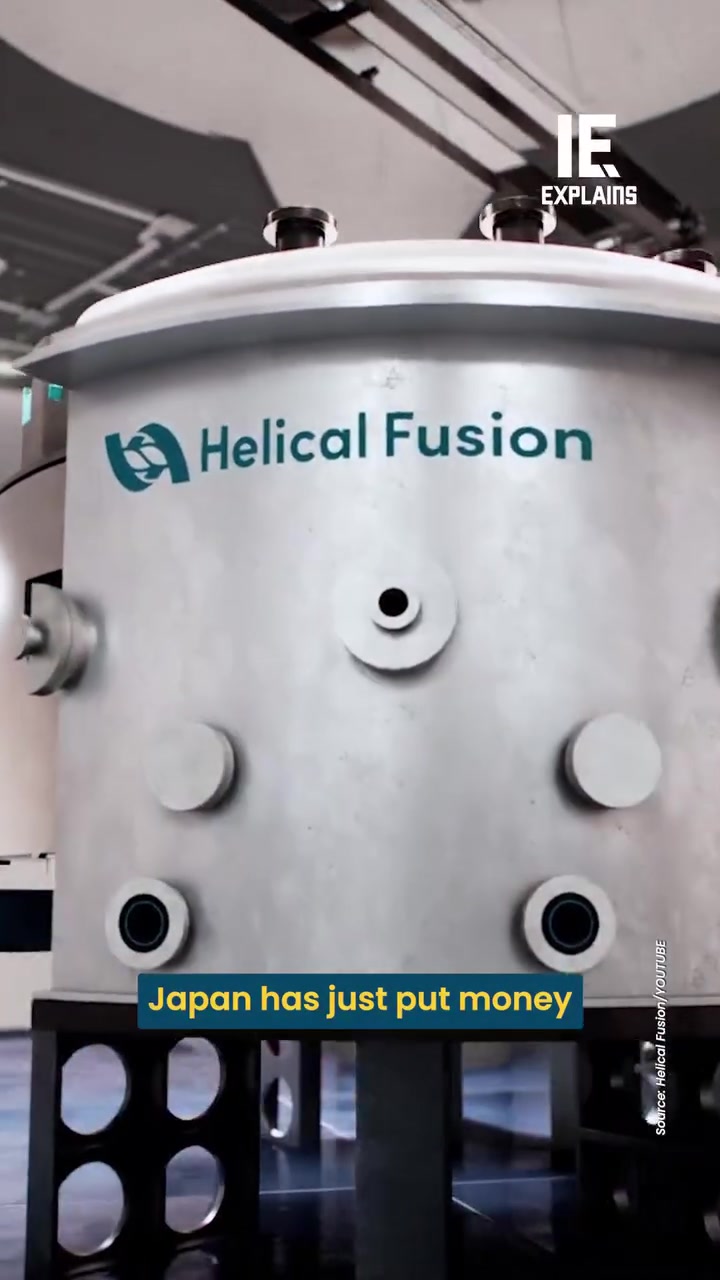
Japan's newest fusion venture bets on a machine that most of the international community left behind. On September 1, Japan's trade ministry pledged 60 billion yen—the equivalent of $400 million dollars—to a fission power demonstration program. One of the selected companies, a Tokyo-based startup called Helical Fusion, wants to create a super hot plasma by designing an optimized stellarator. The helical stellarator it aims to build holds the promise of a more stable and continuous energy generation method.
Helical Fusion’s proposed fusion machine is what’s known as a Helical Stellarator. For most of the 60 years since the concept was first proposed, experiments and buildings centered on the Tokamak. The twisty magnetic coils of a stellarator are designed to confine and heat plasma in a controlled manner. The advantage of the stellarator is that it can maintain a steady-state operation due to the unique shape of its coils, unlike the tokamak, which runs in pulses. Helical coils are continually energized, allowing for a sustained plasma confinement without interruptions. The company spun off from the National Institute for Fusion Science in Japan in 2021, home to the large helical device.
This machine distinguishes from the tokamak in several ways. A tokamak uses a combination of external coils and a toroidal plasma current to generate the magnetic fields necessary to confine the plasma. The helical stellarator, on the other hand, relies solely on external coils with a specific shape to create the magnetic fields. In a tokamak device, the plasma is confined by a combination of toroidal and poloidal magnetic fields, while the stellarator’s coil geometry generates a more complex and stable magnetic field configuration. Helical machines are also free of the problem of plasma instabilities that are common in tokamaks. The helical stellarator's steady-state operation could lead to more efficient and continuous power generation.
## Why Japan's Bet on Nuclear Fusion Matters
Japan's investment occurs against a backdrop of growing global interest in nuclear fusion as a potential source of clean, abundant energy. The scarcity and emissions problems associated with traditional fossil fuels have spurred a renewed push for fusion technology. Unlike wind or solar, fusion offers baseline power capable of meeting consistent grid demands. Fusion’s potential lies in its ability to produce vast amounts of energy from small amounts of fuel, without emitting greenhouse gases or generating long-lived radioactive waste. For Japan, which imports most of its fossil fuels, domestic fusion power could offer significant energy security and economic benefits. The innovative energy approach could contribute to the country’s decarbonization targets by reducing its reliance on fossil fuel imports..
## Fusion in Japan — Nuclear Emphasis
The Large Helical Device
The Japan Atomic Energy Agency houses the Large Helical Device, a revolutionary prototype that held a plasma for nearly an hour. The device is designed to test the feasibility of sustained fusion reactions using a helical stellarator configuration. With the Large Helical Device, researchers have demonstrated the potential of helical stellarators.
Helical Fusion's Approach
For years, the Large Helical Device has been a proving ground for fusion technology. Additional experiments have involved running a high-temperature superconducting coil at 40,000 amps. The tests took place inside a 7-tesla magnetic field at minus 258 degrees Celsius, yet it was declared a world first. More importantly, the Large Helical Device’s success has paved the way for Helical Fusion to develop new fusion technology. Helical Fusion aims to achieve sustained fusion reactions in the 2030s. The company's first prototype, called Haruka, will put electricity onto a grid. The company has already signed a power purchase agreement with a supermarket chain.
The Potential of Nuclear Fusion
Fusion power could generate vast amounts of electricity from small amounts of fuel. The process involves heating plasma to temperatures comparable to those found in the sun. This extreme heat causes hydrogen isotopes to fuse, releasing energy. The potential energy output is immense, with one kilogram of fusion fuel theoretically capable of producing the same amount of energy as 10 million kilograms of coal.
The Financials
The heavily funded demonstration program totals $400 million dollars. The financial backing is significant because it signals a strong commitment from Japan to advance fusion technology. Helical Fusion is confident in its approach, but the question of whether this innovative technology will work remains. The institute is targeting energization tests and production facilities in the 2020s and 2030s, respectively. This cautiously optimistic timeline underscores the significant challenges still facing fusion power.
The Challenges
For all its promise, nuclear fusion remains a formidable technical challenge. The high temperatures and pressures required to confine and control plasma are difficult to achieve and maintain. Plasma instabilities, material degradation, and the need for advanced superconducting magnets present significant hurdles. Despite these challenges, Helical Fusion's helical stellarator design offers a unique approach that could overcome some of these issues.
## How to follow the Helically Harbored
Japan's investment in fusion power represents a significant step forward in the quest for clean, abundant energy. The helical stellarator design offers a promising approach to sustained fusion reactions, with the potential to revolutionize the energy landscape. For those interested in staying informed about the latest developments in fusion technology, Helical Fusion's progress will be closely watched. By signing up for their newsletter, followers can stay updated on the company’s innovations. The site will also offer resources for those who want to learn more about fusion energy and its potential impact on the future of power generation. .
In the National Institute for Fusion Science, visitors can explore the Large Helical Device and learn about the cutting-edge research being conducted there. The institute offers tours and educational programs that provide insights into the science behind fusion energy. Additionally, the institute’s website provides a wealth of information on fusion technology. By participating in these programs, individuals can gain a deeper understanding of the potential of fusion power and its role in shaping the future of energy.
Questions readers ask
What exactly is a helical stellarator and how does it differ from a tokamak?
A helical stellarator is a type of fusion reactor that uses twisty magnetic coils to confine and heat plasma in a steady-state operation. Unlike tokamaks, which use a combination of external coils and a toroidal plasma current to generate magnetic fields, the helical stellarator relies solely on its uniquely shaped external coils. This design allows for continuous plasma confinement without the interruptions seen in tokamaks, leading to more stable and efficient energy generation.
Why did Japan choose to invest in helical stellarators when most other countries are focusing on tokamaks?
Japan's investment in helical stellarators is a strategic bet on a technology that offers steady-state operation and fewer plasma instabilities compared to tokamaks. While tokamaks have been the focus of most fusion research, the helical stellarator's ability to maintain a continuous plasma confinement could lead to more efficient and reliable power generation. This choice aligns with Japan's goals for energy security and decarbonization.
What are the potential benefits of fusion power for Japan, and how does it address the country's energy challenges?
Fusion power offers Japan the potential for clean, abundant energy with minimal greenhouse gas emissions and no long-lived radioactive waste. Given that Japan imports most of its fossil fuels, domestic fusion power could significantly enhance the country's energy security and reduce its reliance on foreign energy sources. This aligns with Japan's decarbonization targets and could provide a stable baseline power supply, unlike intermittent renewable sources like wind and solar.
What is the Large Helical Device, and how does it contribute to Japan's fusion research?
The Large Helical Device is a prototype fusion reactor located at the Japan Atomic Energy Agency. It uses a helical stellarator configuration to test the feasibility of sustained fusion reactions. The device has successfully held a plasma for nearly an hour, demonstrating the potential for continuous operation and contributing valuable data to Japan's fusion research efforts.
Can helical stellarators be built on a small scale, or are they limited to large experimental facilities?
The article does not provide specific details on the scalability of helical stellarators. However, the fact that Helical Fusion, a startup, is involved suggests there is potential for more compact designs. The Large Helical Device is a large-scale experimental facility, but the technology's principles could potentially be adapted for smaller, more practical applications in the future.
What are the main challenges that helical stellarators face in becoming a viable energy source?
While helical stellarators offer advantages in stability and continuous operation, they also face significant technical challenges. These include the complexity of designing and building the uniquely shaped coils, maintaining the high temperatures required for fusion, and ensuring the overall efficiency of the system. Additionally, the technology is still in the experimental phase, and substantial research and development are needed to make it commercially viable.
Related deep dives
Similar reads based on topic and creator.



Recent articles
Fresh deep dives from the latest Reels we unpacked.


Comments
Be the first to comment.