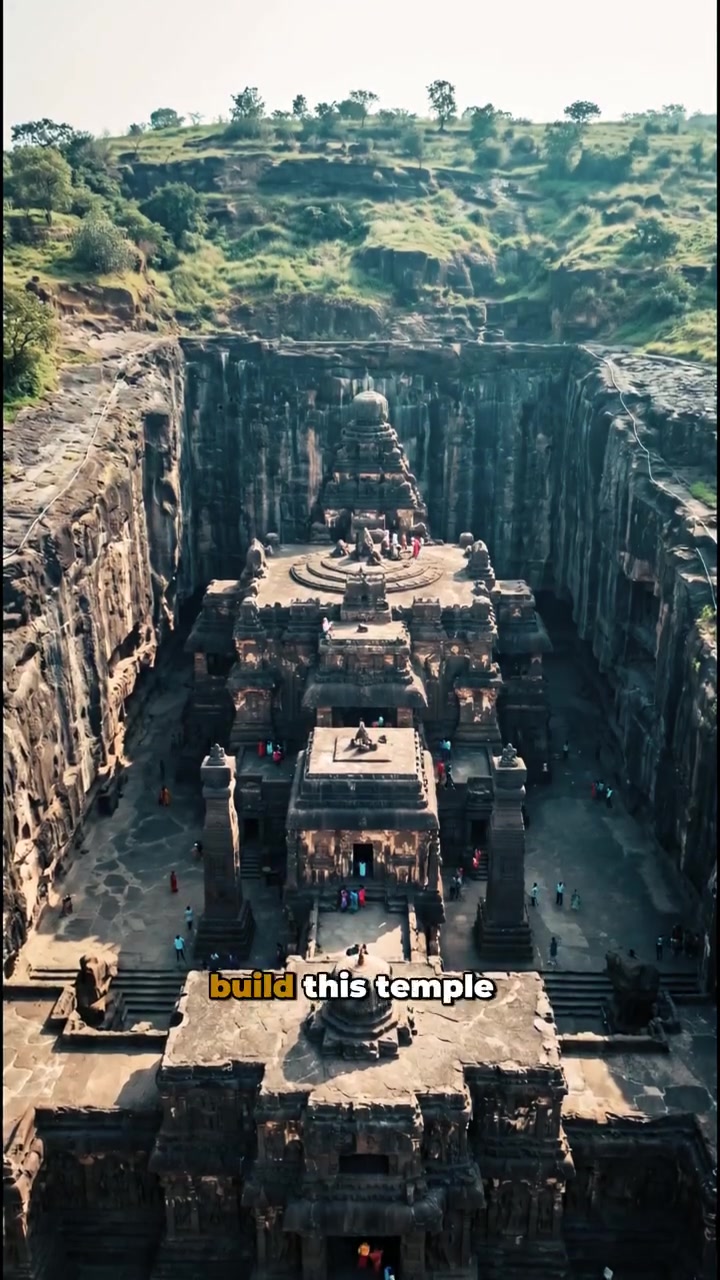
India's Ellora Caves are an architectural marvel, especially the Hindu temple carved out of a single rock in Ellora in Western India. It was created entirely with a subtractive method — stones were chiseled away to reveal the cavernous interior. This technique makes Ellora’s temple the architectural equivalent of sculpting a statue; instead of constructing with bricks, masons carved a massive temple directly from a hillside. The process began at the top, with carvers working downward to avoid creating a significant structural problem. A complex of rock-cut temples and monasteries, the Ellora Caves showcase Hindu, Buddhist, and Jain traditions.
The method of chiseled perfection
Ellora’s temple is carved out of a basalt mountain, standing ten stories or 32 meters tall. The method is like turning a block of stone upside down to carve fine detail into it without erasing. The temple sits in a pit 80 meters long and carved deeply into the hillside. The architect achieved this by starting at the top and cutting down, leaving no room for error. The craftsmanship involved meticulous planning and exact execution. The masons worked from the top to shape the temple’s spire first. The work finally ended by carving out the entrances. The fact that no stone is added means that each chisel-hit is irreversible. Every column, elephant statue, and bridge detail was carefully crafted at the first attempt. Given that the temple and the walls of the pit are a single, continuous piece of rock, with no joints or bricks, the number of workers and the time needed for construction is astounding. Among the architectural marvels of the Ellora Caves, the Hindu temple carved out of a single rock is jaw-dropping. The masterpiece stands inside a pit, 80 meters long and carved down a hillside. The 32-meter tall, 10-story temple is a result of hundreds of thousands of tons of stone chiseled away. The discovery of the Ellora cave temple and how it was discovered is a mystery. It is estimated that the 250 workers took five and a half years to complete the construction. Though one can never know how the masters did what they did, the creation stands unmatched as an incredible achievement in architecture.
Pushing the bounds of architecture
Ellora’s carving challenges our understanding of human capability. Masons can’t correct mistakes — no erasing or adding rock — and hundreds of thousands of tons of stone were removed. The carvings, including columns, elephants, and bridges, were crafted on the first try. When it comes to architectural engineering, the temple’s construction defies modern standards. It involves removing a large amount of rock with no way of reversing any step made. The construction involved the work of 250 people over five and a half years, with some theories suggesting it might have taken longer. The orientation of the building towards the east adds a spiritual element. Since there was no blueprint left behind, no written records remain. Every detail of the carvings, statues, and corridors of this Hindu temple is an ongoing mystery.
Why it matters
The Ellora Caves are a key example of rock-cut architecture, showing how ancient builders pushed limits through sheer skill and precision. The method of “carving” rather than building contrasts with the more familiar technique of constructing buildings from bricks or stones. As a UNESCO World Heritage site, the caves tell a story about the progress of architecture in India, and the power of craftsmanship. The site is a testament to the capabilities of human skill and persistence. The mysterious creation serves as a reminder of how advanced the ancient architects were. The carvings and statues, such as the ones of elephants and bridges, tell a story of the time and the people who created these masterpieces.
Ancient construction methods
Ellora, a sacred place in ancient India, is famed for its rock-cut monuments. These caves were constructed by cutting down into a hillside between the 6th and 8th centuries AD, under Hindu, Buddhist, and Jain auspices. The carvings display an incredible level of precision. The temples and monasteries present a complex structure, which remains a mystery. Certain details of the Ellora caves' construction are elusive. It is known that hundreds of thousands of tons of stone were chiseled away. The process began, as mentioned, at the top, and the fact that every piece of these intricate carvings was created in one go — no stone was returned — showcases the precision. The result is a marvel, a single, continuous piece of stone that makes up both the temple and the pit that surrounds it — no bricks or joints are visible.
How the Ellora temple was discovered
The story of how this temple was discovered could be the plot of a whodunnit. Another point of mystery is the construction. There were an estimated 250 workers at the Ellora site, taking around five and a half years to complete. There is no dedicated inscription in the temple or any surviving blueprints. There is also a lack of written details about the construction procedure, leaving a gap in the overall understanding of the temple.
Timeless carvings
The Ellora temples are renowned for their intricate carvings and statues. These carvings are not just decorative; they tell a story about Indian architecture and culture. The statues of the elephants, columns, and bridges show how the ancient builders were artistic and scientific. Some of the carvings show how the builders went about the whole process. For example, the technique of working downwards from the top offers clues. The columns and supporting structures showcase the builders' careful planning. Some of the temples at the site were likely never finished, but they still tell a story. Some might have been abandoned due to shifting interests in their patron's religion. Others might have been destroyed in the process of excavation.
The Ellora temple year by year
The engineering marvel Kailasa temple is believed to have constructed under the patronage of Rashtrakuta King Krishna I between 756 and 773 AD. The temple is one of the 34 rock-cut Hindu temples at the Ellora site. However, no one has ever documented the years over which the temple was built. The construction itself is a testament to the skill and effort of the builders and engineers of the time.
Ellora temple and its carver’s legacy
The Ellora temples, and the Kailasa temple specifically, are a testament to the incredible skill and precision of the ancient carvers. The meticulous carvings are an intricate process, and each step is precise. The temple was essentially carved from the top down, with the carvers starting with the largest structures and working their way down. The temple's architecture showcases a blend of Hindu, Buddhist, and Jain traditions. The temple’s carvings tell a story of ancient India’s sheer skill and imagination. The site showcases different stories of builders’ vision. The temples are built in a sequence of steps, where the top of the structure is the first part that gets carved out.
How to carve a cathedral out of rock
The Ellora temple showcases an engineering feat that you shouldn’t take lightly. The carvings tell a story of ancient times and are as intricate as an artist’s work. The architecture was done with a strategy that allowed for zero errors. The method involved starting from the top of the temple and working downwards. Everything that was carved was done in one go. The temple itself is carved out of one continuous piece of rock. The craftsmanship of the Ellora temples is both visionary and precise, and the temple is a marvel to behold. How the ancient builders finished the Ellora temple’s construction is a mystery. The site showcases an architectural marvel and is a UNESCO World Heritage site.
Ellora, must-see monument
The instruction to visit Ellora is an understatement, one might say. The Ellora caves are among the most important examples of rock-cut architecture in the country. The temples and monasteries are an expression of creativity and architectural prowess. The site has a plethora of temples, all masterfully carved out of stone. Ellora adds great value to the architecture and culture of India.
- Preparation: If visiting in person, Ellora requires a full day of exploration. Choose the right time of year — winter offers the best weather.
- Know your route: Plan your itinerary to see the highlights, such as the Kailasa Temple and the carvings on display in other temples and monasteries. The other caves are just as important and are right next to the monument.
- Admire the craftsmanship: Pay attention to the details, and appreciate the skill that went into carving these structures from a single rock.
Questions readers ask
How did the masons at Ellora Caves ensure the structural integrity of the temple while carving it from above?
The masons started carving from the top and worked their way down. This method minimized the risk of structural collapse by gradually reducing the weight of the overhanging rock. They also had no room for error, as any mistake would be irreversible.
What is the significance of the temple's orientation towards the east?
The temple's orientation towards the east adds a spiritual element to the structure. However, the article does not specify the exact spiritual significance, it might be related to the Hindu tradition of facing east during rituals and worship.
What are the dimensions of the pit and the temple carved out of the single rock?
The pit is 80 meters long and carved deeply into the hillside. The temple itself stands 32 meters tall, equivalent to ten stories. The temple is carved out of a single basalt mountain, and the pit surrounds it.
Why is the Ellora Caves temple considered a remarkable feat of ancient architecture?
The temple is a remarkable feat because it was carved entirely from a single rock using a subtractive method. This involved chiseling away hundreds of thousands of tons of stone with no room for error, as each chisel hit was irreversible.
What techniques were used to carve the intricate details of the Ellora Caves temple?
The intricate details, including columns, elephant statues, and bridges, were carved using a subtractive method. The masons worked from the top down, ensuring that each chisel hit was precise and irreversible. This required meticulous planning and exact execution.
Related deep dives
Similar reads based on topic and creator.




Recent articles
Fresh deep dives from the latest Reels we unpacked.




Comments
Be the first to comment.