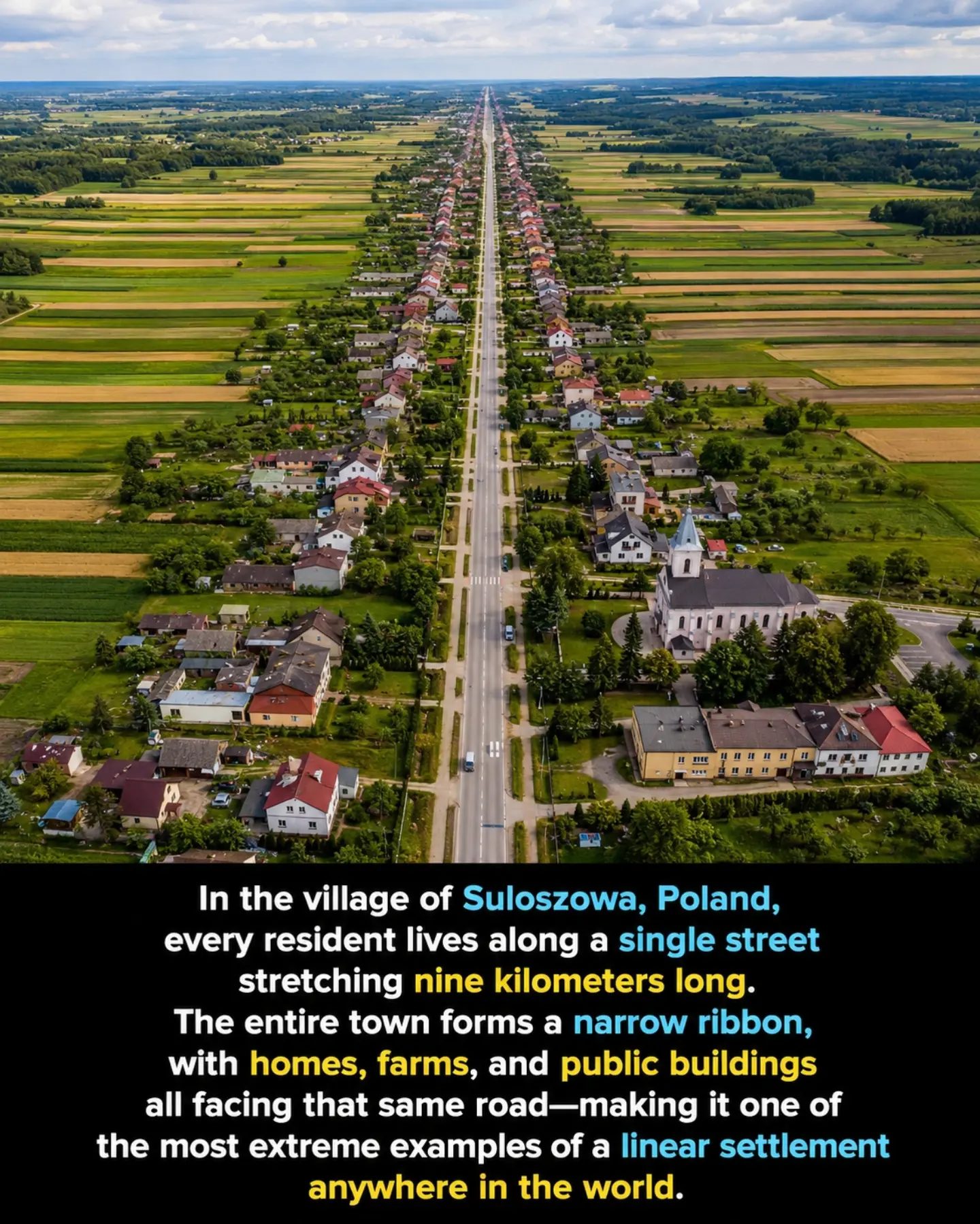
Linear Settlement in Poland
Nestled in Poland, the village of Susoszowa offers a unique example of linear settlement, a pattern where all residences and public buildings are arranged along a single road. This unusual layout makes Susoszowa a notable case study in urban planning and human geography.
Context / Why this matters
Understanding linear settlements provides valuable insights into how communities have adapted to their environments. These settlements often emerge in response to geographical constraints or historical factors. In the case of Susoszowa, the village stretches for nine kilometers along a single street, with homes, farms, and public buildings all facing this central road. This layout is a practical response to the terrain and resources of the region.
Main discussion
The Layout of Susoszowa
Susoszowa’s layout is characterized by its elongated, narrow form. The entire village is aligned along a single, continuous road, creating a ribbon-like structure. This design is not arbitrary; it reflects the historical and geographical context of the village.
Historical Context
Linear settlements often develop in areas where resources or transportation routes are limited. In Susoszowa, the single road likely served multiple purposes: as a transportation route, a source of water, or a boundary between lands. Over time, this central road became the backbone of the village, with all residential and public buildings constructed along it.
Geographical Factors
The geography of Susoszowa also played a crucial role in its development. Linear settlements are common in hilly or mountainous regions where flat land is scarce. In such areas, building along a single road maximizes the use of available space. Although Susoszowa is not hilly, the narrow road layout may still have been influenced by the need to conserve land and resources.
Social and Economic Impacts
The linear settlement pattern in Susoszowa has both advantages and disadvantages. One of the benefits is the strong sense of community that develops along the main street. Residents are in close proximity to each other, which can foster a sense of solidarity and mutual support. Additionally, public buildings, such as schools and community centers, are easily accessible to everyone.
However, there are also challenges associated with this layout. The concentration of buildings along a single road can lead to overcrowding and limited privacy. Public services and amenities, including healthcare and transport, can become strained if they are concentrated in certain areas of the road.
Comparative Analysis
Linear settlements are not unique to Poland. Similar patterns can be found in other regions around the world. In the United States, for example, many rural communities and small towns have a linear layout, often due to the presence of a major road or railroad.
Comparing Susoszowa to other linear settlements provides context for understanding its unique characteristics. For example, some linear settlements are characterized by a high degree of specialization, with different segments of the road catering to specific economic activities, such as agriculture, commerce, or industry.
Practical tips
Appreciating Linear Settlements
When visiting linear settlements like Susoszowa, take the time to appreciate the layout and its historical and geographical significance. Consider how the community has adapted to its environment and how this has shaped its development. Look for key buildings and landmarks along the main street and reflect on their role in the community.
Understanding Urban Planning
Linear settlements offer valuable lessons in urban planning. Understanding how these communities have developed over time can inform strategies for sustainable and efficient urban development. Consider the importance of environmental factors, such as topography and resource availability, in the layout of a settlement.
Engaging with the Community
Interacting with local residents can provide deeper insights into the daily life and culture of a linear settlement. Ask about the history of the village, its traditions, and how people navigate the unique challenges of living in such a community. This engagement can enrich your understanding of the settlement's social and economic dynamics.
Important takeaways
Linear settlements like Susoszowa offer a fascinating study in how communities adapt to their environments. The layout of Susoszowa, with its single, continuous road, is an excellent example of how historical, geographical, and social factors shape urban development. This unique pattern has both advantages and challenges, providing valuable insights into community planning and resource management.
Conclusion
Suszoszowa’s linear settlement pattern is a testament to human ingenuity and adaptability. By understanding the factors that shaped this village, we gain a deeper appreciation for the complexities of urban planning and the resilience of communities. Whether you are a traveler, a geographer, or an urban planner, Susoszowa offers a compelling example of how people have shaped their environments to meet their needs.
Questions readers ask
What defines a linear settlement like Susoszowa, Poland?
A linear settlement is characterized by its layout, where all buildings, including homes and public structures, are situated along a single road. In Susoszowa, this road stretches for nine kilometers, creating a unique and uninterrupted linear structure.
Why is the layout of Susoszowa considered unique?
Susoszowa's layout is unique because it spans an extensive nine kilometers along a single road. This design is not commonly found in other villages, making it a distinctive example of linear settlement.
How does the geography of Susoszowa influence its linear layout?
The village of Susoszowa has adapted to its geographical context by developing a linear layout. This arrangement optimizes the use of available space and resources, reflecting the village's response to its physical environment.
What are some other examples of linear villages in Poland?
While Susoszowa is a prominent example, there are other linear villages in Poland, such as Zygmuntów and Łączany. These villages also feature a single main road with buildings aligned along it, similar to Susoszowa.
Are there any other places in the world with a linear settlement similar to Susoszowa?
Yes, linear settlements can be found in various parts of the world. For example, Grindleford in the UK and Skagaströnd in Iceland are examples of villages that follow a linear settlement pattern, much like Susoszowa.
What can we learn from studying linear settlements like Susoszowa?
Studying linear settlements like Susoszowa can provide insights into how communities adapt to their environments and resources. It offers a perspective on human geography and urban planning, showcasing practical solutions to geographical constraints.
Related deep dives
Similar reads based on topic and creator.




Recent articles
Fresh deep dives from the latest Reels we unpacked.




Comments
Be the first to comment.