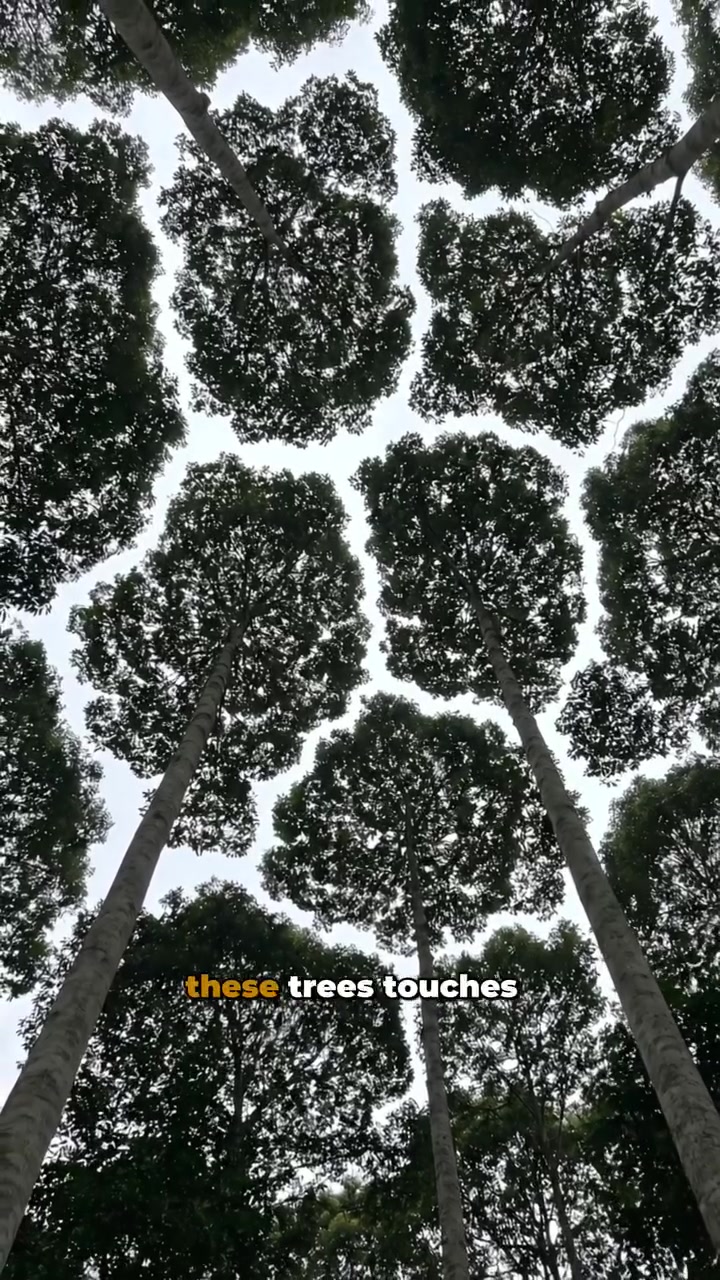
Look up into the dense canopy of certain forests, from Malaysia to Argentina, and you'll notice something curious: the treetops stop growing just short of touching their neighbors. This phenomenon creates a mosaic of foliage, interspersed by narrow channels of open sky. It's called crown shyness.
What is Crown Shyness?
Crown shyness is a natural occurrence in certain forests where neighboring trees' crowns — the uppermost branches and leaves — do not touch each other. From below, the canopy appears as a jigsaw puzzle pulled apart, with each tree stopping short of its neighbor, leaving a gap of open sky. This distinctive feature is observed in various parts of the world, from Malaysia to Argentina, and it occurs even among tree species that are not related. The constant factor is the presence of a crack of sky between the top parts of each tree. Scientists have been investigating crown shyness for over a century, yet the exact mechanisms behind it remain debated. One widely accepted theory involves the role of the wind. Mangroves in Costa Rica, for example, exhibited wider gaps between their crowns when they swayed most. In a controlled experiment in Canada, researchers tied pine trees together to prevent them from hitting each other. After six years, the crowns had filled in the empty spaces above, indicating that wind pruning plays a significant role.
Global phenomena of tree isolation
This puzzling interaction between trees is a worldwide phenomenon, not restricted by geography or tree species. The isolated crowns can be seen from Argentina to Malaysia. Though the pattern is visible all across the globe, the exact causes for these gaps is mysterious. Researchers have only discovered the mechanisms behind crown shyness in select forests. The phenomenon persists across different ecosystems and climates, suggesting a common yet elusive underlying factor. The ongoing debate highlights the complexity of natural phenomena and the need for further research. From Malaysia to Argentina, trees that are not related to each other exhibit crown shyness. Researchers from Costa Rica and Canada have found evidence of crown shyness in their respective regions.
Environmental Factors
One of the leading theories for the mysterious crown shyness phenomenon is the interaction between the environment and the trees. In Costa Rica, scientists have found that mangroves sway more in the wind. The more the trees swayed, the wider the gaps left between them.
Controlled Experiments
Researchers have conducted controlled experiments to uncover the mechanisms behind crown shyness. In Canada, scientists tied pine trees together to prevent them from hitting each other. Six years later, the trees had grown farther into what was once empty sky. This suggests that the interaction between the branches plays a significant role in the way that trees grow. However, the exact mechanism still remains debated.
Multiple Causes
The role of insect activity in the gaps between trees is unexplored. Insects may try to cross between the trees. As they do, they leave debris behind. If the trees try to avoid the debris, the crowns may grow away from one another. Since each tree has an individual response to the wind, light, and insect activity, it's hard to find a single explanation.
Where the theories meet
There are gaps in the wind theory of crown shyness. Some forests do not fit this explanation at all. The phenomenon has even been observed in forests with relatively mild winds. Light, the species of tree, and even insects may all play a part. Insects might try to cross between the trees. If the trees try to avoid the insects, the crowns may grow away from one another.
The Impact of Light
Light is crucial for photosynthesis, the process by which trees convert light energy into chemical energy. Trees may position their branches to maximize light exposure, avoiding contact with neighboring trees to prevent competition. Trees that receive less sunlight may grow differently to maximize light exposure. There are also differences in how trees adjust to varying amounts of light.
Tree Species Influence
The species of the tree may also influence crown shyness. Different species have different growth patterns and responses to environmental factors. For example, some trees may be more sensitive to wind or light than others. The differences in how different species of trees respond to their environment may explain some of the variations in crown shyness. But this still doesn't explain the phenomenon across different ecosystems.
The Role of Insects
Insects may also play a part in crown shyness. Insects might try to cross between the trees, and as the animals leave debris behind, the trees try to avoid the debris. This may explain why some trees have gaps between their crowns. However, more research is needed to understand the role of insects in crown shyness. Insects may leave behind debris as they make their way across a forest. The trees may respond by growing their crowns in a way that minimizes contact with the debris.
Following the research path
Crown Shyness and a scientist
If you're curious about crown shyness and want to delve deeper, following the research path of scientists studying this phenomenon can be a good starting point. Look for studies and articles published in reputable scientific journals. The findings from Costa Rica and Canada have been instrumental. Researchers have conducted experiments and studies in different forests. Reviewing their results and methodologies can provide a deeper understanding of the phenomenon.
Exploring Hypotheses
Crown shyness remains an area of active research, with multiple hypotheses to explore. The leading theory involves the role of wind in pruning the edges of tree crowns. However, other factors like light, tree species, and even insects may also play a part. Considering these hypotheses can help you understand the complexity of natural phenomena and the need for further research. If you want to explore crown shyness further, consider the hypotheses that scientists have proposed. The leading theory involves the role of wind in pruning the edges of tree crowns. However, other factors like light, the species of tree, and even insects may also play a part. Considering these hypotheses can help you understand the complexity of natural phenomena and the need for further research.
Reading Scientific Articles
Reading scientific articles can help you understand the current state of research on crown shyness. Look for studies that have been published in reputable scientific journals. The findings from Costa Rica and Canada have been instrumental. Researchers have conducted experiments and studies in different forests. Reviewing their results and methodologies can provide a deeper understanding of the phenomenon.
Reviewing Field Studies
Field studies on crown shyness can provide insights into how the phenomenon occurs in different ecosystems. Reviewing these studies can help you understand the variability in crown shyness and the factors that influence it. Researchers have conducted experiments and studies in different forests. Reviewing their results and methodologies can provide a deeper understanding of the phenomenon. The role of the wind, light, and tree species in crown shyness is still being debated. Reviewing the various sources in which crown shyness has been observed can help you understand the complexity of the phenomenon. If you are interested in this topic, consider following where the research has gone in the past. Reviewing field studies on crown shyness can provide insights into how the phenomenon occurs in different ecosystems. Understanding the different factors that influence crown shyness will help you learn more about the phenomenon.
Questions readers ask
What exactly causes the gaps between the treetops in crown shyness?
The exact cause of crown shyness is still debated, but one of the leading theories involves wind. Trees swaying in the wind may prune each other, creating gaps. Additionally, some researchers suggest that the interaction between branches and potential insect activity may also play a role.
Is crown shyness a rare phenomenon, or is it widespread?
Crown shyness is surprisingly widespread. It occurs in forests all over the world, from Malaysia to Argentina, and is observed in various tree species that are not even related to each other.
Can humans influence or control crown shyness in forests?
The article mentions controlled experiments where researchers tied pine trees together, preventing them from hitting each other. After six years, the trees had grown into the previously empty spaces, suggesting that human intervention can influence crown shyness, though the exact mechanisms are still debated.
How do insects factor into the crown shyness phenomenon?
The role of insects in crown shyness is still unexplored. It's possible that insects trying to cross between trees leave debris, and the trees may grow away from each other to avoid this debris, creating the gaps observed in crown shyness.
Does crown shyness benefit the trees in any way?
The article does not explicitly state the benefits of crown shyness for trees, but the phenomenon does create a unique canopy structure that allows more light to penetrate the forest floor, which could benefit the ecosystem as a whole. Further research is needed to understand the specific advantages for the trees themselves.
Are there any specific tree species more prone to crown shyness?
Crown shyness is observed in various tree species across different regions, and it is not restricted to any particular species. The phenomenon has been noted in both temperate and tropical forests, suggesting it is not species-specific but rather a more universal tree behavior.
How does crown shyness impact the ecosystem beneath the canopy?
The gaps created by crown shyness allow more light to reach the forest floor, which can influence the composition of the understory. This increased light can promote the growth of certain plants and potentially support a greater diversity of plant and animal life.
Related deep dives
Similar reads based on topic and creator.

Recent articles
Fresh deep dives from the latest Reels we unpacked.



Comments
Be the first to comment.