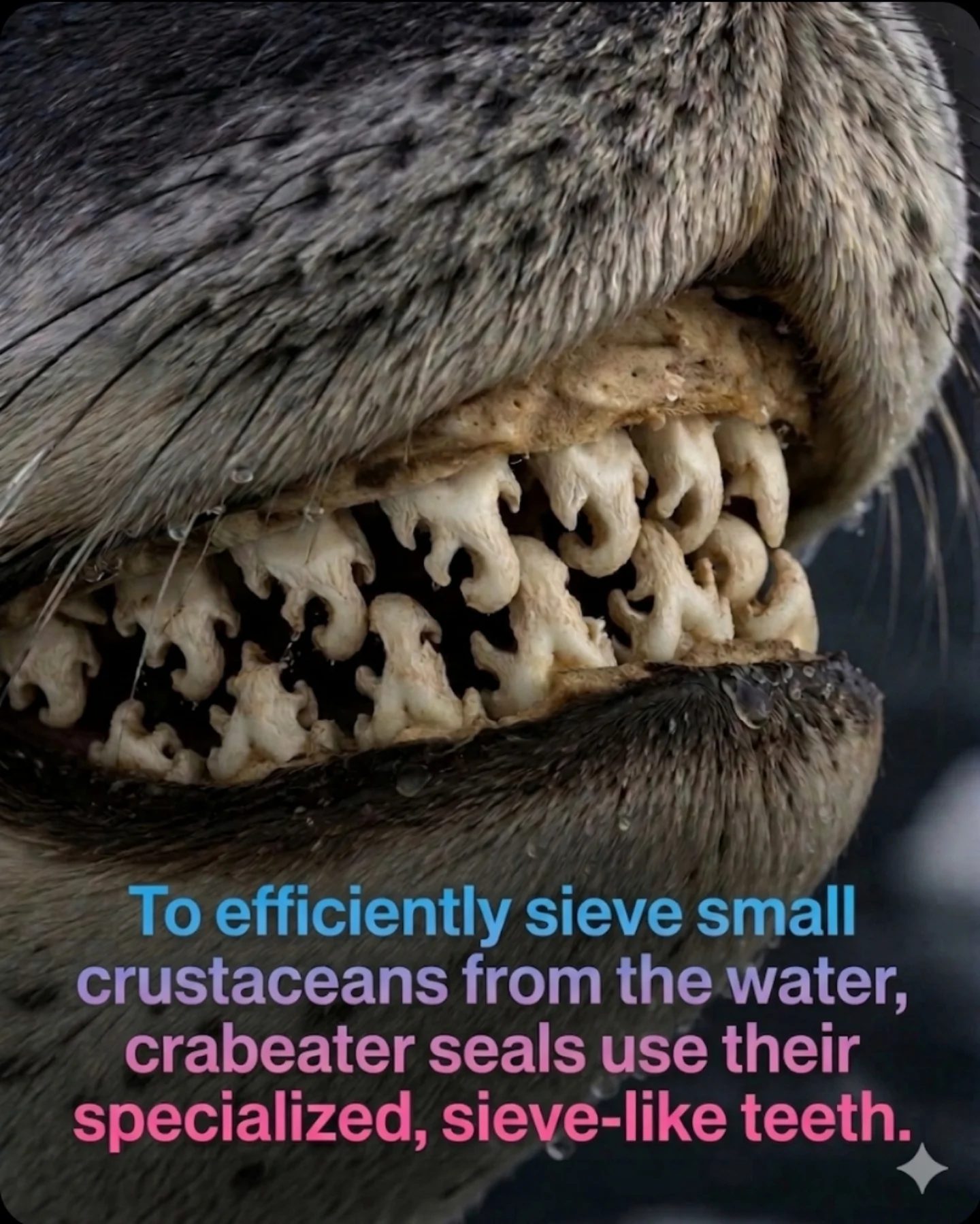
Crabeater Seal Teeth: Nature's Marvel of Filter Feeding
Crabeater seals, despite their name, primarily feed on Antarctic krill rather than crabs. Their unique dental adaptations make them one of the most efficient filter feeders in the marine world. This article delves into the fascinating mechanics of their specialized teeth and feeding process.
Context: Why It Matters
Understanding the crabeater seal's filter-feeding mechanism provides insights into the intricate adaptations that allow these animals to thrive in their harsh Antarctic environment. Their efficient feeding strategy is not just a remarkable example of evolutionary adaptation but also a key factor in the seal's role within the Southern Ocean's ecosystem.
The Unique Dentition of Crabeater Seals
Specialized Teeth Structure
Crabeater seals have evolved a highly specialized dentition that sets them apart from other marine mammals. Their post-canine teeth are equipped with complex, multi-cusped structures. These teeth feature deep, custom-fit interdigitations that form an exceptionally efficient sieve when the jaws are closed.
The intricate bony projections on these teeth fit together precisely, creating a filtering mechanism that allows the seal to sieve small crustaceans from the water effectively. This unique dental structure is one of the most sophisticated filtering mechanisms observed in marine mammals.
The Role of the Tongue in Sieving
In addition to their specialized teeth, crabeater seals use their tongues to enhance the efficiency of their feeding process. When the seal's jaws close, the tongue forces the captured water outward through the gaps between the interlocking cusps. This action ensures that seawater is expelled while the krill is retained within the oral cavity, ready for swallowing.
Comparison to Baleen Whales
The filtering mechanism of crabeater seals is analogous to that of mysticete (baleen) whales. Both species have evolved efficient methods to filter small organisms from large volumes of water. However, the crabeater seal's method is unique, utilizing its teeth to create a sieve-like structure rather than baleen plates.
The Feeding Cycle
Ingestion
The feeding process begins with ingestion. Crabeater seals swim through high-density swarms of krill, sucking in large volumes of krill-laden seawater. This behavior allows them to capture a significant amount of their primary food source in a single action.
Sieving
During the sieving phase, the seal's unique dental structure comes into play. As the jaws close, the specialized gaps between the teeth allow the water to escape while trapping the krill inside. The physical dimensions of these interdental spaces are precisely calibrated to retain the krill, ensuring that the seal maximizes its energy intake efficiently.
Retention
The final step in the feeding cycle is retention. Once the krill is trapped within the oral cavity, the seal can swallow it, ensuring that it gains maximum nutritional benefit from its filter-feeding activity.
Practical Tips for Observing Crabeater Seals
While observing crabeater seals in their natural habitat, it's essential to understand their feeding behavior to appreciate their unique adaptations fully. Here are some practical tips:
-
Patience is Key: Crabeater seals often feed in large groups, and observing them requires patience. Spend time watching their movements and interactions to get a better understanding of their feeding patterns.
-
Environmental Awareness: Be mindful of the environment. These seals are adapted to the harsh conditions of the Antarctic, and their feeding behavior is intricately linked to the availability of krill in the water. Understanding the seasonal variations in krill abundance can provide deeper insights into their feeding habits.
-
Use of Technology: For a closer look, consider using binoculars or telephoto lenses. These tools can help you observe the seals' specialized teeth and feeding mechanisms without disturbing their natural behavior.
-
Conservation Efforts: Support conservation efforts aimed at protecting the Antarctic ecosystem. The health of krill populations directly impacts the well-being of crabeater seals, and preserving their habitat is crucial for their survival.
Important Takeaways
Crabeater seals are a testament to nature's ingenuity in adapting to specific ecological niches. Their specialized teeth and filter-feeding mechanism allow them to thrive in the harsh conditions of the Antarctic, where they play a crucial role in the Southern Ocean's ecosystem.
The unique dental structure of crabeater seals, along with their coordinated feeding behavior, makes them one of the most efficient filter feeders in the marine world. By understanding their adaptations, we gain valuable insights into the complex interplay between evolution, behavior, and ecology.
Conclusion
Crabeater seals' specialized teeth and filter-feeding mechanisms are a marvel of natural adaptation. Their unique dental structure, combined with a highly coordinated feeding behavior, allows them to occupy a distinctive ecological niche, functioning as efficient filter feeders. By studying these adaptations, we can appreciate the intricacies of evolution and the delicate balance of marine ecosystems.
Questions readers ask
What are crabeater seals' primary food source?
Crabeater seals mainly consume Antarctic krill, which are small, shrimp-like crustaceans. Despite their name, crabeater seals rarely eat crabs; their diet is overwhelmingly composed of krill due to their feeding mechanism.
How do crabeater seals filter feed?
Crabeater seals use their unique, multi-cusped teeth and tongue to strain krill from seawater. They open their mouths and take in a large volume of water and krill, then close their mouths and press their tongues against their teeth to filter out the krill, expelling the water.
What makes crabeater seals' teeth so effective for filter feeding?
The crabeater seal's teeth have a distinct structure with multiple cusps, or points, along the edges. This design creates a fine mesh that effectively traps krill while allowing water to pass through, making them highly efficient filter feeders.
Why is the crabeater seal's feeding mechanism important for the Southern Ocean's ecosystem?
Crabeater seals play a crucial role in the Southern Ocean's ecosystem by controlling krill populations. Their efficient feeding helps regulate krill numbers, which in turn affects other species that rely on krill for food, such as penguins, whales, and other seals.
How do crabeater seals adapt to their harsh Antarctic environment?
Crabeater seals have developed specialized adaptations to thrive in the Antarctic environment. Their efficient filter-feeding mechanism allows them to consume large quantities of krill, which are abundant in the region, ensuring they obtain enough nutrition to survive in the cold waters.
What is the role of the crabeater seal's tongue in their feeding process?
The crabeater seal's tongue works in tandem with their teeth during filter feeding. After taking in a mouthful of water and krill, the seal presses their tongue against their teeth to create a fine sieve, allowing water to escape while trapping the krill.
How do crabeater seals contribute to the study of marine crustacean feeders?
By examining the crabeater seal's feeding mechanisms, researchers gain insights into the specialized adaptations of marine crustacean feeders. The seal's unique dentition and filter-feeding process serve as a model for understanding how other marine species have evolved to efficiently consume small crustaceans in their environments.
Related deep dives
Similar reads based on topic and creator.




Recent articles
Fresh deep dives from the latest Reels we unpacked.




Comments
Be the first to comment.