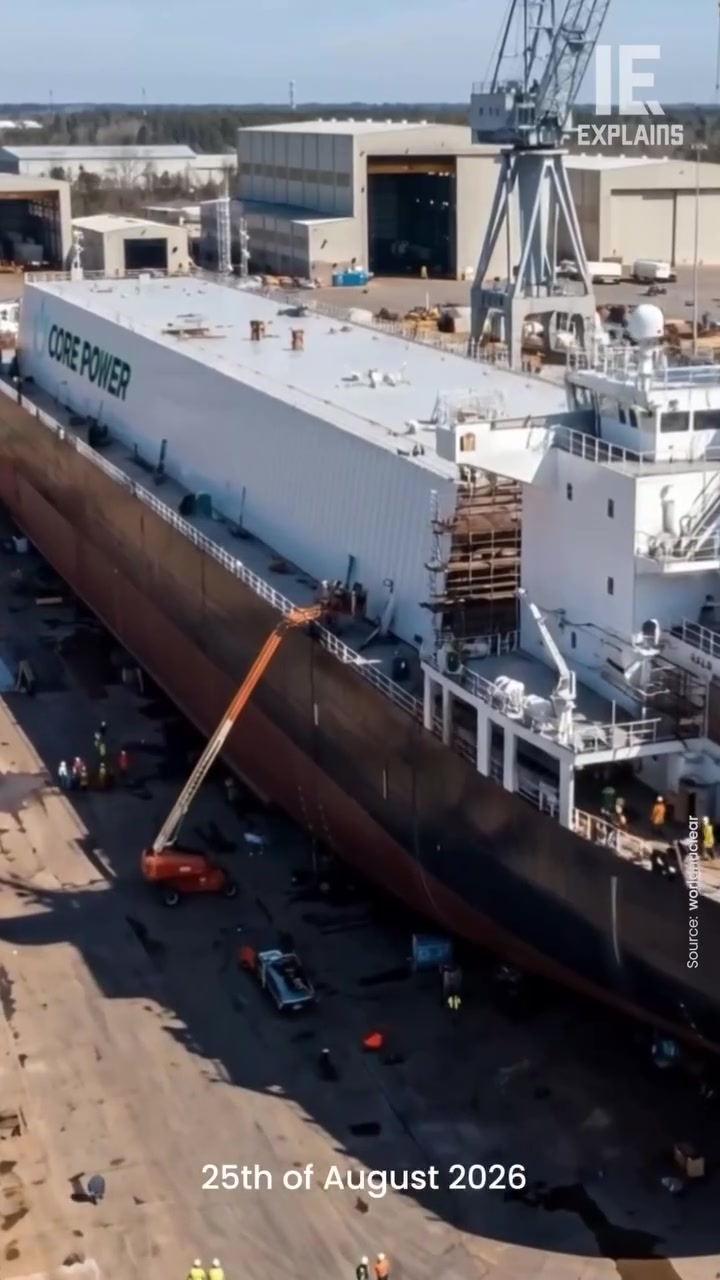
The Nuclear Shipyard: Core Power's Ambition
Nuclear-powered merchant ships have become a talking point in Washington. On August 25, 2026, the US Maritime Administration (Marad) signed a memorandum with Core Power, a relatively new player. The goal: a fleet of American merchant ships powered by nuclear reactors, not fuel tanks. This is no run-of-the-mill prop idea; it’s part of a broader trend. Marad published a request for information in May, working with agencies like the Coast Guard and the Nuclear Regulatory Commission. Long Beach and Corpus Christi ports signed on, with Marad administrator Stephen Carmel calling it a "serious commercial opportunity." The physics backs it up. A large ship’s engine runs at a consistent, high load—something reactors are great at.
The Nuclear Reactor Module Design
Core Power’s approach differs from traditional naval reactors. Their reactor, developed with TerraPower and Southern Company, is a molten chloride fast reactor. Here, fuel is dissolved in chloride salt, which acts as both fuel and coolant. This setup circulates at high temperatures and near atmospheric pressure, mitigating risks from pressure loss. This molten salt design is a sharp contrast to pressurized water reactors. Water reactors require thick pressure vessels and heavy containment, designed to manage sudden pressure loss. Core Power’s molten salt reactor, however, removes the risk of high-pressure water flashing to steam, a common cause of severe accidents in traditional reactors. But there’s a catch: no molten chloride fast reactor has gone critical yet. The largest system built so far is the Integrated Effects Test in Everett, Washington, a non-nuclear rig that heats and pumps chloride salt at up to 1 megawatt. A 180 megawatt demonstrator reactor is planned for the early 2030s. Despite this, the design suits modern ship layouts well. All-electric ships, where the reactor makes electricity and electric motors turn the propellers, align perfectly with this technology. The challenging part is getting it to work.
The NS Savannah: A Historical Misstep
The NS Savannah, launched in 1962, was the US’s first nuclear merchant ship. Beautiful but flawed, it cost $46.9 million, with $28.3 million spent on the reactor fuel alone. Its Babcock and Wilcox pressurized water reactor, rated at 74 megawatts thermal, was a technological marvel but an economic disaster. It cost roughly $2 million more per year to operate than an equivalent oil-fired Mariner-class ship, a significant burden given cheap oil prices at the time. Ports in Australia, New Zealand, and Japan refused entry, and it retired in 1972.
Legal and Regulatory Hurdles
The NS Savannah’s problems are still relevant. International rules for nuclear merchant ships, Resolution A.491 adopted by the International Maritime Organization (IMO) in 1981, are written around pressurized water reactors. Molten salt reactors don’t fit this framework. The IMO agreed in June 2025 to revise these codes, but changes of this scale take years. Liability poses another challenge. A treaty covering nuclear merchant ship accidents lacks enough ratifications, leaving no global regime for accident liability. No insurer will underwrite unlimited liability, and ports won’t accept ships with emergency planning zones sized for land-based power stations.
Fuel Supply and Global Competition
Fuel supply is another roadblock. These reactors need highly enriched uranium (HELEU), produced by Centrus at Piketon, Ohio. By June 2025, Centrus had produced only 900 kilograms, far short of the tons needed for a serious fleet. Meanwhile, China dominates global shipbuilding. In 2025, it built over 53% of the world’s ships and holds over 60% of the global order book. The US, in contrast, accounted for just 0.11% in 2024.
For Investors Interested in Nuclear Shipping
If you’re considering investing in nuclear shipping, here’s what to watch:
- Regulatory Changes: Keep an eye on the IMO’s revisions to Resolution A.491 and SOLAS provisions.
- Fuel Supply: Monitor Centrus’s production capabilities and any new suppliers entering the market.
- Port Acceptance: Follow updates from major ports like Long Beach and Corpus Christi, and how they handle nuclear ships.
- Technological Milestones: Track the progress of Core Power’s demonstrator reactor and other molten salt reactor developments. Nuclear propulsion at sea has long been technically possible but never commercially or legally viable. August 2026 marked a shift, as the government began addressing the legal and regulatory challenges. Whether a nuclear ship exists by 2035 depends more on lawyers, insurers, and port authorities than on physics. The real work lies ahead.
Questions readers ask
What exactly is a molten chloride fast reactor, and how does it differ from traditional nuclear reactors?
A molten chloride fast reactor, like the one being developed by Core Power, uses chloride salt as both fuel and coolant. This design operates at high temperatures and near atmospheric pressure, which reduces the risk of accidents from sudden pressure loss. Unlike traditional pressurized water reactors, which require thick pressure vessels and heavy containment, molten salt reactors avoid the risk of high-pressure water flashing to steam.
Why are nuclear-powered merchant ships being considered again after the NS Savannah's failure?
The push for nuclear-powered merchant ships today is driven by advances in reactor technology and the need to reduce the environmental impact of shipping. Core Power's molten chloride fast reactor is more efficient and safer than the pressurized water reactor used in the NS Savannah. Additionally, the high load requirements of large ships align well with the consistent output of nuclear reactors, making them an attractive option for reducing fuel consumption and emissions.
What are the main challenges Core Power faces in developing their nuclear reactor for ships?
Core Power faces several significant challenges. The biggest is that their molten chloride fast reactor design has not yet reached criticality. Additionally, the regulatory framework for nuclear merchant ships, which is based on older pressurized water reactor technology, needs to be revised to accommodate molten salt reactors. This process is complex and time-consuming. The company must also navigate international regulations and liability concerns, as there is currently no global regime for handling nuclear merchant ship accidents.
How does the cost of operating a nuclear-powered ship compare to traditional fuel-powered ships today?
The cost comparison between nuclear-powered and traditional fuel-powered ships is complex. While the initial investment in nuclear technology can be high, the long-term operational costs might be lower due to reduced fuel consumption. However, the exact cost savings depend on various factors, including fuel prices, operational efficiency, and maintenance requirements. Unlike the NS Savannah, which was more expensive to operate, modern nuclear technology aims to be more cost-effective.
What role do the Long Beach and Corpus Christi ports play in this initiative?
The Long Beach and Corpus Christi ports have signed on to support the initiative, indicating their willingness to facilitate the integration of nuclear-powered ships into their operations. This support is crucial for testing and deploying the new technology, as well as for demonstrating the feasibility of nuclear-powered shipping in real-world scenarios.
Related deep dives
Similar reads based on topic and creator.




Recent articles
Fresh deep dives from the latest Reels we unpacked.



Comments
Be the first to comment.