Cost of Living Comparison
Understanding the purchasing power of money in different countries can be eye-opening. The cost of living varies significantly around the world, and this comparison highlights how $50 and $5 can feel vastly different depending on where you are. This difference is influenced by a variety of factors, including local economies, currencies, and the cost of everyday goods and services.
Why This Matters
The cost of living is a critical factor in determining the quality of life in any country. It affects how far your money can go, what you can afford to buy, and how you can enjoy leisure activities. By comparing the value of $50 and $5 in different countries, you can gain a better understanding of the financial landscape and what to expect if you plan to travel or move abroad.
Main Discussion
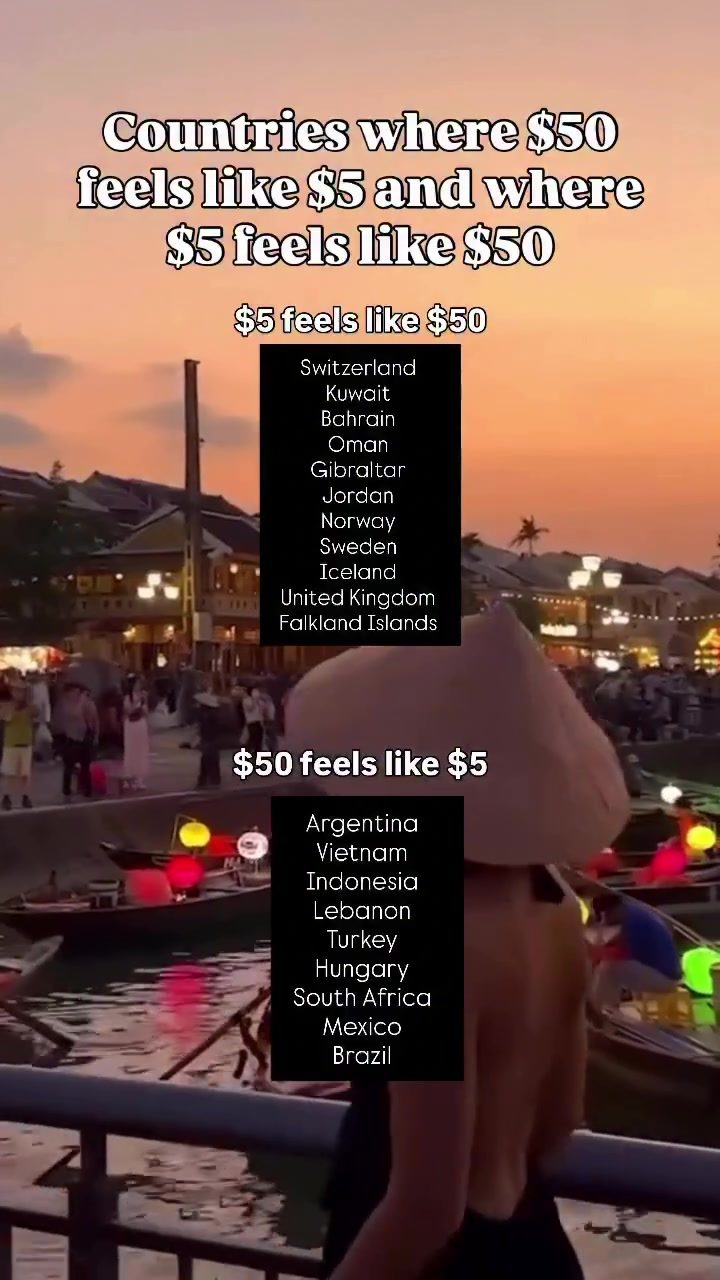
Countries Where $50 Feels Like $5
In some countries, $50 doesn't go as far as it might in others. The list of countries where $50 feels like $5 includes places like:
- Switzerland
- Kuwait
- Oman
- Bahrain
- Gibraltar
- Jordan
- Norway
- Sweden
- Iceland
- United Kingdom
- Falkland Islands
These countries are generally known for their high cost of living. For instance, Switzerland is famous for its luxurious lifestyle, which comes at a high financial cost. Food, housing, and other essentials tend to be more expensive, making $50 feel like a much smaller amount. Similarly, countries like Kuwait and Norway have robust economies with high standards of living, but this comes with a higher cost for everyday items.
Countries Where $5 Feels Like $50
On the opposite end of the spectrum, there are countries where $5 stretches much further. These include:
- Argentina
- Vietnam
- Indonesia
- Lebanon
- Turkey
- Hungary
- South Africa
- Mexico
- Brazil
In these places, the cost of living is generally lower, making $5 feel like a significant amount. For example, in Vietnam, everyday goods and services are relatively affordable, allowing residents and tourists to enjoy a higher purchasing power with less money. Similarly, in Brazil, despite recent economic challenges, the cost of living in many areas remains lower compared to more developed countries, making $5 go a long way.
Factors Affecting Purchasing Power
Several factors contribute to the significant differences in purchasing power:
- Currency Exchange Rates: The value of a country's currency can greatly impact how far your money will go. For instance, countries with strong currencies like the Swiss Franc and Norwegian Krone tend to have a higher cost of living.
- Economic Stability: Countries with stable economies often have higher living costs. This is because a stable economy can support higher prices for goods and services.
- Cost of Goods and Services: The price of essentials like food, housing, and transportation varies widely. In countries with lower costs, everyday items are more affordable, allowing for greater purchasing power.
- Income Levels: Higher income levels can drive up the cost of living. In countries where wages are high, the cost of living tends to be higher as well, to match the increased spending power of the population.
- Government Policies: Policies related to taxation, subsidies, and economic regulations can also impact the cost of living. For example, countries with high taxation may have higher prices for goods and services.
The Impact on Daily Life
The differing values of $50 and $5 in these countries have a significant impact on daily life. In countries where $50 is equivalent to $5, residents may need to work longer hours or have multiple jobs to afford a comfortable lifestyle. In contrast, in countries where $5 feels like $50, people can enjoy a higher standard of living with less financial strain.
Practical Tips
When planning to travel or move to a country with a different cost of living, there are several practical tips to keep in mind:
- Research Local Prices: Before you go, research the cost of essential items like food, housing, and transportation. This will give you a better idea of what to expect and how to budget accordingly.
- Consider Cost of Living Indexes: Use online resources that provide cost of living indexes for different countries. These can help you compare the relative cost of living in various places.
- Budget Accordingly: Plan your budget based on the local cost of living. This may mean saving more if you're moving to a country with a high cost of living, or being more conservative with your spending if you're moving to a country with a lower cost of living.
- Adapt to Local Customs: Different countries have different customs and norms around spending and saving. Be open to adapting your habits to fit the local culture and financial environment.
Important Takeaways
Comparing the purchasing power of $50 and $5 in different countries reveals the stark differences in cost of living around the world. This comparison highlights:
- The significant impact of currency exchange rates, economic stability, and government policies on purchasing power.
- The varied cost of goods and services, which can make $50 feel like $5 in some places and $5 feel like $50 in others.
- The need to research and adapt to the local cost of living when planning to travel or move abroad.
Conclusion
The cost of living varies widely around the world, and understanding these differences can help you make informed decisions about travel, relocation, and financial planning. Whether you're planning a vacation, considering a move, or simply curious about the world, comparing the purchasing power of money in different countries can provide valuable insights.
Questions readers ask
How do local economies affect the purchasing power of $50 or $5?
Local economies greatly influence purchasing power. In countries with strong economies, $50 might stretch further due to higher wages and lower taxes, while $5 might be more modest in places with robust economies. In contrast, in less developed economies, $50 could barely cover essentials, and $5 might not go far at all.
Which cities are known as some of the most expensive places to live?
Some of the most expensive cities to live in include London, New York, and Singapore. In these cities, $50 would only cover a small fraction of daily expenses, and $5 may barely cover a single meal or a short bus ride.
How does currency value impact the cost of living?
Currency value plays a pivotal role in the cost of living. A strong currency, like the US Dollar or Euro, can significantly boost your purchasing power in countries with weaker currencies. Conversely, a weak currency can diminish your spending power in countries with stronger currencies.
Are there places where $50 can feel like a substantial amount?
Yes, in countries like Indonesia, Vietnam, or India, $50 can go a surprisingly long way. This amount could cover multiple meals, local transportation, and even accommodations, providing a comfortable experience for some travelers.
What are some of the cheapest places to live in the world?
Some of the most affordable places to live include cities in Southeast Asia like Chiang Mai, Thailand, or Hanoi, Vietnam. Additionally, certain cities in South America, such as Quito, Ecuador, and Latin American cities like Bogotá, Colombia, offer a low cost of living where $50 can cover a week's worth of expenses.
How can understanding the cost of living help travelers?
Understanding the cost of living in different countries can help travelers budget effectively. Knowing how far $50 or $5 will go in a particular destination allows travelers to plan their expenses, choose affordable accommodations, and enjoy local activities within their budget.
What factors influence the cost of living in a country?
Several factors influence the cost of living, including the cost of housing, food, transportation, and utilities. Other factors include local taxes, wages, and the overall economic stability of the country. These elements collectively determine how far your money can go in a particular location.
Related deep dives
Similar reads based on topic and creator.




Recent articles
Fresh deep dives from the latest Reels we unpacked.




Comments
Be the first to comment.