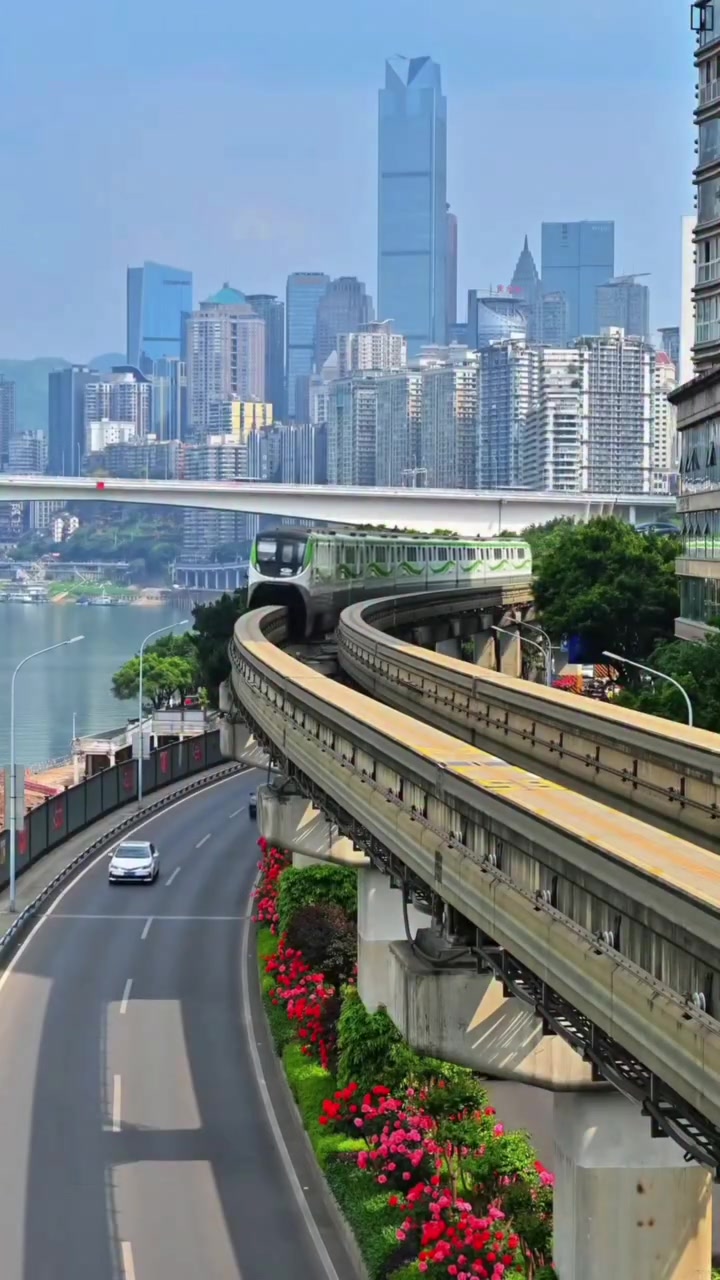
Chongqing's dearest train line: Gateway is a metro station and residential apartment building, a sight engineered into the heart of the city's transportation network. "You'll have to go through that," they say. "There's a train station in the middle of the apartment." Living in Chongqing is living with the train.
Elevated Living
Imagine living in a city where the metro system moves through residential buildings. Chongqing — China’s mountainous municipality — is where this ingenious concept became a necessity. Efficiently blending structure and transportation, people live in complex urban spaces. High-rise apartments integrate a station into their design, allowing the light rail to operate through the building’s center. A metro station passing through an apartment complex defies conventional train engineering. In Chongqing, the metro system does not just serve commuters: integrating living spaces and transportation infrastructure rearranges how urban growth is managed. Building the metro directly through a residential building may look impossible from the outside, but it works: people live in condos above it. The train tracks operate up to 12th floor, ensuring the building functions without interference to daily life. Here, people live over the train tracks and continue to use the metro station as part of their daily commute.
Chonqing's Urban Gravity
Urban transport architecture uniquely shapes the city’s identity. Train tracks through buildings may seem extreme, but such designs are part of Chongqing's broader approach to navigating steep terrain. What sets Chongqing apart is not just its innovative vertical integration of transportation and housing, but its willingness to challenge urban planning norms. Chongqing’s population and urban density have forced the city to innovate. With limited space and steep, mountainous terrain, traditional transit methods would not suffice. Accordingly, Chongqing has turned necessity into identity: a city known for its creative solutions to urban mobility. Elevated train systems and buildings with metro stations built into them reflect the city’s adaptability. This innovation acknowledges urban design constraints and celebrates them.
How elevated tracks work
Rail corridors running through apartment buildings forbid conventional barriers between transit and homes. Tracks run through the building at the ground level, opening spaces on both sides for seamless residential integration. Air retracting chambers absorb vibrations caused by the train, protecting apartments just fifteen yards away. Entering and exiting platforms are on opposite sides of the building, connecting sidewalks with stairs and elevators. A garage separates the tracks, with units on the higher floors.
The Geo-Trajectory
Transportation transform cities. Chongqing sits at the junction of the Yangtze River, Jialing River, and towering mountains. These geographical barriers necessitate unusual urban design. In 2012, the city’s metro system began operating—today, it covers more than 200 kilometers of track. Given Chongqing’s topography, building a fully above-ground system made the most sense. This allows the metro to traverse steep inclines and dense neighborhoods.
Balancing nature and urbanization
Chongqing’s bridges and tunnels capture a dual sense of nature and urbanization. Though the elevated system is modern, lush greenery along the tracks restores the land, giving people access to nature above the tracks. Chongqing’s metro system is clean, and modern. Plants line the tracks to integrate with surrounding urban landscapes. The elevated train, surrounded by urban greenery, provides a unique urban experience, offering a contrast between modern infrastructure and natural elements.
Would you live there?
Lifestyle options are a boon for residents. Chongqing condos give many a drastic change of pace. The metro station, part of daily life, operates without disturbance to nearby residences. People continue to access the metro system during high-traffic periods. Lush greenery is added to the tracks, harmonizing with the urban environment.
* Eco-Growth: By expanding sustainably and integrating public transportation with residential spaces. The city also prioritizes the environment, creating vibrant, green spaces along the elevated train tracks.
* Commuting:The metro station is accessible within the building, making it an efficient way to travel for countless residents.
* Cross-Living: Living adjacent to a metro station provides convenience: it is connected by ten steps. People live above and around the transit connection. The metro station connects the city in under 20 minutes, providing direct access to Chongqing. To travel there is to experience a unique urban landscape.
Nature's Preserve
In Chongqing's urban landscape, elevated train stations intertwine environmental design with city infrastructure. The city’s metro system is built to coexist with nature, integrating urban greenery throughout the elevated tracks. The integration of public transportation with housing provides a sustainable urban environment, blending industry and nature without compromising either. Ultimately, Chongqing's approach highlights that design innovation is needed to meet living standards while preserving the environment.
Questions readers ask
How does the metro system in Chongqing manage to run through residential buildings without causing disturbances to the residents?
The metro system in Chongqing is designed with special air retracting chambers that absorb vibrations from the trains, ensuring that the residents living just fifteen yards away are not disturbed. The tracks are integrated into the building's structure, with platforms on opposite sides and a garage separating the tracks from the residential units, allowing for seamless integration into daily life.
What inspired Chongqing to build its metro system through residential buildings?
Chongqing's unique urban planning is a direct response to the city's challenging topography. With steep, mountainous terrain and limited space, traditional transit methods were not feasible. This necessitated innovative solutions, including integrating living spaces and transportation infrastructure.
Are there other cities that have adopted a similar approach to urban planning as Chongqing?
While Chongqing's approach is quite unique, other cities have explored vertical integration of transportation and housing in response to space constraints. However, the extent to which Chongqing has integrated metro systems directly through residential buildings is relatively uncommon.
Can residents in these buildings use the metro station as part of their daily routine without inconvenience?
Yes, residents can use the metro station as part of their daily routine. The design ensures that the train tracks operate up to the 12th floor, allowing people to live above the tracks without interference to their daily lives. The station is integrated into the building, making it convenient for residents to commute.
What are some of the benefits of having a metro system that runs through residential buildings?
The primary benefits include efficient use of space, reduced travel time for residents, and a unique urban identity. By integrating transportation and housing, Chongqing has managed to accommodate its dense population while creating a distinctive urban landscape.
What are the challenges faced by residents living in buildings with metro systems running through them?
Despite the innovative design, residents might face challenges such as noise and vibration, though these are mitigated by air retracting chambers. Additionally, the constant presence of the metro could be seen as an unusual living environment, which might not appeal to everyone.
How does the metro system in Chongqing impact the city’s overall transportation network?
The metro system significantly enhances Chongqing's transportation network by providing a efficient way to navigate the city's steep terrain. The system covers over 200 kilometers of track, connecting various parts of the city and making it easier for residents to commute despite the challenging geography.
Related deep dives
Similar reads based on topic and creator.




Recent articles
Fresh deep dives from the latest Reels we unpacked.



Comments
Be the first to comment.