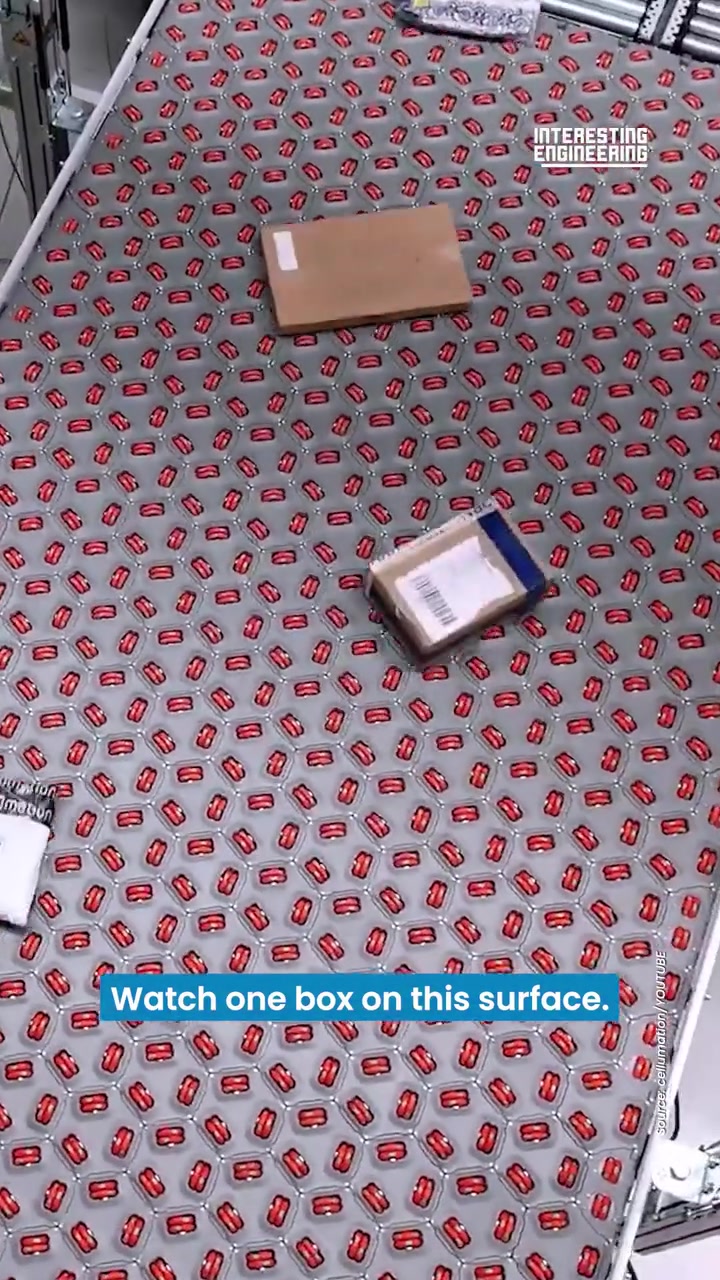
Nearly half a million small warehouses and distribution centers cram onto European shelves, each battling chaos in its inventory. A researcher from Bremen, Germany has a fix for that: a machine that sorts and arranges boxes with surgical precision. The Celluvaea from Cellumation is a modular looping conveyor belt that aligns boxes without the usual robotic arms. No physical contact guides the boxes. The surface itself carries and aligns the boxes. The video describes the movements and explains that the base of the machine is a hexagonal cell. Each Cell holds three omnidirectional wheels, each driven separately. The software adjusts the direction of these wheels and dictates the surface movements.
What makes the Celluvaea remarkable is its exacting navigation without constant guides or pusher arms.
It arranges and rearranges without a conveyor belt. The boxes can slide sideways, then rotate on the spot, turn to face the right way, or clear a pile by itself. The surface makes decisions about the orientation based on the instructions of the controlling software. The machine is flexible. It can "comb a jumbled heap of parcels into a single file line," turning each box according to the next machine's needs. The adaptive behavior is built in — no physical changes required, and older sorting machines rely on recirculation loops to correct errors. Celluvaea corrects itself on the fly – fixing problems as they arise on the surface.
The Case for Intelligent Sorting Machines
As goods floods into distribution centers at high speed, the Celluvaea offers a glimpse into the future of industrially automated sorting. eCommerce, for one, is seeing faster growth with an increase of 8.7% in 2022. This means that for certain retailers, the volume of goods moving through warehouses and distribution centers is greater than ever. This volume of goods would lead to wasted time in conventional sorting machines. The globalization of the supply chain has also increased the complexity of distribution. The average supply chain now involves 21 parties, up from 11 in 2015. Each might have different packaging, which makes sorting a nightmare. Celluvaea varies its sorting based on weight and size automatically, matching the preferences of each client.
The Hexagonal Cell
Imagine a conveyor system that operates with no belts, no arms, and no guides. What makes this possible is Cellumation's hexagonal cells. Each hexagonal cell holds three omnidirectional wheels. These wheels move independently, allowing the machine to decide the surface's movements, guiding boxes with a level of precision set by the software.
The Finer Controls of Software
Control software is the core of the Celluvaea. The software can effectively encode the physical movements of the surface and movement of boxes. It manages the sorting and ensures that the boxes are straight and aligned with the requirements of the next machine.
The Precise Handling of Boxes
The way the Celluvaea handles boxes is also a marvel. It retains the ability to "rotate it on the spot or send two parcels down separate paths at once." The hardware never changes, but the software dynamically adjusts the pathways of each box so that they get to the correct endpoint.
It’s better than traditional sorting machines
One of the most remarkable contrasts the video makes is between the old singulators and Celluvaea. Traditional sorting machines break down boxes into smaller parts or send them to a recirculation loop if they encounter a problem. The Celluvaea, on the other hand, can work with the build-up of the boxes or the mess of boxes and fix it where it is. The floor-based corrections are automatic and on the fly. By fixing errors on the surface, it can save time.
How to Get Your Own Hexagonal Wheel Solution
For logistics professionals anywhere, Christiaansen provides a blueprint for building a more agile system. Cellumation machines are custom-built based on the exact needs of the customer. If you're ready to automate and modernize your warehouse, * Reach out to Cellumation:* Contact the Cellumation team in Savona, Italy, or Bremen. Let them know what your goals are for your warehouse. Given the customer's needs, the company will tailor the design of its machine.
- Determine if the Celluvaea fits your workflow:* Assess the layout of your warehouse and determine if the Celluvaea's potential to save time and labor on your side of the supply chain. A read of the manual explains the technology in depth.
- Test the accuracy of the software:* The algorithm makes the magic happen by adapting its movements to the boxes' conditions. There is an online test to simulate whether the algorithm would work for your boxes in a scenario.
Questions readers ask
What exactly is the Celluvaea and how does it differ from traditional sorting machines?
The Celluvaea is an automated sorting machine developed by Cellumation. Unlike traditional sorting machines that use robotic arms or conveyor belts with physical guides, the Celluvaea uses a modular looping conveyor belt with hexagonal cells that move boxes with surgical precision. The boxes are aligned and rearranged by the surface itself, which is controlled by software that adjusts the direction of omnidirectional wheels within each cell.
How does the Celluvaea's software control the movement of boxes?
The software in the Celluvaea is the brain behind the operation. It encodes the physical movements of the surface and the boxes themselves. The software dictates the direction of the omnidirectional wheels in each hexagonal cell, allowing the machine to guide the boxes with precision. This means the surface can make decisions about the orientation of the boxes based on the instructions, ensuring they are aligned correctly for the next stage of processing.
Can the Celluvaea handle different sizes and weights of boxes?
Yes, the Celluvaea is designed to be highly adaptable. It can automatically adjust its sorting process based on the weight and size of the boxes, accommodating the preferences of each client. This flexibility is crucial in today's complex supply chains, where different parties might use different packaging.
What happens if a box is not aligned correctly on the Celluvaea?
The Celluvaea is equipped with adaptive behavior that allows it to correct errors on the fly. If a box is not aligned correctly, the surface can adjust its movements to fix the issue without needing to recirculate the box through a loop. This self-correcting feature ensures that the sorting process remains efficient and uninterrupted.
How does the Celluvaea compare to older sorting machines in terms of efficiency?
The Celluvaea offers significant advantages over older sorting machines. Traditional machines often rely on recirculation loops to correct errors, which can be time-consuming. In contrast, the Celluvaea can fix problems as they arise on the surface, making it much more efficient. This is particularly important in high-volume environments like eCommerce distribution centers, where speed and accuracy are crucial.
Is the Celluvaea suitable for small warehouses or is it more geared towards larger distribution centers?
The Celluvaea is designed to be flexible and modular, making it suitable for both small warehouses and larger distribution centers. Its ability to handle a variety of box sizes and weights, along with its self-correcting features, makes it a versatile solution for managing inventory chaos in different settings.
Related deep dives
Similar reads based on topic and creator.



Recent articles
Fresh deep dives from the latest Reels we unpacked.


Comments
Be the first to comment.