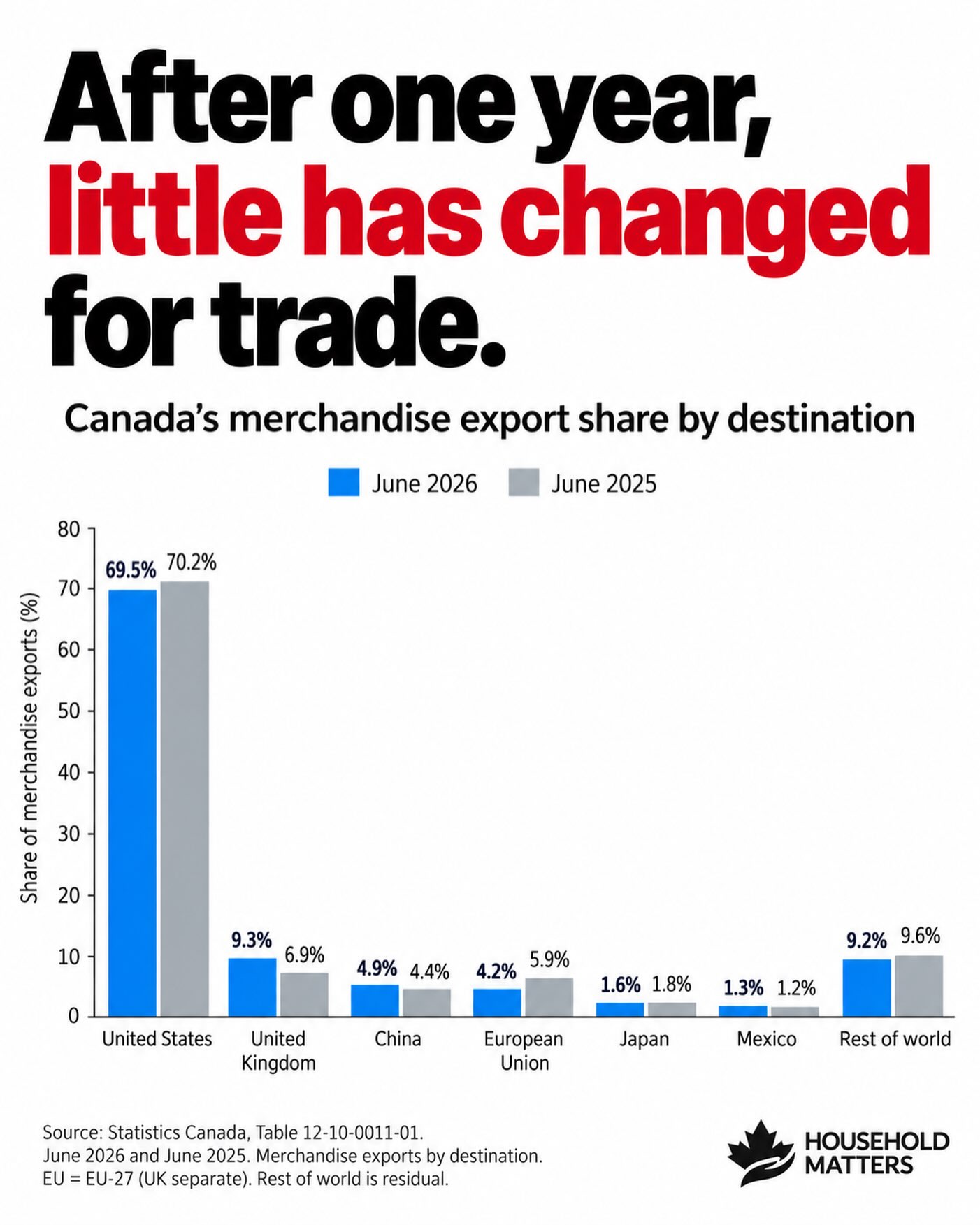
Canada’s merchandise export share to the United States remained remarkably steady between June 2026 and June 2025, hovering around 69.5% and 70.2%, respectively. Despite global shifts, Canada's trade patterns with major partners like the European Union, Japan, and Mexico showed minimal fluctuations, according to Statistics Canada.
The merchandise export map
Canada’s merchandise export share isn't just a number. It's an index of which countries receive Canadian products. From the Pacific to the Atlantic, a snapshot of Canada's export flow shows the United States as its top destination. In June of 2026, sixty-nine-and-a-half-percent of Canadian merchandise exports went to the United States. The United Kingdom, the European Union, Japan, Mexico, and China received smaller shares, while the rest of the world combined for roughly 12%. These percentages paint a picture of Canada’s most lucrative trade routes. At the time, nearly 93% of Canada's merchandise exports were locked down by a combination of the top seven destinations. Canada's trade patterns are distinct. Nearly 70% of Canada’s exports go to the United States, while China and Britain receive smaller but significant shares. The Household Matters graph tracks how Canadian exports flow to different countries — and it shows the stability of Canada’s trade routes with major partner economies. It presents a clearer picture of the continuity of Canadian exports, given only minor changes in the exports to the United Kingdom, for example, where Canada has seen a slight decline, and small increases in exports to Mexico and China.
The trade pattern in a changing world
In a world where confusion might have been expected — the COVID crisis and climate catastrophe — Canada was trading with 9 countries. This matters because it shows that Canada’s merchandise exports are robust, with little change, even in a world beset by chaos. Canadian merchandise export share, which is the share of merchandise exports directed to different countries, can give us insight into that country's economic relationships and trade policies. This means that, on the one hand, it's business as usual. But it also means that Canada has become less competitive in the global market. The lack of significant change in Canada's merchandise exports to other countries shows that they remain reliant on these countries for their economic stability. However, it also presents the opportunity for Canada to diversify its export market.
Settling on the sine waves
Canada’s trade partners have remained consistent, with the United States taking the lion’s share of imported Canadian goods. In June 2026, Canada exported 69.5% of its merchandise to the United States. This number was virtually unchanged compared to June 2025. Neither the economic uncertainty nor the energy crisis nor the pandemic affected Canada's trade routes — with the European Union and Japan's share of Canadian merchandise exports also remaining stable. A closer look at the chart shows minimal fluctuations in Canada's merchandise export shares over the discussed period. The bar graph in this chart shows Canadian merchandise export share by destination, including countries such as the United Kingdom, the European Union, Japan, Mexico, and China. There is one notable change: exports to the European Union and Japan show no change. Canada, Japan, Europe, and China are four countries that have a high relationship in merchandise export share, and these four countries have a high trade relationship. Canada’s trade partners have remained consistent, with the United States taking the lion’s share of imported Canadian goods. The United Kingdom, the European Union, Japan, Mexico, and China received smaller shares, while the rest of the world received about 15% of Canada’s merchandise exports. The lack of significant change in Canada's merchandise exports to other countries shows the resilience and solidity of Canada's trade relations with key partners.
The trade flow changes in Mexico
Canada exports 2.2% of its merchandise to Mexico, a number that has also remained relatively stable over the past year. While Mexico is not one of Canada’s top export destinations, it still receives some share of Canadian merchandise. Mexico’s share of Canadian merchandise exports has remained constant. In June 2026, it was 2.2%, against 2.1% in 2025. This means Canada is importing and exporting merchandise to Mexico at a steady rate. Canada and Mexico share a relationship unique to both countries. In Canada, Mexico is a key trading partner, but in Mexico, it is the United States that holds the top position. Canada exports to Mexico, particularly automobiles and auto parts, cars, and trucks. A significant part of its energy sector receives investment and expertise from Canada.
Factoring for the rest of the world
Nearly 15% of Canada’s merchandise exports go to the rest of the world. This is the country's share in the global economy, a number that has remained steady over the past year. The rest of the world represents a collection of countries that have yet to be included in the bar graph. While this group of countries is not Canada’s primary export destination, it is still an essential part of the country’s trade relations. Canada exports a significant amount of merchandise to the rest of the world, meaning that its trade is not concentrated in a few countries.
Taking a new view of trade with China
Canada exports 3.8% of its merchandise to China. This share has increased year over year — from 3.4% in June 2025 to 3.8% in June 2026. While China is a significant export destination, it has not surpassed Canada’s top trading partners. Canada’s trade relationship with China is complex. On the one hand, it is a massive market for Canadian merchandise. The country exports a significant amount of merchandise to China, making it an essential trading partner. On the other hand, its share of Canadian merchandise exports is relatively low. This is despite the country’s economic growth. However, Canada’s trade relationship with China is a key component of its international trade policy. What makes Canada’s merchandise export share to China particularly intriguing is the complexity of economic relations, and the two countries trading significantly, but not equally. This disparity is due to a variety of factors, including tariffs and trade agreements. Canada’s merchandise exports to China are relatively low, indicating that the country’s reliance on the US. When thinking about Canada’s merchandise export share, Canada ranks among the top countries in the world.
Questions readers ask
What does the term 'merchandise export share' mean in the context of Canada's trade data?
Merchandise export share refers to the percentage of a country's total merchandise exports that are sent to a specific destination. In Canada's case, this is the proportion of goods exported to countries like the United States, the European Union, and others. For example, in 2025, 70.2% of Canada’s merchandise exports went to the United States.
How has Canada's merchandise export share to the United States changed over time?
Canada’s merchandise export share to the United States has remained remarkably steady. In 2025, it was 70.2% and in 2026, it was 69.5%. This stability indicates a consistent trade relationship despite global events like the COVID crisis and economic uncertainty.
Which countries are Canada's other major trade partners besides the United States?
Canada’s other major trade partners include the European Union, Japan, Mexico, and China. These countries, along with the United Kingdom, make up a core group of seven major trade partners. Collectively, these seven countries accounted for nearly 93% of Canada's merchandise exports in 2026.
What does the stability in Canada’s trade patterns indicate about its economic relationships?
The stability in Canada’s trade patterns suggests that the country has robust economic relationships with its major trade partners. However, it also indicates a reliance on these partners for economic stability, which might limit Canada’s competitiveness in the global market. This stability could be an opportunity for diversification.
How have global events like the COVID crisis and climate catastrophe affected Canada's merchandise export share?
Global events such as the COVID crisis and climate catastrophe have had minimal impact on Canada's merchandise export share. The share of exports to major partners like the United States, the European Union, and Japan remained stable, indicating that Canada’s trade routes have been resilient to these disruptions.
What opportunities does the stability in Canada’s merchandise export share present for the country?
The stability in Canada’s merchandise export share presents an opportunity for the country to diversify its export market. By exploring new trade partners and reducing reliance on a few major countries, Canada could enhance its competitiveness and economic resilience.
Recent articles
Fresh deep dives from the latest Reels we unpacked.




Comments
Be the first to comment.