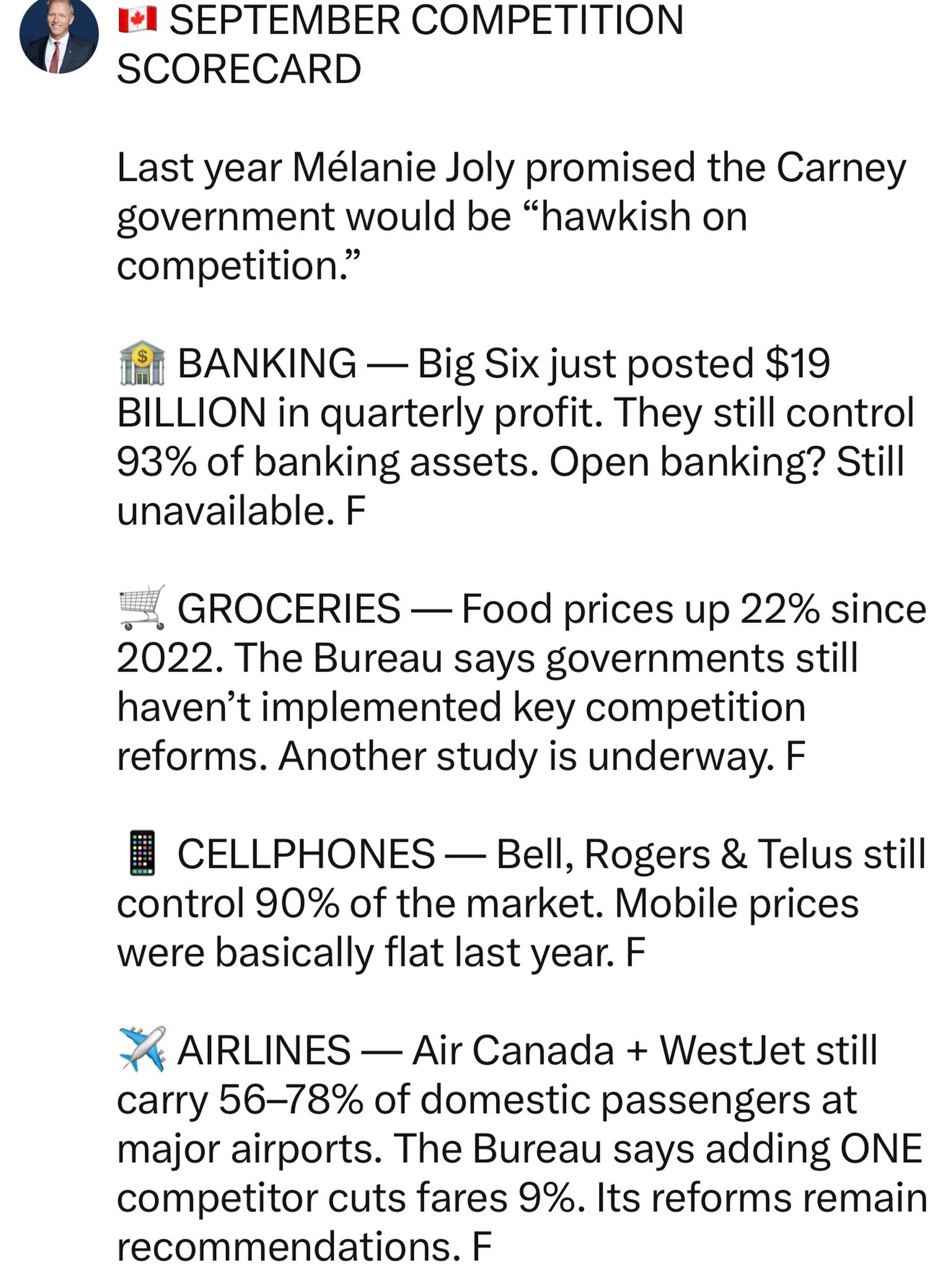
Canada's Competition Scorecard has arrived in September, tallying four sectors with an F rating. The scorecard shows some progress on government reforms, at least in terms of publishing new reports. Canada's September competition Scorecard in four sectors has given a unified F rating to the sectors, meaning that the competitiveness and market reforms in these sectors are below par. The sectors involved were the Big Six banks, groceries, cellphones and airlines, showcasing market dominance in each.
Canadian Economy's Competitiveness in Banking, Groceries, Cellphones, and Airlines
Competition Scorecard is an assessment of the competitiveness and reforms rate in particular sectors.. In Canada, a F rating was given to four core sectors: banking, groceries, cellphones, and airlines. These ratings are based on the dominance of a few major players in each sector and the lack of significant competition. The F rating means that the industries are in urgent need of reforms to boost competition. The Competition Bureau itself says that these particular sectors have a lack of competition, which turns into a higher price for consumers. It aims to bring more awareness to how much a lack of competition can affect the day-to-day lives of Canadians, proving that these sectors are in dire need of this type of reforms.
Competition's Missing Links in the Market
The Big Six banks — Royal Bank of Canada, TD Bank, Scotiabank, Bank of Montreal, Canadian Imperial Bank of Commerce, and National Bank of Canada — control 93% of the Canadian banking assets. This dominance limits competition and innovation. The Competition Bureau believes more competition could cut consumer financial expenses. The lack of progress on open banking reforms and recommendations on mobile prices suggest the usual slow pace of market reforms. The Competition Bureau also said that "majority of Canadians are paying more than they should be for telecom services, and that prices are mostly a result of the dominant market power of the Big Three telecommunications companies, Bell, Rogers, and Telus". Food prices have risen 22% since 2022, squeezing household budgets and highlighting the urgency of competition reforms in the grocery sector. As of September 2023, no key reforms have been implemented to solve these issues, and another study is underway. The Competition Scorecard criticizes the government for its lack of progress on grocery-related reforms.
The Grocery Shakeup
The Competition Bureau's investigation into the grocery sector revealed that food prices in Canada have surged 22% since 2022. This price increase has significantly impacted household budgets, making it more difficult for consumers to afford essential goods. The Bureau explains that “the grocery sector is highly concentrated, with a few large players dominating the market. This lack of competition allows these players to charge higher prices and reduce consumer choice.” The Bureau then notes that governments have still not implemented key competition reforms, despite ongoing studies.
Bell, Rogers, and Telus' Market Dominance
Bell, Rogers, and Telus control 90% of the cellphone market, resulting in consistent extortion of mobile consumers. Mobile prices have remained mostly unchanged, showing that despite the current market, Canadian consumers are still having to deal with expensive prices. “All the Three [Bell, Rogers, and Telus] have substantial market power, which they use to maintain high prices, limit consumer choice, and stifle innovation for Canadians," says the Competition Bureau. Mobile prices have stayed practically flat for a year, suggesting stagnation. This is due to the market being controlled by only a few large players. Despite another ongoing study, no significant reforms have been implemented.
The Dominion of Air Canada and West Jet
Air Canada and WestJet dominate 56-78% of flights at major Canadian airports. Adding even one competitor can reduce fares by 9%, although there have been no actual changes. The dominance of just a few airlines shows the need for increased regulation to increase competition, and ultimately increase flight prices. This reform will increase consumer choice, and give consumers the best bang for their buck. Air Canada and WestJet control 56–78% of domestic passengers at major airports, highlighting the lack of competition in the airline industry. The Competition Bureau reports, "Just by adding one more competitor, you could cut prices [for Canadians] by 9%". However, reforms related to airlines remain only recommendations.
Getting Competitive
The Competition Bureau mainly advocates for two reforms in Canada to increase competition in the market. First, the Competition Bureau encourages Canadians to demand more competition in the economy. Second, the Competition Bureau needs to put more pressure on the government to enforce these reforms. Ultimately, these four F ratings will only be changed if the government takes a hawkish approach, with policy decisions that drive more competition.
Taking a hawkish approach to competition reforms could be the key to mitigating market dominance and its negative effects, like higher prices. Make your voice heard. If the competition in the market does improve with both pressure and demands, Canadians will have a greater number of choices, ultimately resulting in better prices.
Questions readers ask
What exactly are the Big Six banks, and why are they a problem for competition in Canada?
The Big Six banks are Royal Bank of Canada, TD Bank, Scotiabank, Bank of Montreal, Canadian Imperial Bank of Commerce, and National Bank of Canada. They control 93% of the Canadian banking market, which means there's very little room for other banks to compete. This dominance can lead to higher prices and less innovation for consumers.
How do the Big Three telecommunications companies—Bell, Rogers, and Telus—affect competition in the cellphone market?
Bell, Rogers, and Telus control a whopping 90% of the cellphone market. This dominance restricts competition, which can result in higher prices for consumers. The Competition Bureau has noted that many Canadians are paying more than necessary for telecom services due to this market power.
What does it mean when a sector gets an F rating in the Competition Scorecard?
An F rating on the Competition Scorecard means that the sector is performing poorly in terms of competitiveness and market reforms. It indicates that a few major players dominate the market, leading to higher prices and less choice for consumers. The sectors that received an F rating include banking, groceries, cellphones, and airlines.
What specific reforms are needed to improve competition in the grocery sector?
The Competition Bureau has pointed out that the grocery sector needs key reforms to address the high concentration of a few large players. These reforms could help lower food prices, which have surged 22% since 2022, and increase consumer choice. The Bureau has criticized the government for not implementing these reforms despite ongoing studies.
How does the Competition Bureau's investigation into the grocery sector affect consumers?
The investigation revealed that the grocery sector's high concentration leads to higher prices and reduced choice for consumers. This means that households are feeling the squeeze, especially with food prices rising 22% since 2022. The Bureau's findings highlight the need for reforms to make groceries more affordable and accessible.
Why hasn't there been more progress on open banking reforms in Canada?
The slow pace of market reforms, including open banking, has been a concern. The Competition Bureau believes that more competition in banking could reduce consumer financial expenses, but progress on these reforms has been lackluster. This has contributed to the F rating in the banking sector.
Recent articles
Fresh deep dives from the latest Reels we unpacked.




Comments
Be the first to comment.