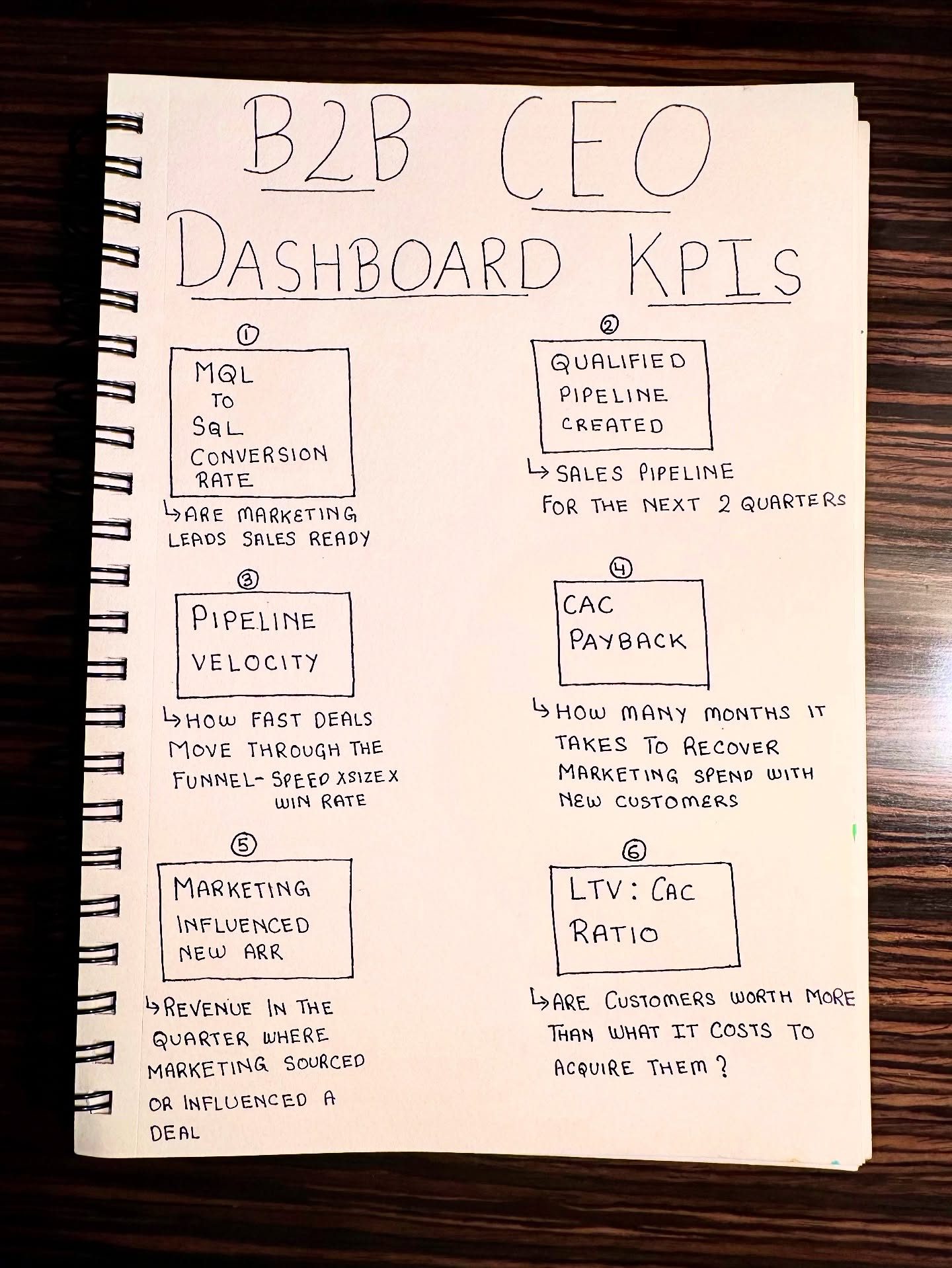
Tracking Key Metrics: Essential B2B Dashboard KPIs for CEOs
For a B2B CEO, a clean and effective dashboard is crucial for making informed decisions. The key to a successful dashboard lies in tracking the right metrics, often referred to as Key Performance Indicators (KPIs). These metrics are not about vanity; they give a clear picture of whether a company’s marketing efforts are translating into actual business results.
Why This Matters
In the world of B2B, decisions need to be data-driven. This means focusing on metrics that reveal the effectiveness of marketing and sales strategies. KPIs help CEOs identify areas of growth, opportunities for improvement, and potential pitfalls. By honing in on the right metrics, B2B CEOs can ensure they are making progress toward their business goals and that their marketing spend is yielding the desired results.
Main Discussion
MQLs and Sales Pipeline Creation
Marketing Qualified Leads (MQLs) are crucial for any B2B business. An MQL is a prospect that has shown some level of interest in a company’s products or services. These leads are qualified by the marketing team and passed on to the sales team, who then work to convert them into paying customers.
The pipeline created from these MQLs is the backbone of a B2B sales strategy. It represents the sales funnel, from the initial lead to the final deal closure. By tracking the number of MQLs and the sales pipeline created, CEOs can understand the effectiveness of their lead generation efforts and how well their sales team is converting these leads into sales.
Conversion Rates
Conversion rates tell the tale of how well a business is transforming leads into customers. This metric doesn't just apply to leads; it also applies to other stages in the sales process, such as moving a prospect from one stage of the pipeline to the next.
Conversion rates are essential for understanding the efficiency of the sales process. High conversion rates mean that a business is successfully moving prospects through the sales funnel, which leads to more closed deals and higher revenue. Keeping an eye on conversion rates helps identify any bottlenecks or inefficiencies in the sales process.
Pipeline Velocity
Pipeline velocity is a measure of how quickly deals move through the sales pipeline. This metric is critical for understanding the speed at which a business can generate revenue. A high velocity means that deals are moving swiftly through the pipeline, leading to faster sales closures.
Pipeline velocity can be influenced by a variety of factors, such as the quality of leads, the effectiveness of the sales team, and the efficiency of the sales process. By tracking this metric, CEOs can identify areas where they can improve the speed at which deals are closed, leading to faster revenue generation.
Win Rate
Win rate is the percentage of deals that are won out of the total number of deals in the pipeline. This metric is crucial for understanding the overall effectiveness of a business's sales strategy. A high win rate indicates that the sales team is effective at closing deals, while a low win rate may suggest that there are issues with the sales process.
Monitoring the win rate allows CEOs to assess the performance of their sales team and identify any areas where improvement is needed. This could involve providing additional training, adjusting the sales strategy, or enhancing the quality of leads.
Customer Acquisition Cost (CAC)
Customer Acquisition Cost (CAC) is the amount of money a business spends to acquire a new customer. This metric is essential for understanding the cost of acquiring new business and the return on investment (ROI) of marketing efforts. A low CAC means that a business is spending less to acquire each new customer, while a high CAC may indicate that a business is overspending on marketing.
By tracking the CAC, CEOs can assess the efficiency of their marketing and sales efforts and make data-driven decisions to optimize their spending. This metric is particularly important for ensuring that the marketing budget is being used effectively to drive new business.
Lifetime Value to CAC Ratio (LTV:CAC)
The Lifetime Value to CAC ratio (LTV:CAC) is a crucial metric for understanding the long-term value of a customer relative to the cost of acquiring them. This ratio helps CEOs determine whether the customers they are acquiring are worth more than the cost of acquiring them.
A high LTV:CAC ratio indicates that a business is acquiring customers who bring in more revenue over their lifetime than the cost of acquiring them. This is a strong indicator of long-term profitability. On the other hand, a low LTV:CAC ratio may suggest that a business is spending too much to acquire customers or that the customers they are acquiring are not generating enough revenue.
Practical Tips
Here are some practical tips for effectively tracking and utilizing these KPIs in a B2B dashboard:
-
Set Clear Goals: Establish clear, measurable goals for each metric. This will help in tracking progress and identifying areas for improvement.
-
Use Real-Time Data: Ensure that the data used for tracking KPIs is up-to-date and accurate. Real-time data allows for timely decision-making and adjustments.
-
Integrate Multiple Data Sources: Combining data from various sources, such as marketing, sales, and customer service, can provide a comprehensive view of the business.
-
Regularly Review Metrics: Regularly reviewing these KPIs ensures that the business is on the right track. This can help in identifying trends, patterns, and potential issues early on.
-
Communicate with Your Team: Share the KPIs and their significance with the entire team. This ensures that everyone is aligned with the business goals and understands the importance of these metrics.
-
Focus on Quality Over Quantity: While the number of MQLs and the size of the sales pipeline are important, the quality of these leads and the efficiency of the pipeline are equally crucial. Focus on generating high-quality leads and optimizing the sales process.
Important Takeaways
Tracking the right KPIs is essential for a B2B CEO to make informed decisions and drive business growth. By focusing on metrics such as MQLs, conversion rates, pipeline velocity, win rate, CAC, and LTV:CAC, CEOs can gain a clear understanding of their business performance and identify areas for improvement.
Conclusion
Keeping a clean and effective dashboard with the right KPIs is vital for any B2B CEO. These metrics provide a clear picture of business performance and help in making data-driven decisions. By focusing on these key metrics, CEOs can ensure that their marketing and sales efforts are driving real business results and that their decisions are sharp and effective.
Questions readers ask
What are Marketing Qualified Leads (MQLs) and why should I track them?
Marketing Qualified Leads (MQLs) are prospects that have shown significant interest in your products, making them more likely to become customers. Tracking MQLs helps CEOs understand the effectiveness of their marketing efforts and forecast potential revenue. By monitoring MQLs, CEOs can allocate resources more efficiently and focus on strategies that generate high-quality leads.
How can pipeline velocity help in making informed business decisions?
Pipeline velocity measures how quickly deals move through the sales pipeline, from initial contact to closure. By tracking this metric, CEOs can identify bottlenecks in the sales process, optimize their sales funnel, and make data-driven decisions to accelerate deal closure. This helps in predicting revenue more accurately and ensuring the sales team is performing efficiently.
What is the significance of the Customer Acquisition Cost (CAC) to B2B CEOs?
Customer Acquisition Cost (CAC) is the total cost of sales and marketing efforts divided by the number of new customers acquired. Monitoring CAC helps CEOs understand the efficiency of their marketing and sales initiatives, and make informed decisions about resource allocation. A high CAC relative to the customer's lifetime value (LTV) can indicate a need to optimize customer acquisition strategies and reduce costs.
Why should B2B CEOs focus on the sales to marketing ratio?
The sales to marketing ratio compares the cost of sales activities to the cost of marketing activities. This metric helps CEOs determine the balance between their sales and marketing spending. If the ratio is skewed too heavily in one direction, it can indicate inefficiencies in either department, prompting CEOs to take corrective actions.
What is the importance of tracking B2B conversion rates?
B2B conversion rates measure the percentage of leads that turn into paying customers. Tracking this metric allows CEOs to assess the effectiveness of the sales process and identify areas where improvements can be made, whether it’s in lead nurturing, sales techniques, or closing strategies. Higher conversion rates generally indicate that marketing and sales teams are well-aligned and effective.
Recent articles
Fresh deep dives from the latest Reels we unpacked.




Comments
Be the first to comment.