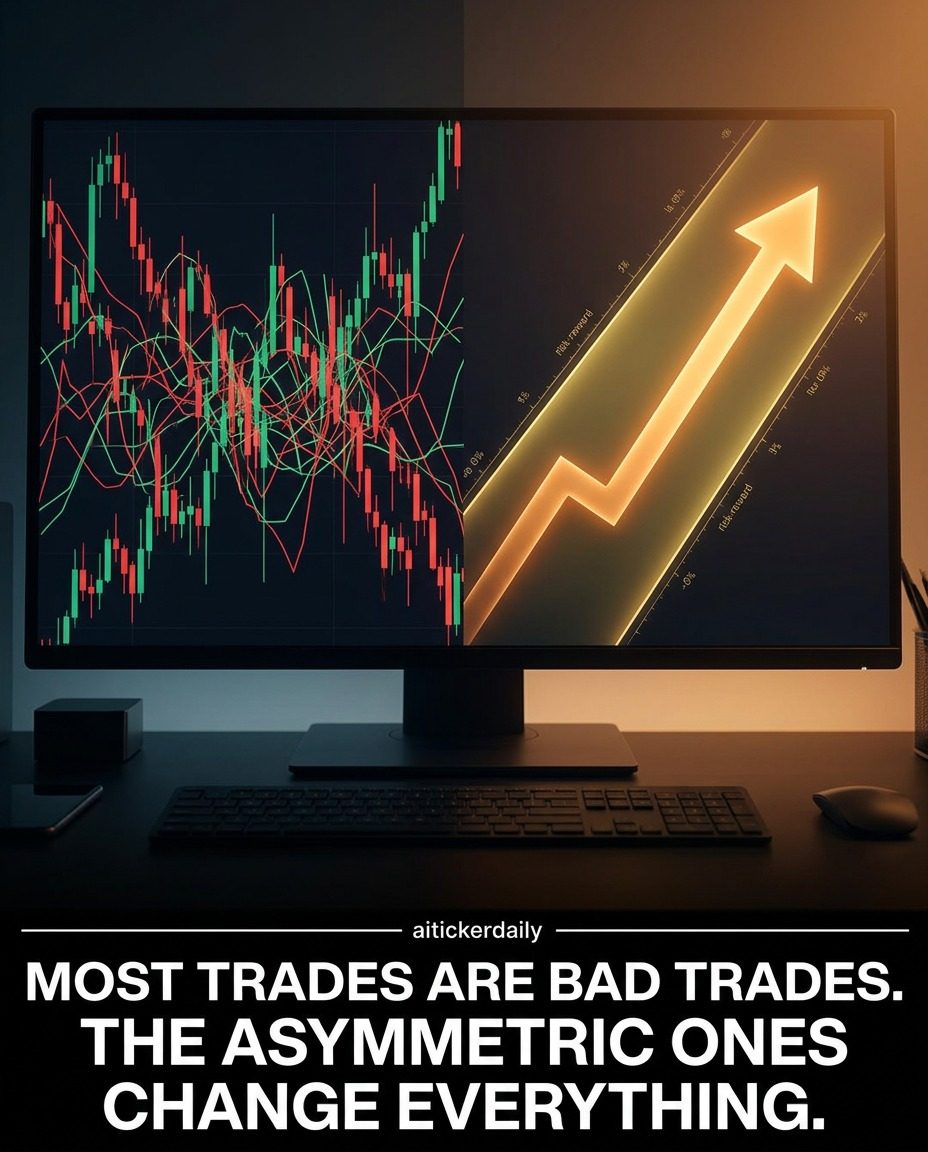
Asymmetric Trading: The Key to Changing the Financial Game
Most trades in financial markets are bad trades. That’s a bold statement, but it underscores a critical point: not all trading opportunities are created equal. The key to successful trading often lies in identifying and acting on asymmetric trades—the ones that can change everything. This approach is about finding skewed reward distributions, sizing them correctly, and executing trades without emotion. In addition, asymmetrically traded stocks often present a unique opportunity in the financial market. Let's dive into the world of asymmetric trading, exploring why it matters, how to identify edges, and the role of volatility in this high-stakes game.
Why Asymmetric Trading Matters
Asymmetric trading is about finding opportunities where the potential reward significantly outweighs the risk. This concept is crucial because it shifts the balance of power away from market makers, who traditionally profit from the spread between buy and sell prices. By focusing on asymmetric opportunities, traders can tilt the playing field in their favor.
The Symmetry Trap
Many traders fall into what is known as the "symmetry trap." This trap occurs when traders assume that market movements are symmetric—that is, that gains and losses are evenly distributed. This assumption can lead to suboptimal trades, where the risk-reward ratio is not in the trader's favor. Breaking out of the symmetry trap involves recognizing that markets are not always balanced and that significant opportunities often lie in asymmetric trades.
Identifying Edges in Financial Markets
To succeed in asymmetric trading, traders must identify edges—the opportunities where the reward potential is skewed in their favor. These edges often exist in illiquid markets, such as micro-caps, where large funds may not participate due to liquidity constraints. Several factors contribute to the creation of these edges:
Information Lag
Information lag occurs when there is a delay in the market's reaction to new information. This delay creates opportunities for traders who can act quickly on new data. For example, if a company releases positive earnings news, but the stock price has not yet reacted, a trader can capitalize on this information lag by buying the stock before the market catches up.
Behavioral Overreaction
Behavioral biases can lead to mispricings in the market. For instance, traders may overreact to negative news, causing a stock to drop more than its fundamentals justify. Conversely, they may underreact to positive news, leading to undervalued stocks. Recognizing and acting on these behavioral biases can provide asymmetric trading opportunities.
Volatility Clustering
Volatility clustering is a phenomenon where periods of high volatility are followed by more high volatility, and periods of low volatility are followed by more low volatility. Understanding and leveraging volatility clustering can help traders identify periods of high opportunity and adjust their strategies accordingly. For example, during high volatility periods, traders may look for opportunities in options markets, where the potential for large price movements can create asymmetric trades.
Volatility as an Input
Volatility is not merely a measure of risk; it is also an input that can be used to identify trading opportunities. Understanding the role of volatility in trading is crucial for success in asymmetric trading.
Regime Awareness
Regime awareness involves recognizing different market regimes—periods of stability, volatility, and trend— and adjusting trading strategies accordingly. During periods of high volatility, traders may focus on short-term opportunities, while during periods of stability, they may look for long-term trends.
Using Realized Volatility
Realized volatility is the actual volatility experienced by a market or asset over a specific period. By tracking realized volatility, traders can identify periods of high and low volatility and adjust their strategies accordingly. For example, during periods of high realized volatility, traders may increase their position size to take advantage of larger price movements.
Forecasting Volatility
Forecasting volatility involves predicting future volatility levels based on historical data and market conditions. While forecasting volatility can be challenging, it is an essential skill for asymmetric traders. By accurately forecasting volatility, traders can identify periods of high opportunity and adjust their strategies to capitalize on these periods.
Practical Tips for Asymmetric Trading
Identifying and acting on asymmetric trading opportunities requires a combination of skill, discipline, and the right tools. Here are some practical tips to help you succeed in asymmetric trading:
Focus on Position Sizing
Position sizing is the process of determining the size of a trade based on the potential risk and reward. By sizing your positions correctly, you can maximize your returns while minimizing your risk. To do this, consider the following factors:
- Risk Tolerance: Determine your risk tolerance and adjust your position size accordingly. If you are risk-averse, you may want to take smaller positions to minimize potential losses.
- Potential Reward: Evaluate the potential reward of a trade and size your position to maximize returns. If a trade has a high potential reward, you may want to take a larger position to capitalize on the opportunity.
- Market Conditions: Consider market conditions when sizing your positions. During periods of high volatility, you may want to take smaller positions to minimize risk.
Execute Without Emotion
Emotional decision-making can be the downfall of even the most experienced traders. To execute trades without emotion, follow these guidelines:
- Set Clear Entry and Exit Points: Before entering a trade, set clear entry and exit points based on your analysis. This can help you avoid emotional decision-making and stick to your trading plan.
- Use Stop-Loss Orders: Stop-loss orders can help you limit your losses and protect your capital. By setting a stop-loss order, you can automatically exit a trade if it moves against you, helping you avoid emotional decision-making.
- Take Breaks: Trading can be emotionally taxing, and taking regular breaks can help you maintain a clear mind and avoid emotional decision-making.
Stay Informed
Staying informed about market developments and trends is crucial for identifying asymmetric trading opportunities. To stay informed, consider the following sources of information:
- News and Media: Follow financial news and media outlets to stay up-to-date on market developments and trends. This can help you identify potential trading opportunities and adjust your strategies accordingly.
- Social Media: Social media platforms, such as Twitter and LinkedIn, can provide valuable insights into market sentiment and trends. By following industry experts and influencers, you can gain valuable insights into potential trading opportunities.
Important Takeaways
Asymmetric trading offers a unique opportunity to tilt the playing field in your favor by focusing on trades where the potential reward significantly outweighs the risk. To succeed in asymmetric trading, it is essential to:
- Break out of the symmetry trap by recognizing that market movements are not always balanced and that significant opportunities often lie in asymmetric trades.
- Identify edges in the market by looking for opportunities in illiquid markets, information lag, behavioral biases, and volatility clustering.
- Understand the role of volatility in trading and use it as an input to identify trading opportunities. This includes regime awareness, using realized volatility, and forecasting volatility.
- Focus on position sizing to maximize returns while minimizing risk.
- Execute trades without emotion by setting clear entry and exit points, using stop-loss orders, and taking regular breaks.
- Stay informed about market developments and trends by following financial news, media, and social media platforms.
Conclusion
Asymmetric trading is a powerful strategy that can help traders tilt the playing field in their favor. By focusing on trades where the potential reward significantly outweighs the risk, traders can identify and capitalize on unique opportunities in the market.
In this dynamic and high-stakes game of asymmetric trading, the edge comes from finding skewed reward distributions, sizing them correctly, and executing trades without emotion. The key to unlocking this edge is to break out of the symmetry trap, identify edges in the market, and understand the role of volatility in trading. By following the practical tips and takeaways outlined in this article, you can position yourself for success in asymmetric trading and change the financial game.
Questions readers ask
What exactly is asymmetric trading and how does it differ from traditional symmetric trading?
Asymmetric trading involves seeking out trades where the potential profit is significantly higher than the risk. It differs from symmetric trading, where the potential gain and loss are roughly equal. By focusing on asymmetric opportunities, traders can tilt the odds in their favor, aiming for high reward trades with low risk.
How can I identify market imbalances to exploit with an asymmetric trading strategy?
Identifying market imbalances involves looking for situations where the market sentiment or price action is skewed. This can include stocks with unusually high short interest, low trading volume, or significant volatility. Analyzing these factors can help uncover opportunities where the market is out of balance, providing a chance for asymmetric trades.
What role does volatility play in an asymmetric trading strategy?
Volatility is a crucial factor in asymmetric trading. High volatility can create large price swings, presenting opportunities for high reward trades. However, it also increases risk. Successful asymmetric traders use specific strategies, like options trading or breakout strategies, to navigate volatility and capitalize on these market movements while managing risk effectively.
How can I manage risk while engaging in asymmetric trading, especially in imbalanced markets?
Risk management is paramount in asymmetric trading. This involves setting a strict stop-loss, managing position sizes, and avoiding emotional decision-making. By focusing on trades with a significantly higher potential reward than risk, traders can afford to take fewer, high-quality trades, which helps in maintaining a favorable risk-to-reward ratio.
What are some common pitfalls to avoid when implementing an asymmetric trading strategy?
One common pitfall is the emotional stress of investing a large portion of your capital into a single trade. To mitigate this risk, it's crucial to maintain a disciplined approach, avoid overtrading, and diversify your portfolio. Additionally, traders should constantly refine their strategies based on market conditions and avoid becoming overly reliant on any single strategy.
How can I determine the correct position size for my asymmetric trades?
Position sizing in asymmetric trading should be based on the risk associated with each trade. A common approach is to risk a small, fixed percentage of your total capital (e.g., 1-2%) on each trade. This ensures that even if a trade doesn't go as planned, your overall portfolio remains resilient, allowing you to continue pursuing high-reward opportunities.
Can asymmetric trading be applied to different types of financial instruments, or is it limited to certain markets?
Asymmetric trading can be applied to a wide range of financial instruments, including stocks, options, forex, and commodities. The key is to identify market imbalances and asymmetric opportunities within each market. For example, in the options market, traders might look for low-volatility options that have the potential for a high return if volatility spikes.
Recent articles
Fresh deep dives from the latest Reels we unpacked.




Comments
Be the first to comment.