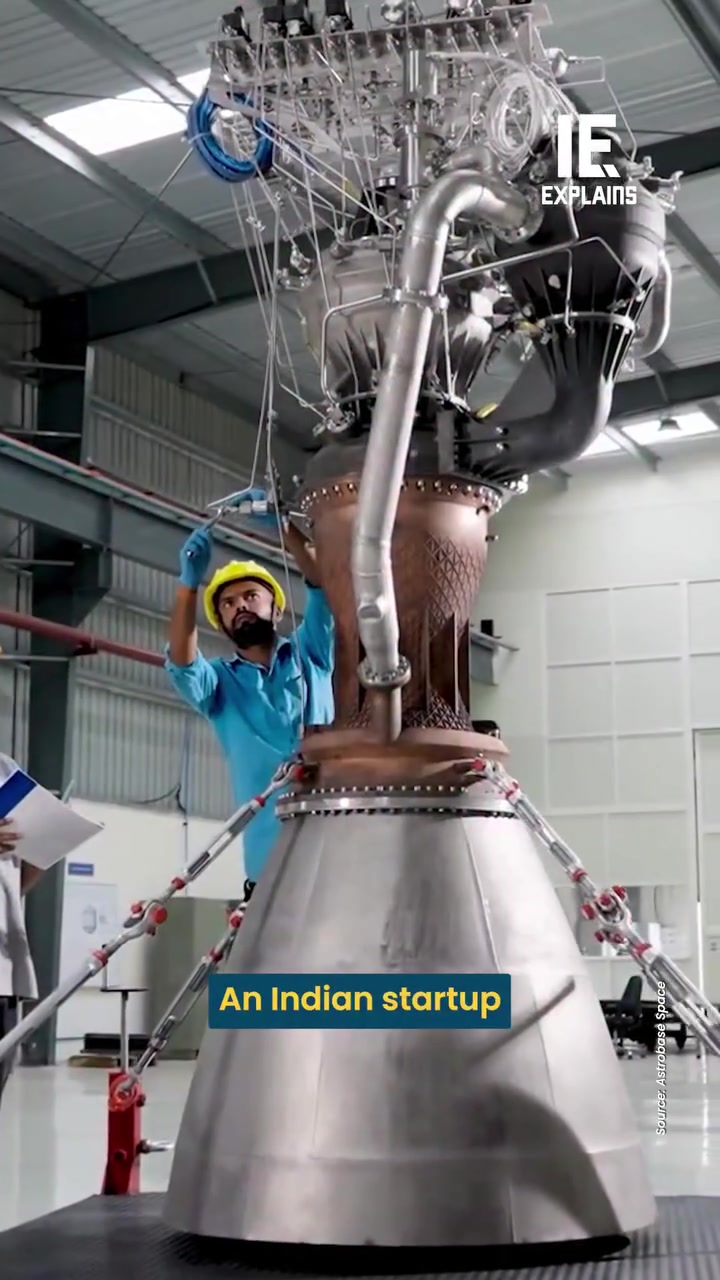
Everest, a new rocket engine from Astrobase Space, India's first full-flow staged combustion engine. This category of engines is notoriously challenging to build and operate, but Astrobase's pioneering effort positions India at the forefront of advanced rocket technology.
The Making of the Everest
Full-flow staged combustion engines represent a leap forward in rocket engine technology. Unlike conventional engines, which waste some propellant to power their pumps, full-flow engines utilize all the fuel and oxidizer efficiently by pushing them through pre-burners first. This design allows the engines to run cooler and more efficiently, but it significantly complicates the engineering and manufacturing process. Astrobase developed the Everest engine, capable of producing 800 kilonewtons of thrust, setting it apart from other Indian space engines. This engine is part of Astrobase's broader goal to achieve a fully reusable rocket system. Most standard rocket engines require new parts after each launch, but Astrobase claims the Everest engine can fly over a hundred times.
The Challenge of Building Advanced Engines
Astrobase is not the only player in the full-flow engine development. This technology has been tested only by the Soviet Union, the United States, and China. SpaceX's Raptor engine is the only full-flow engine to have successfully flown, making the Everest a significant technological milestone. It’s partially run by components from India's space program. But, what’s truly remarkable is that India is making advancements where only a few superpowers have tread this path before.
The Road to Launch
Timeline and Milestones
Astrobase's journey toward a successful launch includes crucial milestones:
- Hotfire Testing: A successful sub-scale hotfire test was conducted in September 2025, followed by turbo pump trials in January 2024. The engine is slated for a full-scale hotfire test later in 2024.
- Reusable Rocket Development: After the hotfire tests, the next step is developing a partly reusable rocket capable of flying seven Everest engines.
Engineering and Design
Everest harnesses liquid oxygen and methane as propellants, a combination increasingly preferred for its efficiency and reduced environmental impact. This choice underscores Astrobase’s commitment to cutting-edge technology and sustainability. The engine is designed to fly over a hundred times, an ambitious goal in the field of space exploration.
Big Plans for Small Steps
Collaboration and Innovation
An Indian startup, once a newcomer, has embarked on creating a more efficient, sustainable rocket engine. By leveraging components from existing space programs and pushing the boundaries of fuel efficiency, Astrobase is redefining what is possible in the aerospace industry. It's not just innovation for innovation's sake; it's a strategic move to make space travel more accessible and efficient.
The Bengaluru Blueprint
Astrobase's factory in Bengaluru is the backdrop for this ambitious project. While the vision is global, the execution is deeply local, highlighting how regional excellence can drive global innovation. The factory's role in this endeavor underscores the importance of localized supply chains and specialized expertise in pushing technological boundaries.
In the Wings
The rocket engine creation hub Astrobase is building in Bengaluru is launching a database of reusable engines for space exploration. This is a clear cut landmark in time, declaring that India as a nation is committed to the future of humanity in outer space. Astrobase Space has made a name for itself by pioneering India's first full-flow staged combustion engine. Their Everest engine is poised to rewrite the rules of rocket technology, setting a new standard for efficiency and sustainability. With ambitious milestones and a commitment to innovation, Astrobase is ready to take the world of aerospace by storm.
Questions readers ask
What makes the Everest engine a full-flow staged combustion engine, and how does it differ from conventional engines?
The Everest engine is designed as a full-flow staged combustion engine, which means it uses all the propellant efficiently by routing fuel and oxidizer through pre-burners before combustion. This is different from conventional engines, which often waste some propellant to power their pumps, making the Everest engine more efficient and cooler running, though more complex to build.
How does the Everest engine's thrust compare to other Indian rocket engines?
The Everest engine is capable of producing 800 kilonewtons of thrust, which is a significant amount compared to other Indian rocket engines. This high thrust capability is part of what makes the Everest engine a standout in India's space exploration efforts.
What are the key milestones Astrobase has achieved so far in developing the Everest engine?
Astrobase has conducted a successful sub-scale hotfire test in September 2025 and turbo pump trials in January 2024. They are planning a full-scale hotfire test later in 2024, which is a crucial step toward the engine's operational readiness.
Why is the choice of liquid oxygen and methane as propellants significant for the Everest engine?
Liquid oxygen and methane are chosen for their efficiency and reduced environmental impact. This choice aligns with Astrobase's commitment to advancing sustainable technology in the aerospace industry, making the Everest engine not only powerful but also eco-friendly.
What role does Astrobase's factory in Bengaluru play in the development of the Everest engine?
Astrobase's factory in Bengaluru is the hub for the Everest engine's development, showcasing how regional expertise can drive global innovation. The factory is where the engine's design and manufacturing processes are executed, highlighting the importance of local engineering excellence in this ambitious project.
Related deep dives
Similar reads based on topic and creator.



Recent articles
Fresh deep dives from the latest Reels we unpacked.



Comments
Be the first to comment.