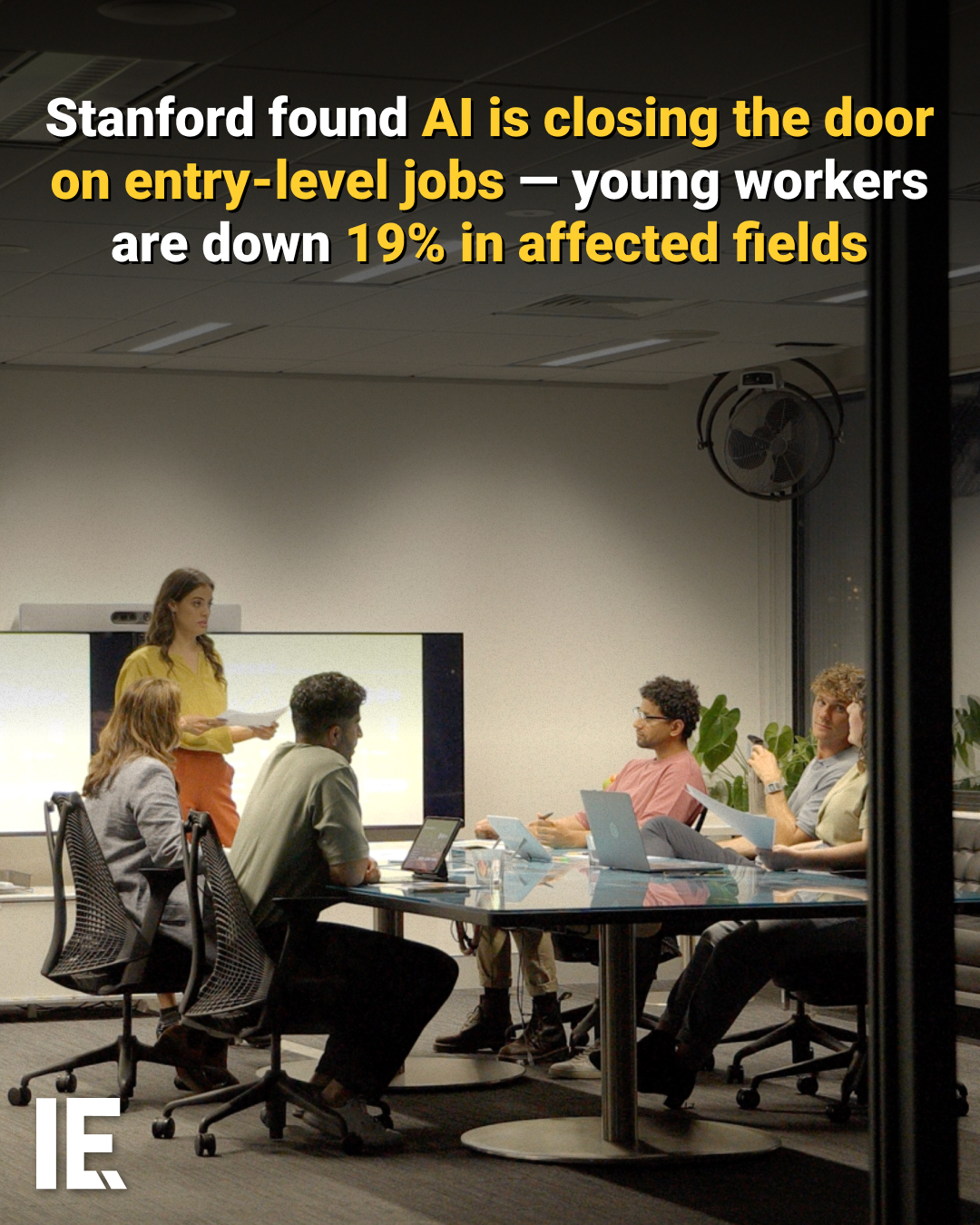
The Stanford study found that artificial Intelligence is closing the door on entry-level jobs — young workers are down 19% in affected fields. The trend that AI impacts entry-level job opportunities has left young workers in fields like customer service, data entry and content creation feeling the pinch.
The Tenuous Link Between Entry-Level Jobs and AI
Young workers are now navigating a complex landscape where automation and AI are reshaping the job market. AI's ability to perform repetitive tasks with high accuracy and efficiency has made it an attractive tool for businesses looking to cut costs and increase productivity. Entry-level jobs, often characterized by routine tasks, are particularly vulnerable to this shift. Stanford found that AI is closing the door on entry-level jobs. The institute's research indicates that young workers, in particular, are being hit hard, with a 19% decrease in affected fields. This decline is not uniform across all sectors, but it is significant enough to raise alarms. The study highlights that young workers are bearing the brunt of this dislocation. Automation is taking over tasks that were once the domain of entry-level employees. More importantly, young workers are not only losing jobs; they are also losing opportunities to gain experience and develop skills. Entry-level positions often serve as stepping stones to more advanced roles within an organization. When these opportunities shrink, so does the pipeline for future growth. Young professionals are now grappling with a situation where the traditional pathways to career advancement are becoming increasingly elusive.
The Automation Advance and the Human Factor
The trend of AI impacting entry-level job opportunities, is part of a larger technological trend reshaping the workforce. AI and automation are not new concepts, but their integration into the job market has accelerated rapidly in recent years. As machines become more capable, the demand for human labor in certain sectors is decreasing. Young workers, who typically fill entry-level roles, are finding themselves in a precarious position. This shift is not just about job displacement; it's also about the changing nature of work itself. Tasks that were once considered routine are now being automated, leaving workers to focus on more complex and creative tasks. This shift requires a different skill set, one that emphasizes problem-solving, critical thinking, and adaptability. However, these are skills that are not always taught. The rise of automation means that young workers will need to adapt quickly to changing job requirements. Entry-level positions are becoming less about performing mundane tasks and more about using technology to innovate and solve problems. This raises questions about how job training will evolve.
Assessing AI’s Impact Across Industries
AI In Customer Service
Customer service is one of the industries hit hardest by this trend. Automated chatbots and virtual assistants are replacing human agents in many roles, handling inquiries and providing support. While this increases efficiency, it also means fewer jobs for young workers. Moreover, the skills required for these roles have shifted from basic communication to more technical competencies, such as programming and data analysis. The impact is rather large on jobs that involve a lot of handling routine emails, customer queries.
AI's Role in Data Entry
Data entry is another field where AI is making significant inroads. Automated data entry systems can process large volumes of information with high speed and accuracy, reducing the need for human data entry clerks. As a result, young workers who previously relied on these jobs for their first employment experience are now struggling to find opportunities. Several credit-union and banks are utilizing the latest technologies to streamline employee onboarding. Onboarding is a process that requires various tasks that need to be completed before a new employee starts working. These tasks can include setting up emails, creating user accounts, and providing necessary equipment and software. This can involve a lot of paperwork and administrative tasks, which can be time-consuming and prone to errors. AI can automate these tasks, reducing the need for human data entry.
Workforce Impact on Content Creation
Content creation is also being transformed by AI, with algorithms now capable of generating articles, social media posts, and even marketing copy. While this technological advancement offers creative possibilities, it also poses challenges for young content creators. Affecting more fields than just journalistic content and mass communication. A Web developer or designer that uses creative tools to automate some tasks to produce content quickly is a new requirement in the market. The AI tools aren’t just used for journalistic content but are also being used in the development of logos, product design, and even video editing.
Young Workers at a Crossroads
Adaptability and Upskilling for Jobs
As AI continues to reshape the job market, young workers are being forced to adapt and upskill. The traditional educational pathways may no longer be sufficient for securing jobs. Entry-level jobs are becoming more specialized, and the competition for these roles is tough. However, there's also an opportunity for young workers to take on new challenges and develop skills that will be in demand in the future. Technical skills, such as programming, data analysis, and digital marketing, are becoming increasingly important. These skills are not just valuable in the tech sector but are also in demand across various industries.
The Changing Role of Education
The changing job market is also forcing educational institutions to rethink their curricula. There is an urgent need to integrate more technical and digital skills into the educational system. Young workers need to be prepared for a job market that is increasingly driven by technology. This doesn't mean that traditional skills are no longer valuable; rather, it means that the job market is evolving, and so must the way we prepare young workers for it. The shift towards technology-driven jobs highlights the need for a more holistic approach to education. Young workers need to be equipped with both technical and soft skills. While technical skills are essential for performing specific tasks, soft skills such as communication, teamwork, and adaptability are equally important. These skills are what make humans indispensable in the age of AI.
Strategies for Young Workers Navigating AI
The transition to a more technology-driven job market is daunting, but young workers can take several steps to navigate this shift.
- Embrace Continuous Learning: Young workers should adopt a mindset of continuous learning. New technologies and job roles are emerging rapidly, and staying updated is crucial. Online courses, workshops, and certifications can be valuable in acquiring new skills.
- Develop a Diverse Skill Set: The job market is becoming more specialized, but it is also becoming more interdisciplinary. Young workers should aim to develop a diverse skill set that combines technical expertise with soft skills.
- Network and Build Connections: Networking is an essential part of finding job opportunities. Connecting with industry professionals, attending industry events, and joining professional groups can open doors to new opportunities. A combination of offline and online networking is key to building a meaningful professional network.
Paving the Future
It's clear that AI is having a tangible impact on young workers, particularly in entry-level positions. While the trend is alarming, it also presents an opportunity for young workers to adapt. The key is to recognize the shift and take proactive steps to develop the skills that will be in demand in the future.
Questions readers ask
What specific entry-level jobs are most affected by AI according to the Stanford study?
The Stanford study highlights that fields like customer service, data entry, and content creation are among the most affected by AI. These roles often involve repetitive tasks that AI can perform more efficiently, leading to a 19% decline in entry-level positions for young workers in these areas.
How does AI's impact on entry-level jobs differ across various industries?
AI's impact varies by industry. For instance, customer service is significantly affected by automated chatbots and virtual assistants, reducing the need for human agents. Other industries, like data entry and content creation, are also feeling the pinch as AI takes over routine tasks, though the extent of the impact can differ based on the specific nature of the work and the industry's adoption of AI technologies.
Why are young workers particularly vulnerable to job displacement due to AI?
Young workers are particularly vulnerable because they often fill entry-level roles that involve repetitive tasks. These tasks are easily automated, leading to a 19% decrease in job opportunities for young workers in affected fields. Additionally, the loss of these entry-level positions means fewer opportunities for young workers to gain experience and advance in their careers.
What skills will be more important as AI continues to automate routine tasks?
As AI takes over routine tasks, skills like problem-solving, critical thinking, and adaptability will become more important. These skills are essential for navigating a job market where technology is constantly evolving and tasks are becoming more complex. However, these skills are not always taught, posing a challenge for young workers who need to quickly adapt to changing job requirements.
How can young workers prepare for a job market increasingly shaped by AI?
Young workers can prepare by focusing on developing skills that are less likely to be automated, such as problem-solving, critical thinking, and adaptability. Additionally, staying informed about technological advancements and being open to learning new skills can help young workers stay competitive in a changing job market. It's also important to consider industries and roles that are less susceptible to automation.
What are the implications of AI's impact on entry-level jobs for the future workforce?
The implications are significant. The decline in entry-level jobs means fewer opportunities for young workers to gain experience and advance in their careers. This could lead to a smaller pipeline of skilled workers in the future. Additionally, the changing nature of work requires a different skill set, which means education and training programs will need to evolve to prepare workers for the jobs of the future.
Related deep dives
Similar reads based on topic and creator.


Recent articles
Fresh deep dives from the latest Reels we unpacked.



Comments
Be the first to comment.